
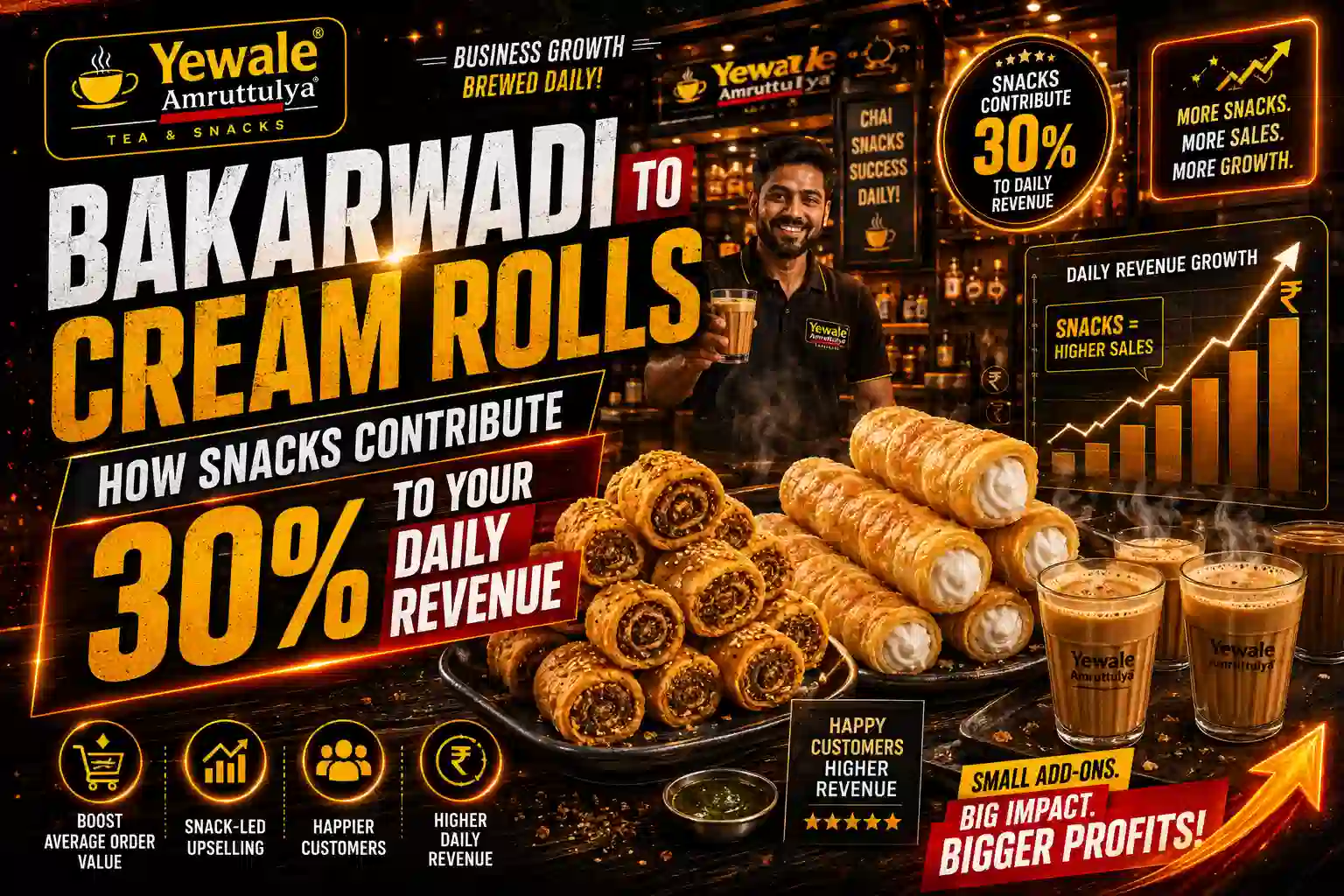
The ₹15 Chai That Became a ₹40 Bill, and Why He Didn't Notice It Happening
Nikhil stops at his usual Yewale outlet on his way home from work most evenings. It is 5 PM, he is tired, and he orders a cutting chai for ₹15. While it is being poured, he glances at the display case beside the counter and sees the golden Cream Roll sitting next to a fresh tray of Bakarwadi. He adds one to his order without really deciding to. His bill, which would have closed at ₹15, closes at ₹40.
Multiply that one small, unplanned decision across 60 evening customers who do exactly the same thing, and an outlet has quietly earned an extra ₹1,500 that evening, without a single additional cup of chai being poured.
This is not a lucky evening. It is a chai counter working exactly as it is designed to. Across Yewale Amruttulya's 650+ outlets, snacks like Bakarwadi, Cream Roll, Jaggery Cream Roll, and Spongy Cake are not side items that happen to sit next to the tea; they are a revenue engine that, run well, contributes close to 30% of an outlet's daily earnings. Franchisees who understand why this happens, and who set up their counter to make the most of it, run meaningfully more profitable outlets than those who treat the snack tray as an afterthought.
Why Chai and Snacks Always Go Together
The pairing is not a marketing invention. Tea and a savoury or sweet bite alongside it has been part of Indian daily life for generations, from the cafés of Mumbai and Pune to the farsan culture of Maharashtrian homes, where a plate of something crisp always appears next to the evening cup. Bakarwadi, in particular, carries this history. It was adapted into Maharashtra decades ago and became a household name in Pune, showing up on shelves at home, at festive gatherings, and as a travel snack for long train journeys. Serving it at a Yewale counter is not simply selling a snack; it activates a memory the customer already has.
There is a simple physiological reason the pairing works so consistently, too. The warmth and mild bitterness of spiced chai increases a customer's appetite and their tolerance for bold, layered flavours, which is exactly what Bakarwadi's spice-sweet-tangy profile delivers. The two are not just culturally linked; they are sensory complements. India's scale of tea drinking makes this pairing a daily, repeatable opportunity rather than an occasional one: the country consumes more than 1 billion kilograms of tea a year, and organised tea cafés still account for less than 5% of the out-of-home café market, which was estimated at only USD 100 to 140 million in 2024. Every cup poured at a Yewale counter is, in effect, an open door to a snack sale that most of the market is not yet capturing.
| Data Point | Figure | Source |
|---|---|---|
| India snacks market size, 2024 | ₹46,571.3 crore, growing at 8.63% CAGR to 2033 | Research and Markets |
| Indian & ethnic snacks segment, 2024 | USD 4.56 billion, namkeen growing at 10.2% CAGR (2025-30) | Technavio |
| India QSR market, 2024 | USD 8.7 billion, growing to USD 16.3 billion by 2033 | IMARC |
| Organised tea café share of out-of-home market | Under 5%, despite 1 billion+ kg of tea consumed annually | Restaurant India |
The Numbers: What a 30% Snack Contribution Actually Looks Like
The maths behind the 30% figure is worth breaking down, because it turns an abstract statistic into something a franchisee can picture on their own counter. A cup of chai at a Yewale outlet typically sells in the ₹15 to ₹20 range. A Cream Roll or a portion of Bakarwadi adds another ₹20 to ₹25. That means a single combo transaction is 45% to 55% higher in value than a chai-only sale.
Across 150 to 200 daily transactions, a reasonable share of which include a snack add-on, the extra revenue from snacks alone can run to ₹800 to ₹1,200 per day. Carried across a month, that compounds to roughly ₹24,000 to ₹36,000 in additional monthly revenue, all from a counter that was already open and already serving chai. Nothing about the footfall changes; only what each customer walks out having bought.
This is amplified by two things that are specific to Yewale's model. First, baked and packaged snack items generally carry gross margins of 40% to 50%, noticeably higher than beverage margins on their own. Second, Yewale's zero-royalty franchise structure means every rupee of that snack margin stays with the franchisee rather than being shared upward. On top of that, well-structured combo pricing has been shown to lift average ticket size by 12% to 25%, and natural, non-intrusive upselling of snacks and sides can lift overall sales by around 10%. None of this requires a new customer. It requires the existing customer to be offered the right thing at the right moment.
| Scenario | Chai Only | Chai + Snack Combo |
|---|---|---|
| Average transaction value | ₹15 - ₹20 | ₹35 - ₹45 |
| Gross margin on the transaction | Beverage margin only | Beverage margin + 40-50% snack margin |
| Daily extra revenue (150-200 transactions) | - | ₹800 - ₹1,200 |
| Monthly compounding effect | - | ₹24,000 - ₹36,000 |
Meet the Snacks: What's on the Counter and Why Each One Earns Its Place
| Snack | Role in Revenue | Why It Works |
|---|---|---|
| Bakarwadi | Heritage anchor, high repeat purchase | Zero prep, long shelf life, deep cultural familiarity in Maharashtra |
| Cream Roll | Impulse buy, highest visual pull | Sits well in a display case, pairs with both chai and coffee |
| Jaggery Cream Roll | Loyalty driver | A Yewale-specific variant customers cannot get elsewhere, which turns a craving into a repeat visit |
| Spongy Cake | All-day, all-age seller | Appeals to children and older customers alike, moves steadily outside peak hours too |
The Snack Counter Psychology: Why Customers Rarely Say No
A well-placed snack display does more work than most franchisees give it credit for. Industry data on food-counter placement shows that visible, eye-level display can lift attachment rate, the share of transactions that include an add-on, by up to 35%. Spiced chai also does some of this work physiologically: it primes appetite, so the customer is already inclined to want something to eat by the time they reach the counter.
There is a second, quieter effect. A customer who orders only chai tends to leave within five minutes. A customer who adds a snack typically stays 12 to 18 minutes, and a longer stay raises the odds of a second cup being ordered before they leave. Snacks do not just add their own margin; they extend the visit long enough for the outlet to sell more tea to the same customer, which is revenue that would not have existed otherwise.
There is also a value perception at play. A customer who buys only a ₹15 chai can feel like they made a quick, forgettable stop. A customer who leaves with chai and a Bakarwadi feels they got something worth pausing for. That feeling is part of why repeat visits build faster around outlets with a strong, visible snack counter than around outlets where tea is the only thing on offer.
What Most Tea Cafés Are Missing
Across the wider chai café category, snacks are commonly treated as a secondary add-on rather than a deliberate revenue lever. Many outlets rely on generic, imported snack items with no regional identity, things that could be bought at any food counter in the country. Others price snacks at a premium that puts them firmly in the add-on category rather than the everyday-pairing category, so the attach rate stays low. Very few chai brands talk publicly about what percentage of daily revenue their snack counter actually contributes, which means most franchise owners in the category are not being told to think about it as a lever at all.
This is the gap Yewale is positioned to close. A menu built around Bakarwadi, Cream Roll, and Spongy Cake is not simply a list of snack options; it is a culturally rooted pairing that customers already recognise and trust, sold at a price point that keeps it an everyday add-on rather than an occasional treat.
How Smart Franchisees Maximise Snack Revenue
- Keep the snack display at eye level near the billing point, not tucked behind the counter, so it is the first thing a customer sees while their order is being taken.
- Train staff to make one natural suggestion at the point of order, such as “Chai ani Bakarwadi?”, rather than a scripted upsell that feels forced.
- Because snack items are pre-standardised and need no cooking, stock the display fully ahead of the two daily peaks, 7 AM to 9 AM and 5 PM to 8 PM, when footfall and impulse buying are both highest.
- Track snack sales separately from beverage sales each week, so the outlet has a clear number to improve rather than a vague sense that “snacks sell okay.”
- Rotate which item sits at the very front of the display; visual freshness itself increases pick-up rate.
The Chef-Less Snack Advantage
One part of Yewale's model that franchisees often undervalue is how little skill the snack counter requires. Bakarwadi, Cream Roll, Jaggery Cream Roll, and Spongy Cake all arrive pre-standardised, so a new franchisee can maximise snack revenue from their very first week without training kitchen staff or worrying about consistency between outlets. Outlets that rely on made-to-order snacks carry an extra layer of cost, training time, and wastage risk that a chef-less counter simply does not have. For a Yewale franchisee, that means the 30% revenue contribution is available almost immediately, not something that has to be built up over months of staff training.
Key Takeaways
- Snacks are not a side item. Done well, they contribute close to 30% of an outlet's daily revenue without adding a single new customer.
- A chai + snack combo runs 45-55% higher in transaction value, adding roughly ₹800-₹1,200 a day and ₹24,000-₹36,000 a month at a typical outlet.
- Snack margins of 40-50%, combined with Yewale's zero-royalty model, mean this additional revenue stays entirely with the franchisee.
- A visible, eye-level display and one natural counter suggestion can lift attach rate by up to 35%.
- A snack purchase extends the average visit to 12-18 minutes, raising the odds of a second cup sold to the same customer.
- Pre-standardised, chef-less snacks mean a new franchisee can start capturing this revenue from week one, with no extra training or wastage risk.
Nikhil still stops at the same outlet most evenings. He does not think of himself as part of a 30% revenue statistic; he just likes that the Cream Roll is always fresh and always right there when he wants it.
If snacks are quietly worth 30% of what an outlet earns every day, what would change at your counter if you started treating that number as a target instead of a coincidence?
