
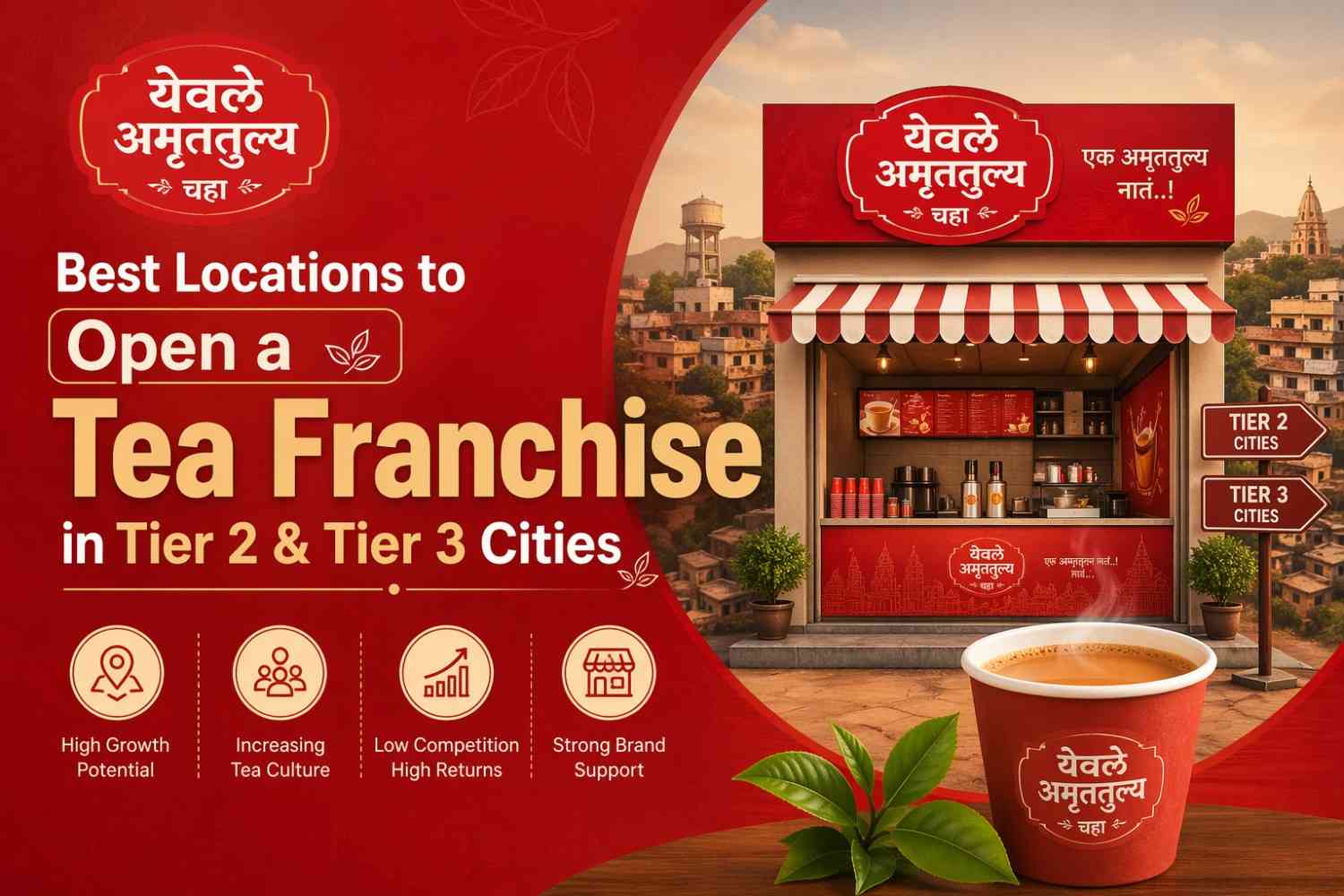
The Cup That Never Gets Old
7:15 in the morning. Nashik. A narrow lane just outside a state transport bus depot.
A man in a faded jacket steps off a long-distance bus, bag in one hand, phone pressed to his ear. He walks past the auto stand, past the paan shop, past the newspaper stall. Then he stops.
Not because someone called him. Not because he saw a sign. He stopped because his nose told him to.
A small tea counter. One gas burner. Two steel vessels. A thin spiral of steam rising from a kettle that has probably never been switched off.
He orders without looking at the menu. "Ek cutting."
That is it. No decision fatigue. No overthinking. Just chai.
He stands there for four minutes. Drinks. Pays twelve rupees. Walks away with slightly straighter shoulders.
This scene does not happen only in Nashik. It happens in Kolhapur bus stands, Solapur railway junctions, Aurangabad market squares, Jalgaon highway exits, and Sangli college lanes. Every single morning. Without fail.
This is not just a habit. This is a location strategy hiding in plain sight.
India Does Not Run on Coffee. It Runs on Chai.
India produces over 1.3 billion kilograms of tea annually and consumes close to 80 percent of it domestically. According to market research estimates, the organized chai retail segment is growing at 12 to 15 percent year on year. But here is the part most people miss: the highest growth is not happening in metro cities. It is happening in Tier 2 and Tier 3 markets.
Why? Because organized tea retail arrived late to these cities. The demand was always there. The habit was always there. What was missing was a brand worth trusting.
In a city like Pune, a customer choosing between five chai outlets has to think. In Ahmednagar or Latur, a customer walking past a Yewale Amruttulya outlet has essentially already decided before they reach the counter. Brand scarcity in smaller cities creates a loyalty speed that metros cannot match.
The average chai purchase decision takes under eight seconds. The average customer visits four to five times a week. At a modest average bill of sixty rupees, that is close to twenty-four thousand rupees per customer per year, from one person, for one habit, at one location.
This is what a "tea franchise opportunity" actually looks like when you strip away the brochure language.
Why Location Is the Product
In the food and beverage business, operators spend years perfecting their recipe and minutes choosing their location. The smarter operators do the opposite.
Chai is not a destination purchase. Nobody plans a trip specifically to buy tea. They buy chai because it is in front of them at the right moment. This means the product is almost never the deciding factor. The location is.
There are three mechanisms that make a chai location successful in smaller cities:
The first is the Routine Overlap. When a chai outlet sits at the intersection of two daily routines, like a commute route and a college gate, it captures traffic from both directions without doing anything extra. The customer did not come for chai. They passed by it. And passing by something every day is the most reliable form of marketing that exists.
The second is Sensory Anchoring. The smell of masala chai brewing outdoors carries up to thirty meters on a still morning. In a Tier 2 city with less noise and less competing stimuli, that scent is a genuine storefront. It does the advertising before the board does.
The third is Social Gravity. In smaller cities, a popular chai counter becomes a meeting point. People do not just come for the tea. They come because they know who else will be there. A chai outlet becomes part of the city's social fabric within weeks, not months. That kind of loyalty is extremely difficult to dislodge once it forms.
The right location does not just attract customers. It creates ones.
Five Locations That Work Best in Tier 2 and Tier 3 Cities
1. College and University Zones
Walk past any degree college in a Tier 2 city between 9 AM and 5 PM and you will see the same scene. Students standing in clusters outside the gate, mid-discussion about something that happened in the lecture or outside it. Someone always has a cup in hand.
College zones are not just high-footfall. They are habitual by design. Students follow fixed timetables, which means they move through the same routes at the same times every weekday. An outlet that captures the morning entry crowd and the post-lunch exit crowd is running two revenue windows on the same location, with the same setup, at nearly zero incremental cost.
Beyond the numbers, this age group is forming its brand preferences. A student who drinks Yewale chai through four years of college does not switch easily afterward. The loyalty installed here has a long shelf life.
2. Highway Entry Points and Transport Hubs
Every Tier 2 city has a pulse. You feel it most at the bus depot, the railway station approach road, or the first main junction after the highway entry. These are the places where the city receives and releases people, dozens of times a day.
Travelers are uniquely good customers. They are slightly outside their routine, which makes them more receptive to buying. They have a few minutes to wait, which is enough time for a cup. And they are often cold, tired, or both, which makes hot chai exactly what they need without needing to be told.
A highway entry chai outlet in a city like Satara or Jalna handles three kinds of customers simultaneously: locals heading out, travelers passing through, and truck or vehicle crew stopping for a break. Each of these groups buys with very little persuasion required.
3. Industrial Areas and MIDC Clusters
Industrial areas in Tier 2 and Tier 3 cities are chronically underserved by organized F&B. Most factory workers and small business employees in these zones eat and drink from whatever is available nearby, not from what they prefer. The bar for winning their loyalty is not especially high. You simply have to show up consistently with a decent product.
The economics here are straightforward. A cluster of four to five factories with a combined workforce of eight hundred people, of whom even thirty percent buy chai twice a day, generates a predictable base volume that most retail locations would envy. Unlike footfall from passing traffic, this demand is anchored. The workers come back every working day, every week, for years.
The operational timing also aligns well. Peak demand at industrial zones falls in the early morning and at the end of afternoon shifts, which distributes the workload rather than concentrating it in a single rush hour.
4. New Residential Townships and Planned Extensions
Every growing Tier 2 city in India has a direction in which it is expanding. Nagpur pushes east. Aurangabad stretches toward the ring road. Kolhapur grows near its new sectors. These new residential zones are interesting because they attract a very specific kind of customer: the aspiring middle-class family that has recently moved away from the old city center.
These customers actively want a branded experience. They are the ones who feel slightly out of place buying from an unbranded roadside vendor, not out of snobbery, but out of a new sense of identity. A well-presented Yewale outlet in their new neighborhood becomes part of how they define their upgraded lifestyle.
The other advantage of new townships is that loyalty forms early and sticks. When you are the first organized chai brand in a growing neighborhood, you are not competing with existing habits. You are creating them.
5. Weekly Market Streets and Mandi Catchment Areas
Tier 2 and Tier 3 cities often have a commercial heart that beats loudest on certain days. In many towns, the weekly market or the agricultural mandi strip sees foot traffic that rivals any urban high street. Farmers, traders, small business owners, and buyers all converge in the same zone, often from early morning.
This crowd shares one characteristic: they are busy. They are not browsing. They are transacting. A chai outlet at the edge of this activity becomes the natural pausing point, the brief moment of rest in the middle of a packed day. Volumes on market days can be two to three times a regular weekday, and the higher footfall spills over to adjacent days as people return to the same strip for follow-up errands.
The Numbers That Make This Real
Let us take a mid-size Tier 2 city. A Yewale Amruttulya outlet near a college zone opens at 7:30 AM and operates until 9:00 PM. Average ticket size is sixty to seventy rupees, including chai and a snack pairing.
Conservative scenario: two hundred and fifty cups per day at an average of sixty rupees equals fifteen thousand rupees in daily revenue. Monthly that is four lakh fifty thousand rupees. After operating costs and royalty, a well-run Tier 2 franchise in the right location clears positive returns well within the first year.
Now consider what changes in a college zone specifically. The footfall is seasonal but extremely dense. During exam season and semester ends, daily counts spike. During festivals, the surrounding residential area compensates for the drop in student traffic. The two rhythms balance each other across the calendar.
Franchise owners in Tier 2 cities also benefit from lower real estate costs, lower staff wages, and a lower competitive density. The unit economics of a smaller city often outperform a metro outlet that looks more impressive on paper.
This is why experienced franchise investors increasingly skip the metros and go straight to the Tier 2 market. Not as a backup plan. As a first choice.
Quick Reference: Location Types at a Glance
The table below summarizes the five location types, their core advantage, ideal operational setup, and approximate daily footfall potential:
| Location Type | Why It Works | Ideal Setup | Avg. Daily Footfall |
| College / University Zone | Habit-forming age group, daily repeat visits | Compact counter, fast service | 300 – 600+ |
| Highway & Transport Hub | Captive travelers, impulse-driven purchase | High-visibility stall, quick billing | 400 – 800+ |
| Industrial & MIDC Cluster | Shift-based workers, predictable demand | Early morning & evening shifts | 250 – 500+ |
| New Residential Township | Untapped micro-community, loyalty potential | Social seating, snack pairing | 150 – 350+ |
| Weekly Market / Mandi Strip | High weekend traffic, discovery-led buying | Prominent outdoor placement | 500 – 1000+ |
Footfall figures are indicative estimates based on location characteristics. Actual performance varies by city, setup, and operations.
The Quiet Logic of Chai
Go back to that man outside the Nashik bus depot. He did not choose that tea stall because of a loyalty app or a discount offer or a review on a platform. He chose it because it was there. Because it smelled right. Because in a slightly disorienting moment of arriving somewhere new, a familiar cup of chai was the one certain thing.
This is the quiet logic that powers every great chai location. People do not buy chai after deliberating. They buy it when it meets them where they already are. The best franchise locations are not discovered through data alone. They are recognized by anyone who watches how people actually move through a city, where they slow down, where they pause, and what they reach for in those pauses.
Tier 2 and Tier 3 India is full of those pauses. They are just waiting for the right counter to be placed beside them.
The city is already drinking. Are you in the right place to serve it?
Yewale Amruttulya | India's Trusted Chai Franchise
yewaleamruttulya.com
