
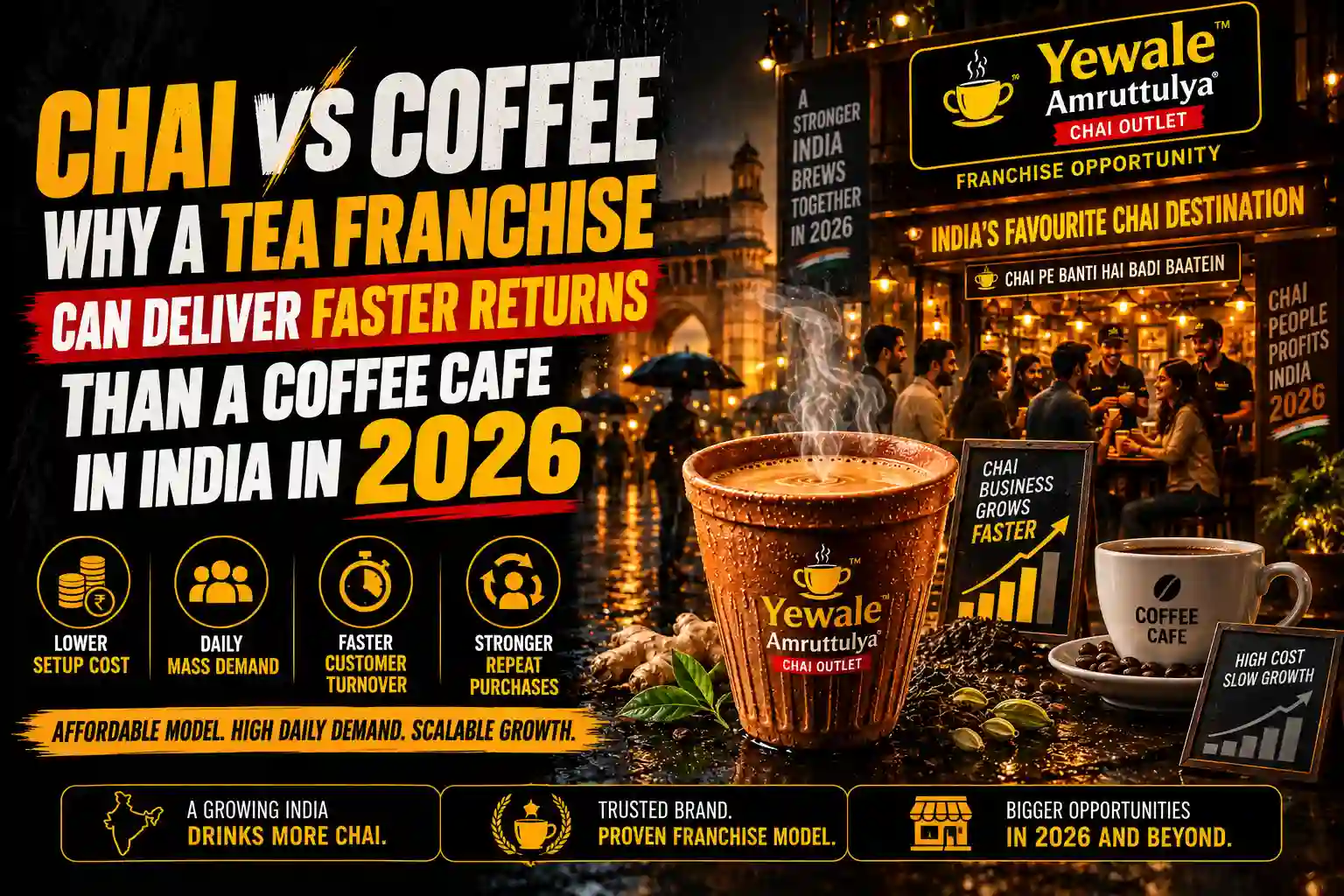
He Compared Two Beverage Business Models. The Numbers Led Him Toward Chai.
Rohit had saved for his first food and beverage business and was comparing two broad formats: a coffee cafe and a tea franchise. Instead of choosing only by brand image or menu appeal, he compared the capital required, operating complexity, staffing needs, everyday customer demand and the time it could take to recover his investment.
The exercise changed the question. It was no longer “Which beverage is better?” Both tea and coffee have established markets in India. The more useful question for a first-time entrepreneur was: “Which operating model fits my capital, location and risk tolerance?”
That distinction matters. A tea outlet typically works with a smaller format, a simpler service process and a lower average ticket. A coffee cafe can command a higher ticket but usually needs more equipment, seating, ambience and trained beverage preparation. The economics therefore depend on much more than the price of a cup.
For entrepreneurs evaluating the Yewale model specifically, the official Yewale Amruttulya franchise opportunity describes a chef-less, standardized operating system with a 0% royalty and commission structure.
The Market Context: Tea and Coffee Are Both Established, but Consumption Patterns Differ
Tea and coffee both have substantial demand in India, so this comparison should not be framed as one beverage replacing the other. The practical difference is how each format is usually consumed and how that consumption translates into outlet economics.
Tea Board India’s domestic consumption study describes tea as a highly penetrated product, with 63% of respondents reporting tea consumption and more than 90% of tea-consuming respondents indicating a preference to drink tea before or with breakfast. The same study also notes that milk-and-sugar tea remains the dominant household preference.
Coffee is also a meaningful domestic category. Coffee Board of India statistics report estimated domestic coffee consumption of 96,000 metric tonnes in 2024, showing that coffee has a substantial and growing place in the Indian beverage market.
For a franchise investor, the important takeaway is not that one market exists and the other does not. It is that tea is deeply embedded in routine, low-ticket consumption, while cafe-style coffee is often positioned as a more premium or experience-led purchase. That difference can influence required location quality, seating expectations, staffing and working capital.
Tea Franchise vs Coffee Cafe: A Practical Operating Comparison
| Factor | Tea Franchise Model | Coffee Cafe Model |
| Outlet format | Often smaller, counter-led and optimized for quick service | Often larger, with seating and stronger ambience expectations |
| Typical capital intensity | Can be lower because of compact setup and simpler equipment | Can be higher because of espresso equipment, interiors, seating and utilities |
| Staffing model | Process-led service can reduce dependence on specialized food preparation roles | Coffee preparation may require barista training and more beverage-specific skill |
| Transaction pattern | Lower average ticket with potential for frequent repeat consumption | Higher average ticket with more occasion-led visits |
| Menu strategy | Tea, milk-based beverages, snacks and quick pairings can support add-on sales | Coffee, cold beverages, desserts and cafe food can support higher-ticket baskets |
| Location flexibility | Compact formats may work near offices, markets, colleges, transit and neighborhood clusters | Cafe formats often benefit from premium commercial catchments and dwell-time demand |
| Operating complexity | Standardized recipes and limited equipment can simplify daily execution | Equipment calibration, milk texturing, cafe service and seating can increase process complexity |
| Royalty structure | Depends on brand; Yewale states 0% royalty and commission | Depends on the selected cafe franchise or operating model |
| Scalability | A repeatable, compact model can make multi-outlet expansion more accessible | Expansion can require repeating a larger equipment and interior investment |
| Return profile | Potentially faster payback when setup cost stays low and daily transactions are strong | Potentially attractive unit economics, but higher upfront capital can extend payback |
This table is an operating-model comparison, not a guaranteed financial forecast. Actual sales, margins and payback depend on rent, city, frontage, local demand, staffing, product mix, pricing, wastage, operating hours and management quality.
What Changes When You Evaluate the Yewale Amruttulya Model?
The comparison becomes more specific when the tea format is Yewale Amruttulya, because the brand publicly describes several operating features that can affect cost and simplicity.
0% royalty and commission: Yewale’s official franchise page states that its model carries 0% royalty and commission.
Chef-less and owner-free positioning: The brand describes its operating model as standardized and designed to reduce dependence on a chef-led kitchen.
Standardized taste across outlets: The franchise page states that recipes and proprietary inputs are designed to maintain consistency across locations.
Broad product range: Yewale sells multiple tea variants, coffee, milk beverages, cold drinks and snacks, giving an outlet more opportunities for add-on sales.
See the full details on the Yewale Amruttulya franchise model and explore the Yewale Amruttulya product range before building any unit-level financial assumptions.
Why Product Mix Matters More Than Beverage Price Alone
A common mistake in beverage-franchise comparisons is to compare only the selling price of tea with the selling price of coffee. Outlet revenue is actually driven by the full basket: how many transactions happen, how often customers return, and what else they buy with the main beverage.
Yewale’s official menu includes Regular Tea, Kulhad Chai, Jaggery Tea, Ginger Tea and Black Tea along with milk-based beverages, cold drinks and snack items such as Bakarwadi, Cream Roll, Jaggery Cream Roll, Cookies and Spongy Cake.
That range matters because a tea-led outlet can increase average order value without changing its core positioning. A customer may enter for tea and add a snack, choose Kulhad Chai for a more distinctive experience, or select a milk-based beverage at another time of day.
Investment and Payback: Use Brand-Verified Numbers, Not Generic Claims
The original draft used fixed claims for tea-franchise margins, daily customer counts, coffee-cafe royalties and break-even periods. Those figures can vary widely by format and location, so they should not be presented as universal facts.
For Yewale-specific investment planning, use the brand’s current Tea Franchise Cost in India 2026 guide together with the official franchise enquiry process. The current Yewale guide states a 2026 franchise package figure of ₹7.9 lakh and says break-even can vary by city tier and outlet performance.
Even with an official package figure, investors should budget separately for items that may vary by location, including rent deposit, local licences, working capital, utilities, staff cost and site-specific requirements. A lower setup cost can shorten the payback path, but only if the outlet generates sufficient contribution after all recurring costs.
Operational Simplicity: Why Process Standardization Matters
Operational simplicity can create financial value in ways that are easy to overlook. Every additional skill dependency increases training time, replacement risk and the chance of inconsistent output. A compact tea outlet built around standardized recipes can reduce that dependency, especially for first-time operators.
Coffee preparation is not inherently difficult to manage, but a cafe may depend more heavily on equipment calibration, espresso extraction, milk texturing, machine maintenance and beverage-specific training. The economics are still attractive in the right location, but the operator should account for those requirements before comparing payback periods.
Yewale’s official franchise page specifically emphasizes standardization, a chef-less operating structure and a daily-consumable product model.
Location Economics: The Rent-to-Revenue Equation Matters
A beverage outlet does not succeed because tea or coffee is popular nationally. It succeeds because the site delivers enough relevant footfall at a rent the outlet can support.
Tea outlets can often use smaller footprints and faster service, which can open more location types: office clusters, college areas, transport corridors, neighborhood markets and high-frequency local catchments. Cafe formats may benefit more from dwell time, visibility, seating and premium commercial environments. Neither model is automatically better in every location.
Before signing a site, compare expected transactions, average order value, rent, staffing, utilities, local competition, frontage, access and peak-hour demand. The lower-capital model only wins if the location can produce enough repeat traffic.
From One Outlet to Two: Why Replication Cost Changes the Growth Path
Multi-outlet expansion is where a compact, standardized format can become especially attractive. If the second outlet does not require a large kitchen, premium seating build-out or expensive beverage equipment, the capital needed to replicate the format may be easier to plan.
Yewale’s 0% royalty structure can also matter here because the outlet does not pay a recurring royalty or commission to the brand, according to the official franchise page. That does not guarantee that retained cash will finance another outlet, but it reduces one recurring franchisor charge that would otherwise affect unit economics.
Entrepreneurs planning multi-outlet growth should review the Yewale Amruttulya franchise opportunity and discuss location, investment and support directly with the franchise team rather than relying on generic market estimates.
Which Model Fits Which Investor?
| Investor Consideration | Tea Franchise May Fit If... | Coffee Cafe May Fit If... |
| Capital available | You want to start with a more compact F&B format | You have more capital for equipment, interiors and seating |
| Operating preference | You prefer a standardized, fast-service process | You want to operate a cafe experience with a broader service environment |
| Customer occasion | You want to capture frequent tea breaks and quick purchases | You want longer visits, premium beverages and cafe occasions |
| Location | You have a high-frequency catchment where speed and convenience matter | You have a site suited to seating, ambience and discretionary visits |
| Expansion goal | You want a format that may be easier to replicate across multiple outlets | You are comfortable repeating a higher-capital cafe setup |
| Risk tolerance | You want to limit upfront capital exposure | You can absorb a higher initial setup and potentially longer recovery period |
Interested in a Yewale Amruttulya Tea Franchise?
For a first-time entrepreneur, the strongest argument for a tea franchise is not that coffee is a weak business. It is that a compact, standardized tea model can reduce the amount of capital and operating complexity that must be recovered before the outlet starts generating an acceptable return.
Review the Yewale Amruttulya franchise opportunity for the current model, support structure and enquiry form. You can also contact Yewale Amruttulya for franchise enquiries to discuss your city, preferred location and investment requirements.
If you want to understand what customers can order beyond regular chai, explore the complete Yewale Amruttulya products and snacks menu.
Key Takeaways
Tea and coffee both have established demand in India. The investment decision should be based on operating model, location and capital requirements rather than beverage preference alone.
Tea Board India data supports tea’s high penetration and strong morning-consumption habit, while Coffee Board data confirms a significant domestic coffee market.
A compact tea outlet can have lower equipment, interior and staffing complexity than a full cafe format, which may shorten the capital-recovery path when sales are strong.
Yewale Amruttulya publicly states a 0% royalty and commission model, chef-less positioning and standardized recipes across outlets.
Yewale’s product mix extends beyond regular tea to Kulhad Chai, Jaggery Tea, Ginger Tea,Black Tea, milk beverages, cold beverages and snacks, creating opportunities for add-on sales.
Returns are never automatic. Rent, site selection, daily transactions, average order value, operating costs and execution determine actual profitability and break-even.
The better question is not “chai or coffee?” It is “which business model can I operate consistently, finance responsibly and replicate profitably in my chosen market?”
References and Official Links
Tea Board India - Domestic Consumption Study Executive Summary - Tea consumption penetration and household consumption patterns.
Tea Board India - Consumption - Official Tea Board consumption resource page.
Coffee Board of India - Coffee Statistics - Estimated domestic coffee consumption data.
