
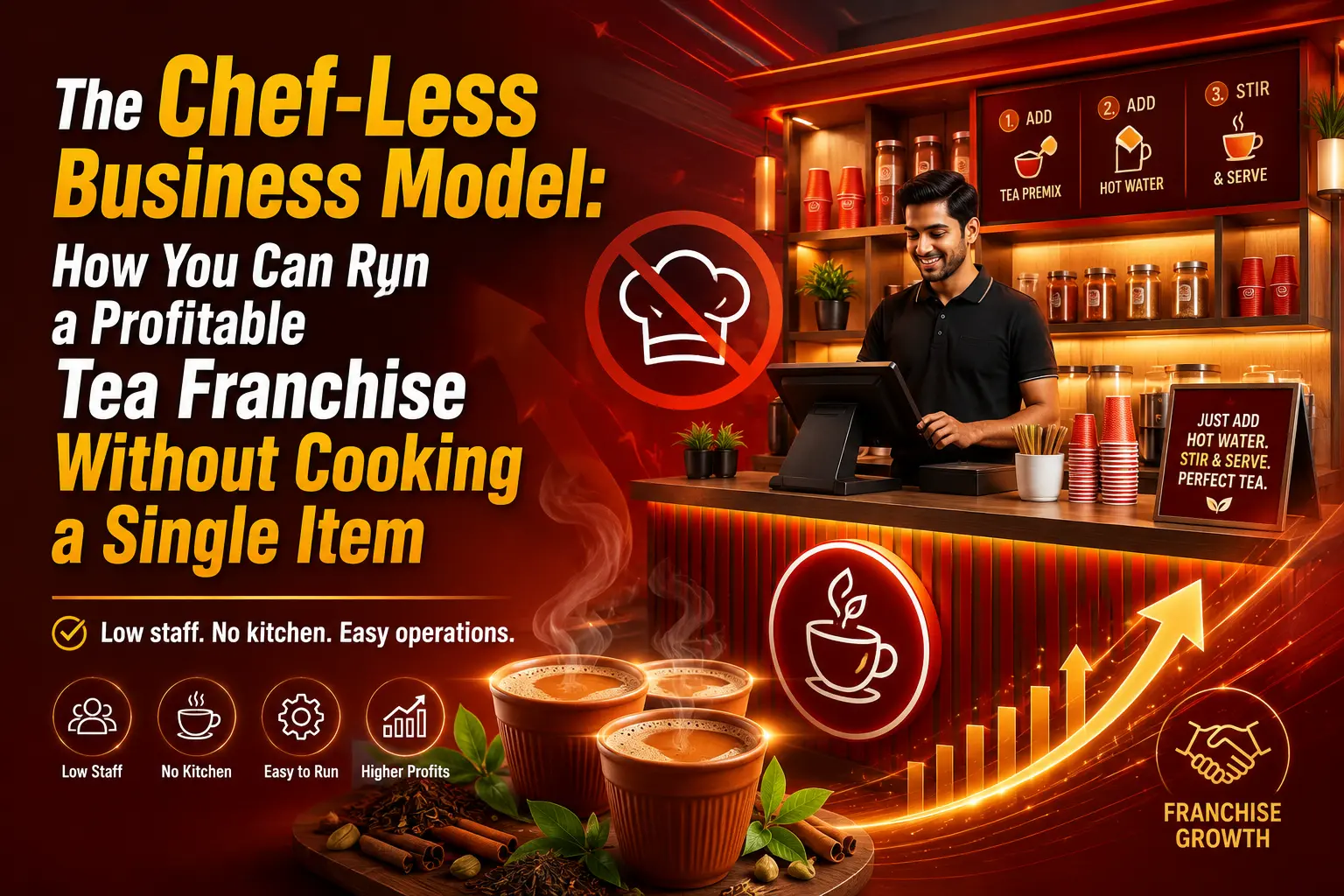
He Opened a Food Business and Had Never Cooked a Meal in His Life
Sameer was 29, working in logistics, and had been saving money for three years. He wanted to start a business, but the standard advice kept stopping him: to run a food business, you either need to cook yourself or you need to find and keep a reliable cook.
Sameer could not cook. He had no chef contacts. And from what he had seen in his neighbourhood, finding a reliable cook who stayed long enough to matter was harder than it sounded.
He spent six months looking at options: a sandwich stall, a small restaurant, a snacks counter. Every model he researched had the same dependency built in. The quality of the food depended on the skill of the person making it. And that person could quit, fall sick, or simply have a bad day, and your business would suffer every time.
Then someone told him about a tea franchise model where no cooking was required at all.
No chef. No kitchen. No recipe complexity. Just a counter, a kettle, and a centrally supplied product that tasted exactly the same every single day regardless of who was on shift.
Sameer opened his outlet. It was profitable within the first month.
Here is what most people do not understand about the food and beverage business in India: the biggest hidden cost is not rent or ingredients. It is the dependency on skilled cooking staff. A model that removes that dependency entirely changes the risk profile of your business from day one.
This blog explains how the chef-less franchise model works, why it is one of the most underrated business advantages in Indian franchising, and what it means in practical terms for your daily operations, your profitability, and your ability to scale.
The Chef Problem: Why Skilled Kitchen Staff Is the Silent Killer of Small Food Businesses
Ask any independent restaurant owner in India what keeps them up at night, and the answer is rarely rent. It is the cook. Finding a reliable cook, keeping them, managing their moods, worrying about the day they call in sick or simply stop showing up: this is the daily reality of running a kitchen-dependent food business.
The data on food service employee turnover globally tells a stark story.
According to 360training's 2024 restaurant employee turnover analysis, the average annual restaurant employee turnover rate is approximately 79.6%, nearly double the turnover rate across other industries. The cost of replacing a single front-line restaurant employee runs between USD 2,000 and USD 6,000.
The Center for American Progress research cited by Meez estimates that replacing an hourly food service employee costs 16% to 20% of that employee's annual salary. For a cook earning ₹20,000 per month in India, that means every time they leave, it costs you ₹38,000 to ₹48,000 in replacement and retraining costs alone.
These numbers do not include the cost of inconsistent food quality during the transition, the lost revenue while you are short-staffed, or the time you personally spend managing a kitchen problem instead of building your business.
The Consistency Problem That Never Goes Away
Even when you have a good cook who stays, you face a different problem: consistency. Food prepared by a person is never exactly the same twice. Spice levels vary. Proportions shift. The masala chai that earned a five-star review on Monday tastes different on Thursday when the cook is tired or distracted.
In a beverage business like chai, where the customer visits every single day and has a calibrated memory of exactly how their regular cup should taste, even a small variation can feel like a betrayal. Customers who experience inconsistency do not complain. They quietly start going somewhere else.
A chef-less model removes this problem at its root. When the product is centrally standardized and supplied, it does not have a bad Tuesday. It does not vary with the cook's mood. It tastes the same in Nashik as it does in Pune, and it tastes the same today as it will six months from now.
The Real Cost of Running a Kitchen-Dependent Outlet: What Most Business Plans Leave Out
When people calculate the cost of opening a food franchise, they usually account for the chef's salary. What they miss are all the associated costs that come attached to kitchen dependency.
| Hidden Cost of a Skilled Chef / Cook | Typical Monthly Cost (India) | Chef-Less Model Cost |
| Chef salary (experienced cook) | ₹15,000 to ₹30,000 | ₹0 |
| Recruitment and sourcing cost | ₹5,000 to ₹15,000 (one-time, recurring) | ₹0 |
| Training and onboarding time | 2 to 4 weeks of lost productivity | ₹0 / not required |
| Recipe inconsistency and wastage | ₹3,000 to ₹8,000 per month in waste | Eliminated |
| Chef absence backup cost | ₹500 to ₹1,000 per day when absent | Not applicable |
| Quality control and monitoring time | Owner's daily attention required | Centrally standardized |
| Total monthly hidden cost (est.) | ₹25,000 to ₹55,000+ | Near zero |
The table above shows that the true monthly cost of kitchen dependency is not just the cook's salary. It is the recruitment cycle cost, the training time, the inconsistency-driven wastage, the absence backup problem, and the owner attention it demands. Together, these can add ₹25,000 to ₹55,000 per month in direct and indirect costs to a small food outlet.
A chef-less model eliminates all of those costs simultaneously. Not reduces them. Eliminates them.
According to Bharat Franchise's 2024 restaurant franchise margin analysis, QSR franchises generally see profit margins of 5% to 15% in India. A reduction of ₹30,000 per month in chef-related hidden costs on a ₹2 lakh revenue base is worth 15 percentage points of margin. That is not a small improvement. It is the difference between a struggling outlet and a profitable one.
How the Chef-Less Model Actually Works at a Yewale Outlet
The chef-less model is not about cutting corners. It is about moving the complexity upstream, out of the individual outlet and into the central supply chain, so that every outlet benefits from standardized quality without needing to recreate it locally.
Here is how it works in practice at a Yewale Amruttulya franchise.
Centralized Recipe Standardization
The chai recipe developed over 40 years in Pune is not left to the interpretation of each outlet. The precise blend of ingredients, the proportions, the specific tea leaves and spice profile: all of it is standardized at the source. What reaches your outlet is a controlled input that produces a predictable output every single time.
Your counter staff does not need to know how to create the recipe. They need to know how to execute it, which is a skill that takes two to three days to learn, not two to four weeks.
Pre-Standardized Snack Supply
Cream Rolls, Spongy Cakes, Jaggery Cream Rolls, and Bakarwadi arrive at your outlet ready to display and sell. No baking, no preparation, no cooking equipment required for the snack range. The highest-margin items on your counter are also the easiest to serve.
This means that the 28% to 32% of daily revenue that comes from snack sales requires zero cooking knowledge and zero kitchen infrastructure. It is display and sell, full stop.
Counter Staff, Not Culinary Staff
The skill set you need at a Yewale outlet is a counter skill set: friendly customer interaction, fast service, basic hygiene, and the ability to execute a standardized beverage process consistently. These are skills that can be trained in two to three days. They are also skills that are far more common in the general workforce than culinary skills, which means you have a larger hiring pool and lower attrition pressure.
What most people do not realize is this: the chef-less model does not give you a worse product. It gives you a better one, because consistency is the highest form of quality in a daily-visit business. A cup that tastes exactly the same every day is more valuable to a habitual customer than a cup that is excellent on some days and mediocre on others.
Chef-Less vs. Kitchen-Dependent: A Side-by-Side Operations Comparison
Here is how the two models compare across every major operational dimension.
| Operational Area | Traditional Food Franchise (with kitchen) | Yewale Chef-Less Model |
| Staff requirement | Cook, kitchen hand, counter staff | Counter staff only |
| Opening readiness | 45 to 60 min prep before opening | Under 15 min setup |
| Product consistency | Depends on cook's skill and mood | Centrally standardized always |
| Quality control effort | Daily monitoring required | Built into supply chain |
| New staff training time | 2 to 4 weeks for kitchen role | 2 to 3 days for counter role |
| Impact of staff absence | Cannot open or operate safely | Another counter staff covers |
| Monthly staff cost | ₹40,000 to ₹80,000+ | ₹15,000 to ₹30,000 |
| Owner daily involvement | High, kitchen oversight required | Low after first 30 days |
| Scalability to second outlet | Complex, need trained cook each time | Simple, same model replicated |
The operations comparison table reveals something that goes beyond cost: it shows how the chef-less model gives back time. Time that a kitchen-dependent franchise owner spends on monitoring quality, managing chef relationships, and handling daily kitchen problems becomes time a chef-less franchise owner invests in customer experience, business development, and expansion planning.
The Owner's Day: How Different the Two Models Feel
In a kitchen-dependent outlet, a typical owner starts the day by checking whether the cook arrived. Then ensuring prep is on track. Then tasting to verify quality. Then handling any kitchen issues that arise through the rush. Then briefing the cook on the evening's expected volume. Kitchen management is an active, daily, time-consuming role.
In a chef-less outlet, the owner checks that supplies are stocked, that the counter is clean and display-ready, and that staff are at their positions. The first customer of the day gets the same cup as the last customer 12 hours later, without the owner having needed to intervene in between.
That difference in daily experience is not just about convenience. It is about where your attention goes. Owners who are not managing kitchens are thinking about growth.
From Zero to Open: How the Chef-Less Model Gets You to Revenue Faster
One of the most under-discussed advantages of the chef-less model is the speed at which you can go from investment to revenue. The typical kitchen-dependent food outlet takes weeks of pre-opening preparation that has nothing to do with the business and everything to do with getting the kitchen ready.
| Activity | Traditional Food Outlet | Yewale Chef-Less Franchise |
| Week 1: Setup and equipment | Kitchen installation, equipment testing | Counter setup, display arrangement only |
| Week 2: Staff hiring | Chef search, interview, negotiation | Counter staff hired, trained in 2 to 3 days |
| Week 3: Recipe trials | Test batches, quality adjustments, wastage | Not required, recipe already standardized |
| Week 4: Soft launch | Limited menu, inconsistent quality likely | Full menu, consistent quality from cup one |
| Month 1 net revenue | Often negative, high wastage and trial costs | Positive revenue from first week typically |
| Break-even | 12 to 24 months average | 7 to 9 months typical for Yewale |
According to industry franchise research cited by Yewale's blog, 60% of tea franchisees recover their initial investment within 18 months. For chef-less outlets where pre-opening costs and wastage are eliminated, the typical break-even timeline runs 7 to 9 months. The difference between these two timelines is largely the absence of kitchen setup, recipe trial, and cook training costs in the early weeks.
The Most Powerful Benefit Nobody Talks About: Scaling Without a Kitchen
Here is the insight that separates first-time franchise buyers from serial franchise investors. The real financial value of the chef-less model is not in what it saves at outlet one. It is in how fast it allows you to open outlet two, three, and four.
In a kitchen-dependent model, every new outlet requires a new trained cook. Finding them, hiring them, and stabilizing their quality takes months. It is the single biggest bottleneck to expansion in food and beverage franchising. Most operators who want to open three outlets eventually learn that their model can only move as fast as they can find reliable kitchen talent.
In a chef-less model, the replication bottleneck is location and capital, both of which are much easier to solve than culinary talent dependency.
| Outlet Number | With Chef-Dependent Model | With Yewale Chef-Less Model |
| Outlet 1 | Took 6 months to find a reliable cook | Opened in week 3, chef-less from day one |
| Outlet 2 | Needed to source a second trained cook | Same counter-staff model, replicable instantly |
| Outlet 3 | Quality varied between outlets | Identical taste across all outlets guaranteed |
| Time to open 3 outlets | 18 to 36 months | 6 to 12 months |
| Key growth bottleneck | Finding and retaining skilled kitchen staff | Location selection and capital only |
The scale table shows how the compounding advantage of the chef-less model grows with each additional outlet. By the time a kitchen-dependent franchise owner is stabilizing their second outlet's cook situation, a chef-less franchise owner may already be evaluating their third location.
This is the detail that long-term franchise investors understand very clearly: in a chef-less model, your growth rate is limited only by your capital and your location choices. In a kitchen-dependent model, it is limited by your ability to source, train, and retain a skill that is genuinely scarce in the Indian labor market.
Who Is the Chef-Less Model Actually Built For?
The chef-less franchise model is not a compromise solution for people who cannot find a cook. It is a deliberate design choice that makes the franchise accessible and sustainable for a much wider range of entrepreneurs than a kitchen-dependent model can ever reach.
First-Time Business Owners
If you have never run a food business before, the idea of managing a kitchen, a chef, recipes, and quality control simultaneously is genuinely intimidating. A chef-less model removes all of that from your responsibility list and lets you focus entirely on customer service, operations, and business growth. You learn to run a business, not to run a kitchen.
Salaried Employees Launching Their First Venture
Someone transitioning from employment to entrepreneurship rarely has food industry expertise. A chef-less model requires general business management skills, people management, and a commitment to operational standards: all of which a capable professional already possesses. The food complexity is handled by the franchisor's supply chain.
Entrepreneurs Who Want to Run Multiple Outlets
As discussed above, the chef-less model removes the single biggest bottleneck to multi-outlet expansion. If your goal is to build a small portfolio of tea franchise outlets rather than run a single one forever, the model that does not depend on scarce culinary talent is the one that grows with you.
Investors Looking for a Business That Runs Without Daily Micromanagement
After the initial setup period, a well-staffed chef-less outlet can operate with minimal daily input from the owner. The product does not require owner oversight to stay consistent. A trusted counter staff manager and a reliable supply chain can run the day-to-day effectively, freeing the owner to focus on growth or maintain other professional commitments.
Want to run a profitable tea business without a single chef on your payroll? Explore the Yewale Amruttulya tea franchise under 8 lakhs and see how a chef-less model delivers consistent profit from day one.
Common Questions About the Chef-Less Model: Answered Directly
Does chef-less mean lower quality?
No. It means standardized quality, which is actually superior for a high-frequency daily-visit business. A cup that tastes perfect today and mediocre tomorrow loses customers. A cup that tastes exactly the same every day keeps them. Central standardization produces the kind of consistency that individual cooking never reliably can.
What if the centrally supplied ingredients are unavailable?
A franchise with a 40-year operating history and 650+ outlets has a supply chain infrastructure that is specifically built to prevent this problem. Multiple supplier relationships, managed inventory systems, and delivery schedules that account for demand fluctuations are baked into a mature franchise supply chain at this scale.
Is there any food prep at all?
Preparing the chai itself requires a counter staff member who can follow a standardized process, which takes two to three days to learn fully. It is not culinary skill. It is process execution, the same way a barista does not need a culinary degree to pull an espresso shot. Snack items require only display and serving. No cooking of any kind.
What happens when a counter staff member leaves?
Because the skill required is a counter skill rather than a culinary skill, replacement is significantly faster and easier. The training timeline is two to three days, not two to four weeks. And because counter staff roles are more common and less specialized than chef roles, the hiring pool is wider. Turnover, when it happens, is a minor operational inconvenience rather than a business crisis.
Key Takeaways
- The chef dependency problem is real and costly: India's food service sector sees nearly 80% annual employee turnover. Replacing a cook costs 16% to 20% of their annual salary every cycle, plus weeks of lost quality and productivity.
- Hidden chef costs add up to ₹25,000 to ₹55,000 per month: Salary, recruitment, training, wastage, absence backup, and quality monitoring together make kitchen dependency far more expensive than most business plans account for.
- Chef-less means centrally standardized: The product's quality does not live in an individual's skill. It lives in the supply chain. That makes it perfectly consistent across every shift, every outlet, and every day of the year.
- Day-one readiness is dramatically faster: No recipe trials, no kitchen prep, no cook training. A chef-less outlet can go from setup to serving its first paying customer in days rather than weeks.
- The scaling advantage is the biggest long-term benefit: In a chef-less model, growth is limited only by capital and location. In a kitchen-dependent model, it is limited by the scarce supply of reliable culinary talent.
- Counter skill is easier to hire and train than culinary skill: Two to three days versus two to four weeks. A far larger hiring pool. Significantly lower turnover pressure. These advantages compound at every outlet in your network.
Sameer's outlet is in its second year now. He is looking at a second location. When someone asks him what the hardest part of running a tea franchise is, he says the same thing every time.
"Finding the right location. Everything else is straightforward."
That is what the chef-less model gives you. Not an easier cup of chai. An easier business.
If you could remove the biggest staffing risk from your food business entirely, what would you do with the time and money that frees up? And is the chef-less model something you have been considering longer than you have admitted?
