
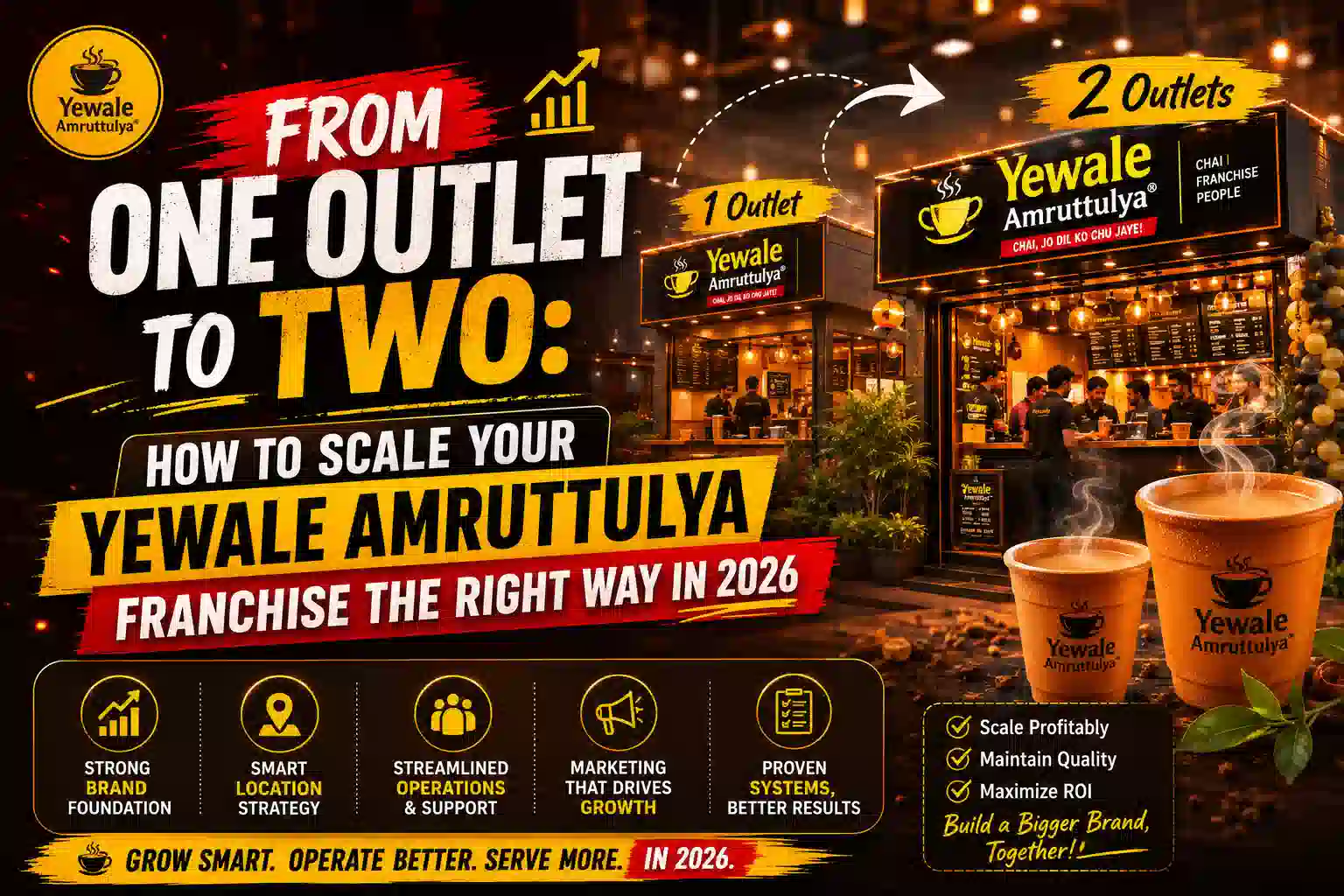
He Opened His Second Outlet Before Most People Had Even Considered Their First.
Kiran opened his first Yewale Amruttulya outlet in Sangli in February 2025. By month six, the outlet was running 280 cups a day, his staff handled the morning rush without him, and monthly profit had consistently cleared ₹95,000.
One evening, sitting outside after the evening rush wound down, he did a calculation he had been putting off.
In 16 months at this pace, his retained profit would fully fund a second outlet. No loan. No outside investor. No financial risk beyond what his own business had already validated.
He opened Outlet 2 in October 2025, near a college campus four kilometres from the first. The same brand. The same system. A different neighbourhood of customers who had never had a Yewale near them before.
By April 2026, his two outlets combined were generating ₹1,85,000 in monthly net profit. From ₹95,000 to ₹1,85,000. Not by working harder. By replicating a system that already worked.
Here is what the franchise expansion data for 2026 confirms: multi-unit franchisees now account for 53% of all franchise owners in India. The franchisees who scale to a second outlet consistently report that Outlet 2 becomes profitable faster than Outlet 1 because the learning curve has already been completed.
This blog walks through exactly how to go from one Yewale outlet to two: when the right time is, how to fund it without debt, what mistakes to avoid, and what the economics of running two outlets look like in real numbers.
Why Multi-Unit Ownership Is the Single Biggest Wealth-Building Move in Franchising
In 2026, multi-unit franchisees account for 53% of all franchise operations in India, according to StartupTalky's 2026 franchise analysis. That figure tells you something important: the people who have actually run a franchise for a year or more are choosing to add more outlets, not exit the business. This is the clearest possible signal that expansion economics are real.
Research from the International Franchise Association's 2026 investment strategy report confirms why: multi-unit operations create 15% to 35% margin improvement through operational leverage and fixed-cost spreading. The skills, supplier relationships, and operational habits you built at Outlet 1 do not need to be rebuilt at Outlet 2. They replicate.
Why a Tea Franchise Specifically Scales Better Than Most Food Businesses
A tea franchise scales better than most food businesses for one structural reason: the product quality lives in the centrally standardized recipe and supply chain, not in a person. When you open Outlet 2, you are not searching for a second skilled chef, training a second kitchen team, or developing a second menu. You are placing the same system in a new location and watching it produce the same results.
The Most Important Question: When Are You Actually Ready?
The most common and most costly mistake in franchise expansion is moving too early. Opening Outlet 2 before Outlet 1 is genuinely self-sustaining means you are attempting to replicate a system that has not yet been fully mastered. The result is two struggling outlets instead of one strong one.
Franchising.com's 2026 multi-unit expansion analysis puts the signal clearly: 'The moment when systems are repeatable, leadership structures are in place, and performance becomes predictable is what turns a single-unit owner into a growth-minded operator.' All three conditions must be present. Here is a practical checklist.
| Readiness Signal | What to Check | Green Light Threshold |
| Consistent revenue | Are your last 3 months of revenue stable or growing? | Less than 10% swing month-to-month for 90 days |
| Break-even confirmed | Has your initial ₹7 to 8 lakh investment been recovered? | Full investment recovered from operating profit |
| Staff runs without you | Can your outlet operate for a full day without you present? | Yes, with zero quality incidents |
| Training system documented | Is your training process written down and repeatable? | A new hire can be fully trained from a written process alone |
| Supply chain reliable | Are ingredients and snacks arriving consistently on schedule? | No stockout incidents in the last 60 days |
| Financial tracking in place | Do you know your exact monthly cost, revenue, and profit? | You can quote all three without checking notes |
| You feel bored, not stressed | Is Day 60 operationally calmer than Day 10? | The outlet runs on routine, not on crisis management |
If you can tick every row in that table with genuine confidence, you are ready. If any row gives you pause, address that specific weakness before committing to Outlet 2. A premature expansion that damages Outlet 1 is far worse than a delayed expansion that protects it.
How the Zero-Royalty Model Funds Your Second Outlet From Within
Because there is no royalty fee leaving the business each month, profit accumulates significantly faster at a Yewale outlet than at a typical franchise charging 5% to 8% of revenue. Here is what that accumulation looks like for a mid-footfall outlet over 18 months, assuming profit is deliberately set aside for expansion.
| Month | Est. Net Monthly Profit (Mid-Footfall) | Cumulative Savings if Reinvested | Milestone |
| Month 6 | ₹60,000 to ₹80,000 | ₹3.6 to 4.8 lakh | Investment recovery midpoint |
| Month 9 to 10 | ₹75,000 to ₹1,00,000 | ₹6.75 to 9 lakh | Full investment recovered |
| Month 12 | ₹80,000 to ₹1,05,000 | ₹9.6 to 12.6 lakh | Second outlet deposit fundable from profit |
| Month 15 | ₹85,000 to ₹1,10,000 | ₹12.75 to 16.5 lakh | Second outlet fully self-funded |
| Month 18 | ₹90,000 to ₹1,15,000 | ₹16.2 to 20.7 lakh | Second outlet opened, third in planning |
A Yewale franchisee at a well-positioned outlet can accumulate enough retained profit to fully fund a second outlet between months 12 and 15 of operation, without requiring any external financing. At a franchise charging 6% royalty on the same revenue, that accumulation is ₹1.44 lakh per year slower, pushing the self-funding timeline out by 2 to 3 additional months per year of operation.
What most people do not realize is this: the zero-royalty model does not just save money month-to-month. It actively accelerates the timeline to your second outlet by compounding the retained profit that a royalty would have consumed. Over 18 months, the difference can represent a meaningful portion of an entire second outlet investment.
The Economics of Two Outlets: What the Numbers Actually Look Like
| Factor | Outlet 1 (Established) | Outlet 2 (Ramp-Up, Month 6) | Combined |
| Monthly revenue | ₹2,00,000 | ₹1,20,000 | ₹3,20,000 |
| Operating costs | ₹84,000 | ₹75,000 | ₹1,59,000 |
| Monthly net profit | ₹1,16,000 | ₹45,000 | ₹1,61,000 |
| Annual income | ₹13,92,000 | ₹5,40,000 | ₹19,32,000 |
| Growth vs single outlet | +₹5,40,000/year extra | ||
| Outlet 2 investment | ₹7 to 8 lakh | Funded from Outlet 1 retained profit |
The combined annual income of ₹19,32,000 represents a 39% increase over a single-outlet income, achieved with an investment in Outlet 2 that was funded entirely from Outlet 1's retained profit. No new external capital. No loan interest. No additional equity risk beyond what the business had already self-validated.
By month 12 of Outlet 2's operation, as it reaches full performance matching Outlet 1, the combined annual income shifts toward ₹24 to 26 lakh. This is the compounding effect of franchise replication that multi-unit operators consistently point to as the primary wealth-building mechanism in franchising.
How to Choose the Right Location for Outlet 2
The Most Important Rule: No Catchment Overlap With Outlet 1
Your first outlet has built loyalty in a specific radius of streets, offices, and residential areas. Outlet 2 must serve a genuinely different catchment. Two Yewale outlets within easy walking distance of each other do not double your income. They split it.
Map your Outlet 1 customer base honestly: which direction do most regulars come from, and what is the furthest anyone walks? Then look for Outlet 2 locations that begin where that radius ends. Different footfall pool, different opportunity.
Location Type Diversification: The Smart Expansion Strategy
If your first outlet is near a residential market, your second outlet works well near an IT park or office complex. If your first serves a college crowd, your second targets a mid-age office demographic. Different location types create two largely independent revenue streams that do not compete with each other even within the same city.
What the 2026 Market Data Says About Expansion Zones
For franchisees already in a Tier 2 city, Francorp India's 2026 franchising industry report identifies Tier 2 and Tier 3 expansion as the dominant F&B franchise growth zone. Opening a second outlet in the same city is a lower-risk starting point than crossing into a new city — you already understand the local market, have supplier relationships in place, and carry some word-of-mouth recognition that will carry to the second location.
The Staff Transition: Build a Team for Outlet 2 Without Weakening Outlet 1
The instinct is to take your most trusted staff member from Outlet 1 and put them at Outlet 2 as a foundation. This feels logical. It is almost always a mistake.
Your Outlet 1 team has built the habits, the speed, and the customer relationships that make Outlet 1 work. Moving your best person disrupts all three simultaneously. Loyal regulars notice immediately. Your remaining staff's confidence drops. Quality consistency takes a hit at the exact moment you need Outlet 1 to be self-sustaining.
The correct approach: train a new hire for Outlet 2 from your documented system. Your training process has already been proven at Outlet 1. Apply it again, with you more directly present for the first two weeks of Outlet 2's operation. Keep your Outlet 1 team intact and undisturbed.
The 5 Most Common Expansion Mistakes and How to Avoid Them
| Common Mistake | What Actually Happens | What to Do Instead |
| Opening Outlet 2 before Outlet 1 is stable | Both outlets underperform; owner is stretched across two crises simultaneously | Wait until Outlet 1 runs independently for at least 60 full days without owner involvement |
| Choosing a location near Outlet 1 | Both outlets compete for the same catchment, cannibalizing each other's regulars | Map a different neighbourhood, office cluster, or zone with no catchment overlap |
| Moving your best staff to Outlet 2 | Outlet 1 quality drops; loyal regulars notice within days | Train a new hire for Outlet 2 from your documented system; keep Outlet 1 team intact |
| Underestimating Outlet 2 ramp-up | Month 1 at Outlet 2 is compared to Month 10 at Outlet 1, creating unnecessary panic | Expect 60 to 90 days for Outlet 2 to reach Outlet 1's mature performance level |
| Not telling Outlet 1 regulars about Outlet 2 | A natural word-of-mouth source is left completely untapped | Tell your most loyal regulars personally — they become ambassadors for the new location |
The Mindset Shift That Separates Successful Multi-Unit Operators
Research consistently shows the transition from single-unit to multi-unit operator requires a specific mental shift. Franchising.com's 2026 expansion guide describes it directly: the operator must move from being the person who does the work to being the person who oversees the system. At two outlets, no individual can be physically present at both simultaneously. The system, not the individual, must drive quality.
This means your training documentation, supply chain reliability, and staff's ability to execute without supervision are not just nice-to-haves at two outlets. They are the foundational requirement. Everything the Yewale chef-less model delivers, standardized recipes, centrally supplied ingredients, process-based training, was designed precisely to make this transition possible.
What Two Outlets Do for Your Long-Term Wealth Position
In 2026, FranchiseBazar's franchise ROI analysis confirms that earnings for low-investment QSR formats plateau quickly at a single unit. Two outlets do not simply double that income: they multiply it, because the second outlet adds revenue with proportionally lower overhead since training systems, supplier relationships, and operational knowledge are already in place.
After two outlets stabilize, the conversation about Outlet 3 typically starts around month 18 of Outlet 2. The same math applies again. Outlet 2's retained profit funds Outlet 3's investment. The cycle compounds. The operators who build real long-term wealth through franchising are almost universally multi-unit operators, not because they took more risk, but because they applied a proven system to a new location and let it compound.
Start building your first outlet today, with your second already in mind. Explore the Yewale Amruttulya tea franchise under 8 lakhs and see how the zero-royalty model funds your expansion from within.
Key Takeaways
- 53% of franchise owners in India are multi-unit operators in 2026: The people with real franchise experience are choosing to expand, not exit. This is the strongest signal that expansion economics work.
- The readiness threshold is specific: Outlet 1 must run without your direct presence for a full day without quality incidents. Systems repeatable, leadership in place, performance predictable.
- Zero royalty accelerates the expansion timeline: A 6% royalty delays self-funded expansion by 2 to 3 months per year of operation. Yewale's model means Outlet 2 can be funded from Outlet 1's retained profit in 12 to 15 months.
- Combined income at two outlets grows 39% and above: Outlet 2 in ramp-up adds ₹5.4 lakh annually at minimum. At full performance, combined income approaches ₹24 to 26 lakh with ongoing growth as both outlets mature.
- Location choice is the most important Outlet 2 decision: No catchment overlap with Outlet 1. Different neighbourhood, different customer profile, ideally a different location type to diversify income sources.
- Never weaken Outlet 1 to staff Outlet 2: Keep your Outlet 1 team intact. Train a new team for Outlet 2 from the same documented process that built your first team.
- The system is what scales, not the individual: The transition from single-unit to multi-unit owner is a mindset shift from doing to overseeing. The chef-less standardized model is built to make this transition possible.
Kiran is scouting locations for Outlet 3. He expects to open it by October 2026, funded from the combined retained profit of Outlets 1 and 2.
He still visits both outlets every day, but not to run them. He visits to confirm the system is working and to greet the regulars he built relationships with in year one. The system makes the chai. He makes the decisions.
If your outlet became self-sustaining tomorrow and you could open a second one in 12 months using only your own retained profit, which neighbourhood in your city would you choose first, and why?
