
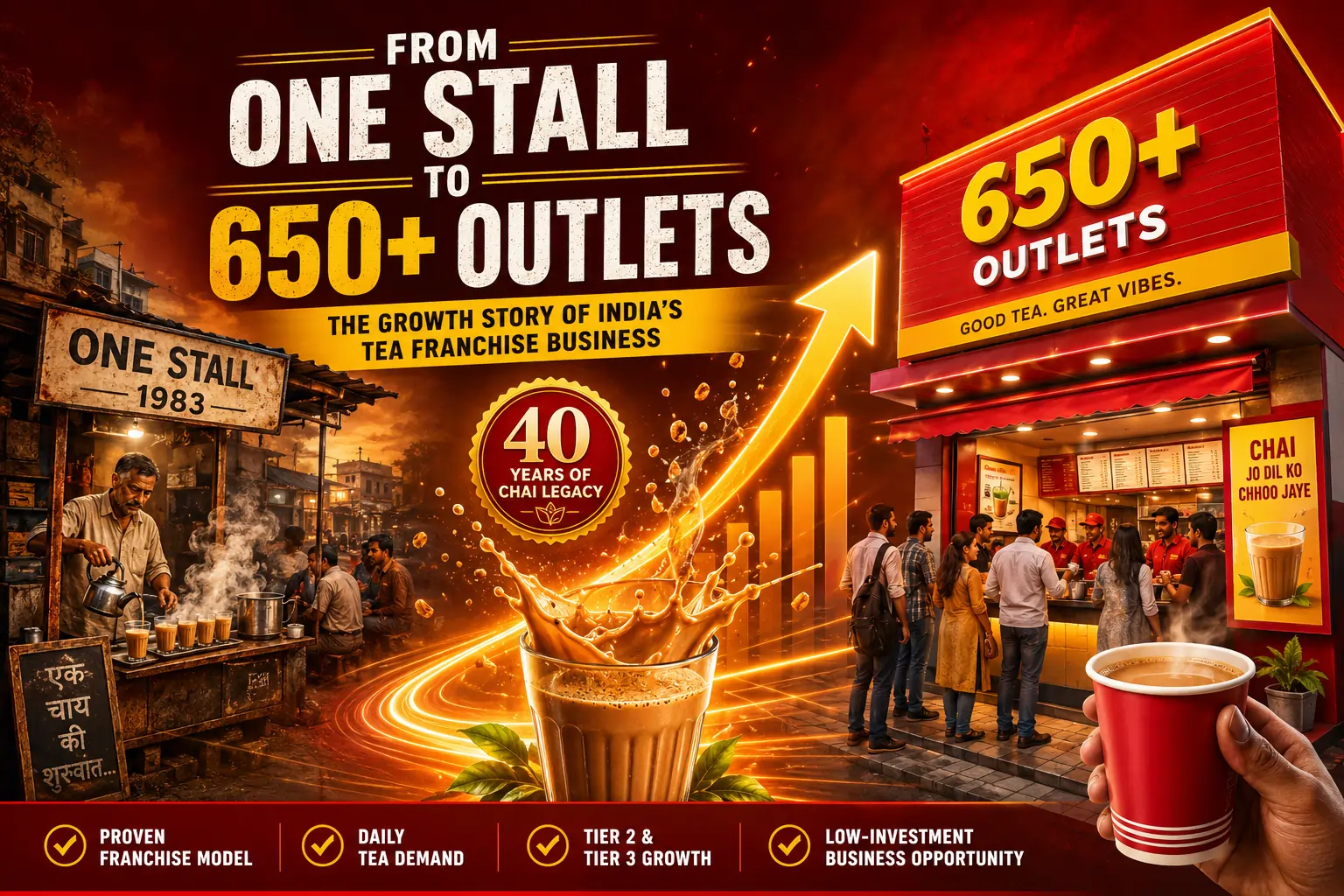
A Small Stall. A Big Idea. And 40 Years of Chai.
It is 1983. Pune is a quieter city. There are no tech parks, no flyovers, no franchise consultants. There is just a small chai stall and a man who makes tea the way his family always has, with real milk, fresh ginger, and spices that fill the lane with a smell that makes people slow down and stop.
One cup. Two cups. A handful of regulars every morning. Word spreads the way it always does in a Pune galli: through taste.
Fast forward to today. That same stall has become a network of over 650 outlets. It has 16 lakh loyal customers. It operates in Maharashtra, across Tier 2 and Tier 3 cities, and it is still expanding with 200 new outlets planned for 2025 alone.
The brand is Yewale Amruttulya. And its journey from a single tapri to one of India's most recognized tea franchises is not just a success story. It is a masterclass in what works in the tea business in India.
Here is the surprising truth: behind every great tea franchise in India is not a big investment or a complicated model. It is a simple product, done right, every single day, for decades.
This blog breaks down exactly what that growth looks like, why it happened, and what it tells every aspiring entrepreneur about the tea business opportunity in India right now.
The Tea Business in India Is Bigger Than Most People Realize
India is the second largest tea producer in the world and one of its largest consumers. But most people think of the tea business as a small, informal sector: roadside stalls, daily vendors, and home brewing. The organized tea café and franchise space tells a completely different story.
| Market Indicator | 2024 / 2025 Value | Projected Growth |
| India tea market value | USD 12,140 million (2025) | USD 20,459 million by 2033 (CAGR 6.8%) |
| India cafes and bars market | USD 18.83 billion (2025) | USD 31.47 billion by 2031 (CAGR 8.92%) |
| India organized QSR sector | INR 674.4 billion (FY 2024) | INR 1,270 to 1,311 billion by FY 2028 |
| India franchise industry | INR 9,00,000 crore (2025) | INR 11,50,000 crore by 2027 (CAGR 30%) |
| New tea franchises in Tier 2 and 3 | 65% of all new outlets (2024-25) | Primary growth zone for next decade |
The numbers paint a clear picture. Tea is not a shrinking, informal market. It is a growing, organized, high-margin business sector that is still in its early phases of franchising. The window is open, and it is wide.
What Most Articles on the Tea Business Miss
Most content about the tea franchise industry focuses on investment costs and profit margins. Those numbers matter. But they miss the deeper reason why tea franchises in India succeed at a rate that food businesses generally do not.
Tea is a daily consumption product. It is not a treat, a luxury, or an occasional meal. It is something most Indians have two to three times every day, regardless of income, season, or economic climate. That daily habit is what gives a tea outlet a floor of guaranteed footfall that most other F&B businesses never have.
A restaurant has good days and slow days. A tea stall has morning rush and evening rush, every day, every week, every year. That consistency is the foundation on which Yewale Amruttulya built an empire of 650 outlets.
The Growth Timeline: How One Stall Became 650+ Outlets
Growth like this does not happen by accident. It happens because a model works, and people who see it working want to replicate it. Here is how the Yewale Amruttulya story unfolded across four decades.
| Year | Milestone | What It Proves |
| 1983 | First chai stall opens in Pune | Authentic Maharashtrian chai finds its audience |
| 2000s | First franchisee partners join | The model is replicable beyond the founder |
| 2015+ | 100+ outlets across Maharashtra | Strong regional brand trust established |
| 2020-22 | Expansion through pandemic years | Chai is recession-proof and demand is daily |
| 2024 | 650+ outlets, 295 in Maharashtra alone | One of India's widest tea franchise networks |
| 2025 | 200 new outlets planned in Tier 2 and 3 cities | Next growth phase already in motion |
What the timeline above shows is not a sudden spike. It is slow, steady, compounding growth built on one consistent product: authentic Maharashtrian chai. No sudden pivots. No brand overhauls. Just the same tea, made better every year, served to more people every year.
The Detail That Most Growth Stories Skip: The Franchise Model Itself
Many tea brands have grown quickly on paper. But the model that sustains growth is what separates a brand from a business. Yewale Amruttulya's franchise structure has three features that directly explain its expansion.
- Zero royalty: Franchisees pay no ongoing percentage of revenue to the brand. Every rupee earned stays with the outlet owner. This is unusual in franchising and it is a direct reason why Yewale franchisees invest in their own growth.
- Chef-less operation: No cooking required. No skilled kitchen staff needed. The entire operation is designed so that a first-time business owner can run a profitable outlet from week one.
- Full support system: Location selection, setup, operations training, and supply chain are all handled centrally. Franchisees are not left to figure things out alone.
These three features together make Yewale a genuinely accessible franchise for people who want to own a business but do not have a food industry background. And that accessibility is what drives the network expansion. When a franchise model is easy to operate and profitable from early on, word travels fast.
Why Tea Specifically Works as a Franchise Business in India
The tea business in India is different from most food and beverage categories in one fundamental way: the customer comes to you. You do not need aggressive marketing to create demand. Demand already exists. Your job is simply to be the best option available when the customer wants their next cup.
The India tea market stood at USD 11,702 million in 2024 and is on track to reach USD 17,934 million by 2033. More importantly, tea is consumed by over 88% of Indian households as a daily habit, not an occasional choice.
That 88% figure is what makes tea different from almost every other franchise category. A coffee shop targets a specific urban, aspirational customer. A juice bar targets health-conscious consumers. A tea outlet targets everyone, every day.
The Recession-Proof Argument for Tea
Here is a pattern worth understanding. When household budgets get tight, discretionary spending drops. Restaurant meals, movie outings, and premium groceries all take a hit. But chai does not. In fact, during economic slowdowns, the neighborhood tea stall often sees higher footfall, because people cut down on expensive coffee and dining but they do not cut down on chai.
This behavior is not unique to India. Beverage habits, especially warm beverage habits, are among the most resistant to economic pressure. They are small, affordable, and tied to deeply ingrained routines. Yewale grew through the pandemic years precisely because of this. When restaurants closed and malls emptied, the chai outlet with its small footprint and daily regulars continued to operate and serve.
The Next Chapter: Why Tier 2 and Tier 3 Cities Are the Real Opportunity
The story of India's tea franchise growth is not playing out in Mumbai, Delhi, and Bengaluru. It is playing out in Nagpur, Nashik, Aurangabad, Kolhapur, Solapur, and hundreds of smaller cities and towns where the demand for branded, consistent chai is growing fast but the organized supply has barely arrived.
Tier 2 and Tier 3 cities are projected to contribute 45% of India's GDP growth by 2025. More specifically for the tea franchise sector, over 65% of all new profitable tea franchise outlets in 2024 to 2025 opened in Tier 2 and Tier 3 locations, not in metro cities.
The reason is straightforward. Metro cities have high rent, intense competition, and customers with many beverage choices. Smaller cities have lower operating costs, less competition from organized brands, growing middle-class incomes, and a deeply chai-drinking population that currently has few quality branded options to choose from.
What This Means for a First-Time Franchise Investor
If you are considering a tea shop franchise in India and you are based in a city with a population between 5 lakh and 30 lakh, you are looking at one of the best market conditions possible. You are early enough to build a loyal customer base before the market fills up. The cost to enter is lower. The daily footfall potential is high. And the brand support infrastructure from a 40-year-old franchise network gives you a massive head start over someone building from scratch.
- Lower entry cost: Setting up in a Tier 2 or 3 city costs significantly less in rent and fit-out compared to a metro location.
- Less organized competition: Most smaller cities still rely on unbranded local stalls for chai. A Yewale outlet offering consistent quality stands out immediately.
- High chai consumption base: Tea culture in smaller Maharashtrian and North Indian cities is often stronger than in metros. The daily habit is even more entrenched.
- First-mover recognition: In a city where no branded tea chain has arrived yet, the first quality outlet builds a loyal base that is very hard for later entrants to displace.
Want to be part of this growth story? Explore the Yewale Amruttulya tea franchise under 8 lakhs and take your first step toward owning a proven tea business.
5 Lessons That Yewale Amruttulya's Growth Teaches Every Tea Entrepreneur
1. Consistency Beats Creativity Every Time
Yewale did not grow by reinventing chai every season. It grew by making the same authentic chai, the same way, at every outlet, every day. Customers do not visit a tea stall because it offers something new. They visit because they know exactly what they are going to get. Consistency is the product.
2. Authenticity Has a Longer Shelf Life Than Trends
While many food businesses chase the latest trend, Yewale stuck with what it knew: Maharashtrian chai culture. That authenticity resonated with customers in 1983, and it resonates with their children and grandchildren today. Cultural rootedness is a competitive advantage that no new entrant can buy overnight.
3. The Right Model Multiplies Faster Than the Best Product
Yewale's chai is excellent. But what really powered the growth from 1 to 650+ outlets was not the recipe. It was the franchise model: zero royalty, chef-less operations, and full support. A great product with a hard-to-replicate model will always expand faster than a great product alone.
4. Chai Is a Daily Business, Not a Weekend Business
The outlets that earn the most are not in malls or tourist areas. They are near offices, colleges, hospitals, and residential areas where the same people come back every single day. When your customer base is daily habit-driven rather than occasion-driven, your revenue has a natural floor that most businesses envy.
5. Smaller Cities Are Not a Backup Plan. They Are the Main Plan.
The next 200 outlets are not going to Tier 1 cities. They are going to Tier 2 and Tier 3 cities. This is a deliberate strategic decision based on where the demand is underserved and where the economics are most favorable for franchisee success. If you are an entrepreneur in a smaller city, you are exactly who this expansion is designed for.
The Business Case: Why a Tea Franchise Under 8 Lakhs Makes Sense in 2025
Let us be direct about the investment picture. Starting any food business from scratch involves sourcing a brand, building a menu, creating systems, training staff, and marketing to build a customer base. All of that takes money, time, and energy, and it still carries significant risk.
A tea franchise under 8 lakhs changes that equation entirely. You step into a business that already has:
- Brand recognition: 40+ years of Yewale Amruttulya's name does marketing for you before you open your door.
- A proven menu: 25+ products that have already been customer-tested across 650 outlets. No guesswork on what to serve.
- Supply chain support: Ingredients and snacks supplied centrally with consistent quality. No sourcing stress.
- Operational training: Complete setup support so you are ready to run profitably from day one.
- Zero royalty: Unlike most franchises that take 5% to 10% of your revenue, Yewale takes nothing. Every rupee you earn is yours.
The India franchise industry is expected to grow from INR 9,00,000 crore to INR 11,50,000 crore by 2027 at a CAGR of 30%. Inside that growth, the tea and beverage category offers one of the lowest barriers to entry and one of the highest consistency of daily demand. That combination does not appear often in entrepreneurship.
What most people do not realize is that the best time to join a growing franchise network is not when it is already everywhere. It is when it has proven itself in one market and is actively expanding into yours.
Key Takeaways
- 40 years of proof: Yewale Amruttulya's journey from a single Pune stall to 650+ outlets is one of the most consistent growth stories in Indian food franchise history.
- Market timing is right: India's tea market, café sector, and organized QSR industry are all growing simultaneously. The window for low-investment entry is now.
- Tier 2 and 3 cities are the opportunity: Over 65% of new profitable tea franchises are opening in smaller cities. Lower cost, less competition, and high chai demand make this the priority zone.
- Daily habit equals daily revenue: Tea is consumed multiple times a day by 88% of Indian households. No other F&B category offers that kind of guaranteed, recurring footfall.
- The model matters as much as the product: Zero royalty, chef-less operations, and full support make Yewale a franchise that a first-time business owner can run successfully from the start.
- You are not just buying a tea stall: You are buying into 40 years of brand trust, a proven operational system, and a network of 650+ outlets that validates the model every single day.
The story of Yewale Amruttulya is really the story of what happens when a great product meets a model that lets other people replicate it. The chai was always good. The genius was making it possible for hundreds of entrepreneurs to serve that same chai, in their own cities, under their own roofs, with their own growing customer bases.
That story is still being written. And the next chapter is being opened in a city very much like yours.
If you could open a tea outlet in your city tomorrow with 40 years of brand trust behind you, a proven daily-revenue model, and zero royalty fees, what would be the one thing holding you back?
