
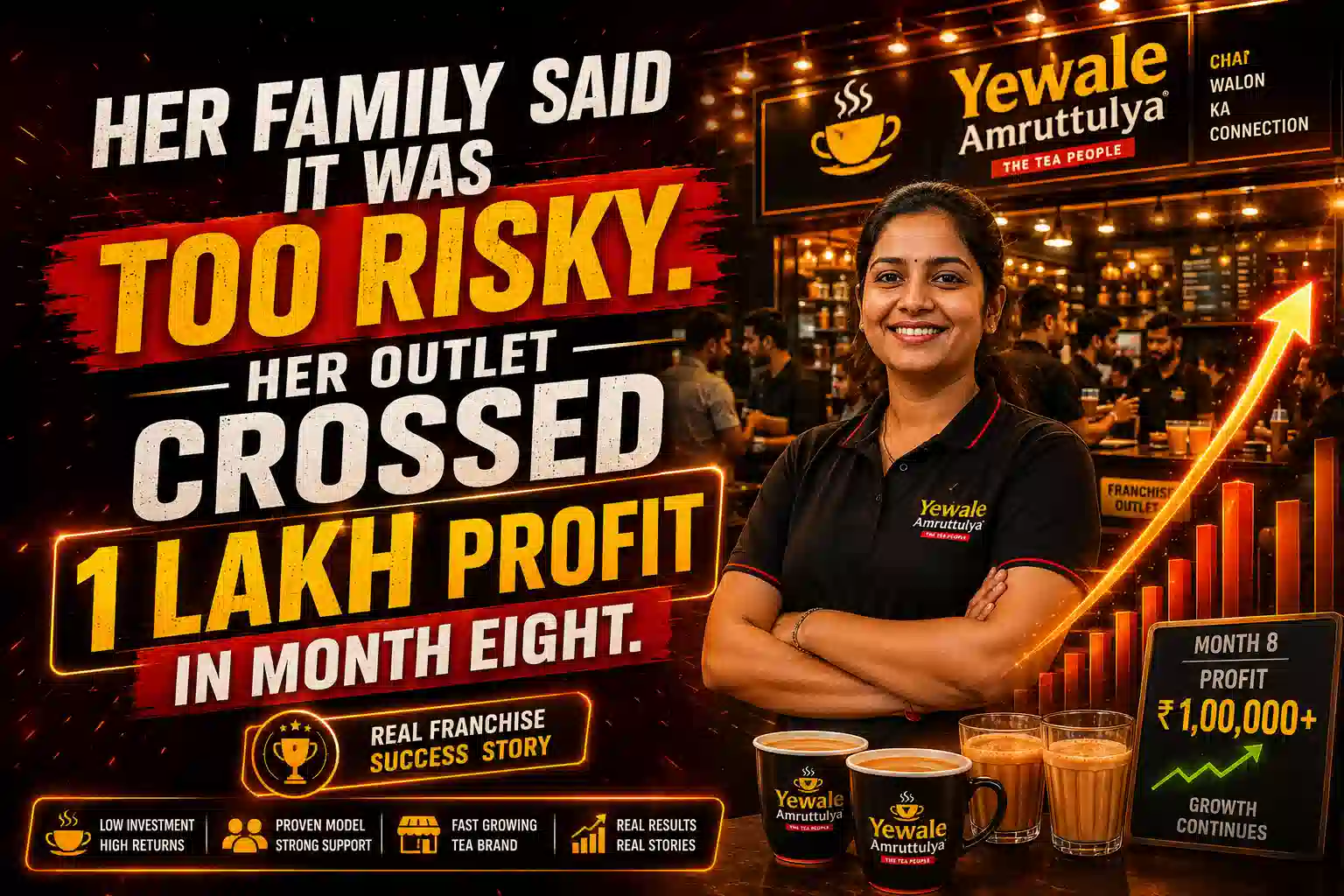
She Had Never Run a Business. Her Family Was Worried. She Was Not.
Savita had worked as a school receptionist in Osmanabad for eleven years. At 36, she had savings of 6.5 lakh, a clear head, and a question she could not stop asking herself: if I am going to spend the next twenty years working, why not spend them building something that is mine?
Her husband was supportive but nervous. Her mother-in-law was direct: a business is not for women like you. You have no experience. You do not know cooking. What will you sell?
What Savita sold was chai. And Bakarwadi. And Cream Rolls. And Cold Coffee when the summer came.
She opened a Yewale Amruttulya outlet near the district government offices in Osmanabad. Month one was slow and educational. Month three she cleared 65,000 in profit. Month eight she crossed 1 lakh. By her first anniversary, she was evaluating a second location.
Her mother-in-law visits the outlet every Tuesday now. She orders Yewale Special and Bakarwadi. She tells the regulars it was her idea.
Here is what the 2026 data on women entrepreneurship in India confirms: women-led businesses deliver 35% higher ROI than male-led counterparts. Women have better loan repayment rates. And the franchise model specifically removes the structural barriers that historically kept women out of food business ownership. In 2026, women-led franchises have become the fastest-growing investment trend in India's franchise sector.
This blog explains why a Yewale Amruttulya tea franchise is one of the most well-suited business opportunities available to women entrepreneurs in India right now, what the data shows, what government schemes are available, and what the real first-year experience looks like.
The State of Women Entrepreneurship in India in 2026
India has 13.5 to 15.7 million women-owned businesses that provide direct opportunities to 22 to 27 million people, according to a Google and Bain and Company report cited by Business Connect India. Women-led startups have demonstrated 35% higher ROI compared to male-led ventures, and women entrepreneurs show higher emotional resilience, faster adaptability, and stronger customer relationship-building.
Women-led businesses are estimated to grow 90% in the next five years and provide 150 to 170 million jobs by 2030, according to IBEF's women entrepreneurship analysis. Women business ownership is expected to rise from 20% to 33% of all businesses by 2030.
FranchiseBazar's 2026 report explicitly identifies women-led franchises as the fastest-growing investment trend in India's franchise sector. The franchise model, with its proven systems, structured support, and flexible operation, maps directly onto the specific strengths and constraints that women entrepreneurs navigate.
Why the Franchise Model Specifically Works for Women Entrepreneurs
The franchise model has structural advantages over independent startups. But it carries specific advantages for women that are rarely discussed in detail.
| Common Challenge | Traditional Startup Handles It | Yewale Franchise Handles It |
| No food or business experience | Expensive trial and error under financial pressure | Proven system from day one. Training provided. Chef-less model requires no food expertise |
| Difficulty raising capital | Banks require collateral and credit history | PM Mudra Yojana provides up to 10 lakh collateral-free. Franchise model qualifies readily |
| Quality inconsistency fear | Product quality varies with personal skill and daily effort | Central supply chain and standardized recipe guarantee the same quality every day |
| Time flexibility needed | Business demands constant owner presence | Staff can run the outlet independently after training. Owner presence optional post-setup |
| Isolation without a business network | Solo entrepreneur solves every problem alone | Part of 650+ outlet national network with Yewale support from Day 1 |
| Risk of losing entire investment | ~50% independent food business failure rate in 5 years | Franchise model ~4% failure rate. Brand trust reduces financial risk from the start |
Every row in that table represents a real barrier women face when starting an independent food business. The franchise model, particularly a chef-less franchise with a proven supply chain, removes or dramatically reduces each one.
Government Schemes That Can Fund Your Franchise Investment
As of early 2026, PM Mudra Yojana has disbursed over 40 lakh crore across 57 crore+ loan accounts, with approximately 60% of those loans going to women entrepreneurs, according to Barristery's 2026 government loan scheme analysis. This is the country's single largest small business funding mechanism, and it specifically prioritizes women.
| Government Scheme | What It Offers Women | Fit for a Tea Franchise |
| PM Mudra Yojana (Tarun) | Collateral-free loan up to 10 lakh for women in micro businesses | Covers a major portion of the Yewale franchise investment outright |
| PM Mudra Yojana (Kishore) | Loans from 50,000 to 5 lakh for early-stage businesses | Suitable as working capital supplement in early months of operation |
| Stand-Up India Scheme | Loans from 10 lakh to 1 crore for women starting new enterprise | Suited for high-footfall locations with slightly higher setup cost |
| Cent Kalyani Scheme | Collateral-free loan up to 1 crore for women-owned businesses | For expansion to a second outlet after Outlet 1 is stabilized |
| Udyogini Scheme | Subsidized funding for eligible women categories | Relevant for SC/ST/OBC women entrepreneurs entering food service |
The Mudra Tarun category covers loans from 5 lakh to 10 lakh. The Yewale franchise investment sits at under 8 lakh. A Mudra Tarun loan can cover a significant portion of that investment, collateral-free, at a lower rate than a personal loan. Women between 18 and 65 are eligible to apply at any nationalized bank, or online at mudra.org.in.
What most women considering a franchise investment do not realize is this: a 7.5 lakh franchise investment funded partly by a 5 lakh Mudra Tarun loan means the out-of-pocket requirement can be as low as 2.5 to 3 lakh. Government schemes have effectively co-invested in women's entrepreneurship. The personal financial risk is dramatically lower than most people assume.
Why This Specific Franchise Is Well-Suited for Women Entrepreneurs
No Cooking Experience Required
The single largest perceived barrier for women considering a food franchise is the assumption that they must know how to cook. A Yewale Amruttulya franchise is explicitly chef-less. The product quality lives in the centrally standardized recipe and pre-supplied ingredients. No cooking training is required. A woman entrepreneur who has never worked in food can train staff in days and serve consistent quality chai from week one.
Schedule Flexibility That Most Food Businesses Cannot Offer
At a Yewale outlet, a well-trained staff team can run the counter independently. The owner sets the schedule, trains the team, and then has genuine flexibility over how much daily time she invests. For a woman managing a household, children's school schedules, or other commitments alongside a business, this flexibility is a practical requirement that the chef-less model delivers.
The Financial Independence Story That Repeats Itself
A Bain and Company and Google study found that women solopreneurs and small company owners show high resilience, adaptability, and emotional intelligence as business operators. These qualities, daily relationship-building with regulars, intuitive customer understanding, and consistent care in service delivery, are precisely the qualities that build a loyal chai outlet customer base over time.
Five Profiles: Who This Is Specifically Right For
| Franchisee Profile | Why the Yewale Model Fits | What Month 1 to 12 Looks Like |
| Homemaker entering business for first time | Chef-less model removes cooking as a barrier. Schedule can fit school timings and family routines | Month 1 to 3 hands-on. Month 4+ staff runs daily; owner oversees and builds local relationships |
| Salaried woman planning to exit corporate life | Proven system replaces corporate structure. Familiar with targets and process management | Transition manageable because franchise provides complete operational blueprint |
| Young woman in Tier 2 or 3 city | Low entry cost, first-mover advantage, strong local network benefit | Local connections accelerate customer loyalty faster than in anonymous metro markets |
| Retired or semi-retired professional | Low physical effort required. Part-time oversight model well-suited | Business generates income with minimal daily involvement after staff training is complete |
| Second income alongside family business | Near family home. Owner presence for supervision only, not daily production | Independent income stream that builds without competing with family priorities |
What all five profiles share is this: the outlet is designed to be run from a position of oversight, not constant physical labor. That design is what makes it compatible with real women's lives.
The Real Earnings Picture
| Outlet Footfall | Monthly Revenue (Est.) | Monthly Net Profit (Est.) | Break-Even Timeline |
| Low footfall (100 to 150 cups/day) | 90,000 to 1,20,000 | 35,000 to 45,000 | 16 to 20 months |
| Mid footfall (250 to 300 cups/day) | 1,80,000 to 2,10,000 | 75,000 to 1,00,000 | 10 to 12 months |
| High footfall (400+ cups/day) | 3,00,000 to 3,60,000 | 1,40,000 to 1,70,000 | 6 to 8 months |
A mid-footfall outlet generating 75,000 to 1,00,000 in monthly net profit is a consistent, achievable baseline for a well-positioned outlet. Over 12 months, that is 9 to 12 lakh in annual income from a 7 to 8 lakh initial investment. According to Yewale's own 2026 ROI analysis, this trajectory is consistent across outlets at similar footfall levels.
The Zero-Royalty Cash Flow Advantage
Most franchises charge 5% to 8% of monthly revenue as royalty. On 1,80,000 monthly revenue, that is 9,000 to 14,400 per month flowing out of the business indefinitely. Yewale charges zero royalty. Every rupee from chai and snacks stays with the franchise owner. For a woman managing personal finances alongside a business, this cash flow stability matters most in the first 12 months.
Practical Steps to Get Started in 2026
Step 1: Check Your Mudra Loan Eligibility
Visit your nearest nationalized bank with Aadhaar and PAN, or apply online at mudra.org.in. The Mudra Tarun loan application for a food franchise is a standard process. No collateral required. Processing typically takes 7 to 21 working days.
Step 2: Register Under Udyam
Udyam Registration is free, takes under 30 minutes online, and establishes your MSME status required for Mudra and other government scheme eligibility.
Step 3: Contact Yewale Amruttulya
Once funding is clear, contact Yewale's franchise team for location availability, setup timelines, and training support details. Every stage of setup is guided.
Step 4: Choose Your Location
A Tier 2 or Tier 3 city location near offices, a government complex, a college, or a busy residential market is ideal. First-mover advantage in an underserved city means building a loyal base before any organized competitor arrives.
Ready to own a business built to work around your life? Explore the Yewale Amruttulya tea franchise under 8 lakhs and take the first step toward a business that is entirely yours.
Key Takeaways
- Women-led businesses outperform: 35% higher ROI. Better loan repayment rates. Strong resilience. Women entrepreneurs are the fastest-growing segment of India's franchise sector in 2026.
- Government funding reduces personal risk: PM Mudra Yojana has disbursed 40 lakh crore to 57 crore+ borrowers with 60% going to women. A 5 to 10 lakh collateral-free loan can fund a significant portion of the franchise investment.
- Chef-less removes the biggest perceived barrier: No cooking experience required. Any motivated person can run this outlet. The product quality lives in the centrally standardized system, not in the owner's skill.
- Schedule flexibility is structurally built in: A trained staff team can run the counter independently. Owner presence is optional after the setup period. This is the only food business format that genuinely accommodates real women's lives.
- Zero royalty matters more for women managing cash flow: Every rupee saved from royalty stays in the business. Over 12 months that is 1 to 1.7 lakh retained compared to a 6 to 8% royalty model.
- Mid-footfall outlets earn 75K to 1L monthly from month three or four onwards: Full investment recovery in 10 to 12 months. Second outlet fundable from retained profit in 12 to 15 months.
Savita crossed 1 lakh in monthly profit in month eight. By month fourteen she signed her second franchise agreement for a location near the new school complex coming up in the next district.
Her mother-in-law no longer offers opinions about what businesses are and are not for women like Savita. The outlet answers that question on its own.
If the only thing standing between you and a business that is entirely yours is the belief that you need the right background or the right amount of savings, what would change for you if you discovered that neither of those is actually required?
