
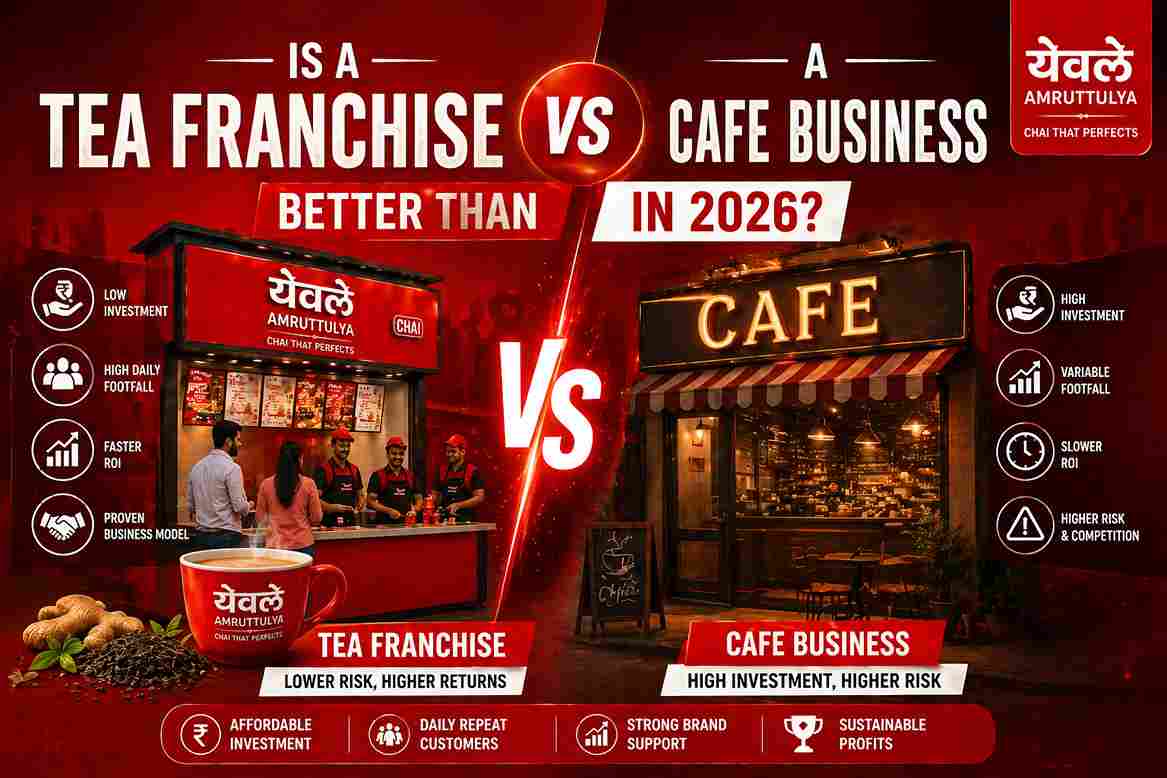
Two Doors on the Same Street
Indore. A Tuesday morning in January 2026. A main road in a mid-income commercial neighborhood, the kind that has a pharmacy, a stationery shop, a mobile repair counter, and somewhere in between, two businesses that opened within a month of each other.
On the left is a cafe. The kind that photographs well. Exposed brick on one wall, Edison bulbs overhead, a handwritten menu on a chalk board. The owner spent fourteen months planning it, eight months setting it up, and a significant portion of his savings furnishing the interior. It seats twenty-four people. It opens at 10 AM.
On the right is a Yewale Amruttulya outlet. A compact counter, clean branding, two staff members, and a gas burner that has been running since 6:45 that morning. It does not seat anyone. People stand, drink, and leave.
At 9:15 AM, the cafe is locked. The owner is still commuting.
At 9:15 AM, the tea counter has already served sixty-two cups.
Neither business is doing anything wrong. They are simply built around two completely different theories of how people spend money on beverages. And in 2026, those two theories are producing very different financial results.
The question is not which one looks better. It is which one works better, and why.
The Cafe Dream vs. the Chai Reality
Between 2018 and 2024, India saw an extraordinary boom in cafe culture. Specialty coffee, artisanal brewing, third-wave aesthetics. Thousands of entrepreneurs, many of them young and urban, opened independent cafes in Tier 1 and Tier 2 cities. The Instagram appeal was undeniable. The financial performance, on average, was considerably more complicated.
Industry data from the hospitality sector suggests that nearly sixty percent of independent cafes in India do not cross the three-year mark. The primary reasons are consistent: high real estate costs, high staff-to-revenue ratios, long break-even timelines, and a customer base that visits infrequently and is easily drawn away by the next new thing.
Meanwhile, the organized tea retail segment has been growing at twelve to fifteen percent annually. Tea remains India's most consumed beverage by a wide margin. Approximately eighty percent of Indian households drink chai daily. That is not a trend. That is a structural reality of how this country starts its day.
In 2026, with inflation compressing household discretionary spending, the gap between aspirational cafe visits and habitual chai purchases has widened further. Consumers are making fewer deliberate decisions to spend and more automatic decisions based on ingrained habit. Chai is almost always on the automatic side of that line.
A cafe sells an experience people choose occasionally. A chai franchise sells a habit people follow daily. These are not the same kind of business.
Why This Comparison Matters More in 2026 Than It Did Before
The cafe versus chai franchise question is not new. But the context around it has shifted in ways that change the answer more decisively than before.
Three mechanisms are worth understanding clearly.
The first is the Cost of Aspiration. Cafes operate in a segment where customers are buying more than a beverage. They are buying a feeling: comfort, status, a pause from routine. This is a powerful sell, but it is vulnerable. When economic conditions tighten, aspirational spending is the first category to contract. The customer who visited the cafe four times a month reduces to twice, then once. The customer who drinks chai every morning does not reduce at all. The habit has no affordable substitute.
The second is the Real Estate Equation. A functioning cafe in a decent location in a Tier 2 city requires a minimum of three hundred to five hundred square feet of usable space. Monthly rent on this, depending on the city and zone, runs between thirty thousand and one lakh rupees. A Yewale counter can operate from forty to eighty square feet. The same location that would cost a cafe owner seventy thousand rupees per month costs a tea franchise operator a fraction of that. This is not a minor difference. Over a five-year lease, it is the difference between profit and a financial drain.
The third is the Velocity of Return. A cafe investment of fifteen to twenty-five lakh rupees, at realistic revenue levels, takes two to four years to return the principal. A tea franchise at three to five lakh rupees, at documented daily volumes, returns the investment in six to ten months. The first year of cash flow surplus for a cafe owner is often year three or four. For a tea franchise owner, it is year one.
The business you can sustain for three years without a return is very different from the business that returns your money in ten months.
Five Differences That the Business Plans Do Not Show You
1. The Investment Gap Is Much Wider Than It Appears
When someone lists the startup cost of a cafe at fifteen lakh, they are often counting furniture, kitchen equipment, and the first month's rent. What gets left out is the cost of the months before the business reaches operational stability: staff salaries during the setup phase, marketing spend to build initial footfall, the revenue shortfall while the customer base is being built.
A realistic total cost for a mid-size independent cafe in a Tier 2 city, including setup and the first six months of losses, frequently lands between twenty and thirty lakh rupees. By contrast, the all-in cost of a Yewale Amruttulya franchise, including equipment, setup, franchise fee, and initial working capital, stays within a structured and predictable range. There are no surprise months where the owner is subsidizing an empty dining room.
2. Staff Costs Are a Silent Pressure on Cafe Economics
A cafe that seats twenty-four people needs a minimum of five to six staff to run professionally: a barista or two, a kitchen helper, a cashier, a cleaner, and someone to manage floor service. In 2026, with rising labor costs in urban markets, this translates to a monthly payroll of sixty thousand to one lakh rupees before any other cost is considered.
A Yewale outlet runs on two to three staff members, sometimes two during non-peak hours. The operational simplicity of a standardized tea counter means less training, less supervision, and significantly less payroll exposure. For a first-time business owner managing cash flow carefully, this difference in staffing overhead is not small.
3. Cafe Customers Are Visitors. Chai Customers Are Regulars.
A well-run cafe in a good location might see a customer return once or twice a week. A great cafe with a very loyal following might see regulars three to four times per week. These numbers are considered strong performance in the cafe segment.
A Yewale outlet, positioned correctly, sees the same customers every single day. Some of them twice a day: once on the morning commute and once on the way back. The unit economics of a daily repeat customer versus a weekly repeat customer, applied across a customer base of two hundred people, produce fundamentally different revenue floors. The chai franchise owner has a predictable daily baseline. The cafe owner is always working to rebuild it.
4. Location Requirements Work Differently
A cafe needs what real estate agents call a destination location: a place where people are willing to walk in deliberately, sit down, and spend thirty to ninety minutes. These locations command premium rent and are genuinely scarce in Tier 2 and Tier 3 cities where the cafe culture is still developing.
A Yewale outlet needs what might be called a passage location: any point where people already move as part of their daily routine. A colony gate, a college lane, a market entry, a bus stop proximity. These locations are abundant, affordable, and often more valuable in terms of consistent daily traffic than any destination space. The franchise model is built to extract maximum value from passage locations, which is where most of the country actually lives and moves.
5. 2026 Consumer Behavior Has Shifted Toward Value
Post-pandemic spending patterns in India, reinforced by inflation pressures through 2024 and 2025, have produced a meaningful shift in how middle-income consumers allocate discretionary spending. The willingness to spend three hundred rupees on a cafe experience has not disappeared, but it has become more selective and less frequent.
Meanwhile, spending sixty to seventy rupees on chai and a snack has not changed at all, because it was never discretionary to begin with. It was routine. Routine spending is recession-resistant in a way that experience spending is not. In 2026, this distinction is more commercially significant than it was five years ago.
The 2026 Numbers: What Each Business Actually Returns
Scenario A: An independent cafe in a mid-traffic zone of a Tier 2 city. Investment: twenty to twenty-five lakh rupees. Average monthly revenue after reaching operational stability at month six: five to seven lakh rupees. Monthly operating costs including rent, staff, ingredients, utilities, and marketing: four to five lakh fifty thousand rupees. Net monthly surplus: fifty thousand to one lakh rupees. Time to recover the original investment: three to four years.
Scenario B: A Yewale Amruttulya franchise in a comparable zone of the same city. Investment: three to five lakh rupees. Average monthly revenue from month three onward: four lakh fifty thousand to five lakh fifty thousand rupees. Monthly operating costs: two lakh to two lakh eighty thousand rupees. Net monthly surplus: one lakh seventy thousand to two lakh fifty thousand rupees. Time to recover the original investment: six to ten months.
The cafe generates a higher gross revenue in absolute terms, but the gap between revenue and profit is far thinner because the cost base is so much heavier. The franchise generates a lower gross revenue but a significantly higher net margin relative to investment, and it does so in a fraction of the time.
For someone with four to five lakh rupees in savings and a goal of building a sustainable income-generating business, the risk-adjusted return on the franchise model is not just better. In 2026, it is substantially better.
Revenue on paper is not the same as money in hand. The gap between the two is where most cafe businesses disappear.
Tea Franchise vs Cafe: Head to Head
A direct comparison across the factors that actually determine long-term business viability:
| Factor | Cafe Business | Tea Franchise (Yewale) | Edge |
| Startup Investment | 10 – 30 lakh | 3 – 5 lakh | Tea Franchise |
| Break-Even Timeline | 24 – 48 months | 6 – 10 months | Tea Franchise |
| Daily Operating Hours | 8 – 10 hrs (peak dependent) | 12 – 14 hrs (stable all day) | Tea Franchise |
| Customer Visit Frequency | 1 – 3 times per week | 5 – 7 times per week | Tea Franchise |
| Avg. Ticket Size | 250 – 600 per visit | 55 – 75 per visit | Cafe (per visit) |
| Revenue Reliability | Moderate (trend-sensitive) | High (habit-driven) | Tea Franchise |
| Staff Requirement | 5 – 12 people | 2 – 4 people | Tea Franchise |
| Real Estate Dependency | High (large footprint) | Low (compact counter) | Tea Franchise |
| Scalability | Slow, capital-heavy | Fast, system-driven | Tea Franchise |
| Seasonal Variance | High (footfall dips) | Low (chai is year-round) | Tea Franchise |
Figures are based on realistic market estimates for Tier 2 city operations in 2026. Individual results vary by location, execution, and market conditions.
What the Indore Street Tells You, If You Watch It Long Enough
By 11 AM on that Tuesday, the cafe has opened. A couple of college students are inside, working on laptops. The ambiance is genuinely pleasant. The owner is behind the counter, managing the morning alone until his part-time barista arrives at noon.
The Yewale counter has already served one hundred and forty cups. It is moving into its mid-morning rhythm: office workers grabbing a second cup, a few retired men settling in for a longer conversation, a delivery rider stopping for three minutes.
Both of these businesses are real. Both of them belong on the street. But they are not solving the same problem, and they are not serving the same financial goal.
The cafe is a business of moments: beautiful, intentional, occasionally memorable moments. The tea franchise is a business of mornings, all of them, every week, without exception.
In 2026, if the goal is a reliable return on a modest investment with a path to a second outlet within two years, the math consistently points in one direction. Not because cafes are failing, but because chai franchises, built on daily habit and a proven system, simply compound faster.
You have seen both businesses from the outside. Now that you have seen the numbers from the inside, which door would you open?
Yewale Amruttulya | India's Trusted Chai Franchise
yewaleamruttulya.com
