
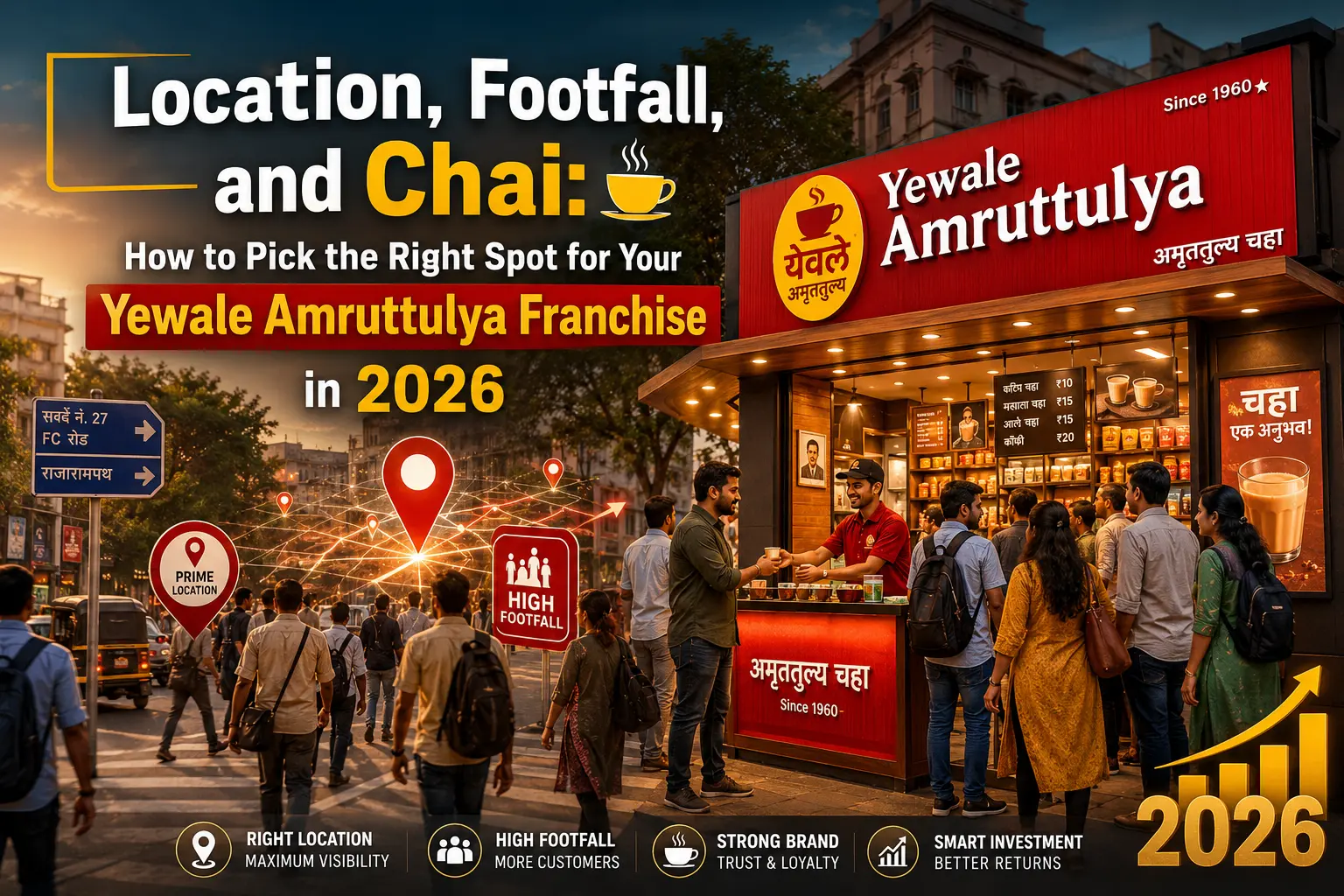
Same Brand. Same Investment. ₹95,000 Difference in Monthly Profit.
Two friends, Vivek and Santosh, decided to open Yewale Amruttulya outlets in the same week, in the same city, with nearly identical investment amounts. They had the same training, the same supplier access, the same menu, the same zero-royalty model.
Vivek picked a quiet residential lane two streets away from the main road. Rent was low. He liked the calm feel of the area.
Santosh picked a spot directly outside the gate of a busy IT park, with a steady stream of two-wheelers and walkers from 7 AM straight through to 9 PM. Rent was higher, but not dramatically so.
Eight months later, Vivek was clearing roughly ₹40,000 in monthly profit. Santosh was clearing close to ₹1,35,000.
Same brand. Same chai. Same training. The only real difference was the few hundred square feet of pavement outside their front door.
Here is the truth that decides almost every tea franchise outcome before the first cup is even served: a tea shop franchise in India near an IT park, railway station, college gate, or busy market intersection consistently earns 2 to 3 times more per day than one in a quiet residential lane.
This blog walks through exactly how to evaluate a location for a Yewale Amruttulya outlet in 2026, what the data shows about different site types, and the checklist that separates a profitable spot from a slow-moving one.
Why Location Decides More of Your Profit Than Almost Any Other Factor
Most first-time franchise buyers spend weeks comparing investment amounts, royalty structures, and brand reputation. All of that matters. But once you have chosen a strong, zero-royalty brand like Yewale Amruttulya, the single biggest variable left in your control is where you place your outlet.
According to Yewale Amruttulya's own 2026 earnings analysis, at a mid-footfall location with 300 orders per day, a franchise owner can expect roughly ₹75,000 to ₹80,000 in net monthly profit on a ₹7.9 lakh investment, with break-even around month 10 to 11. At a high-footfall location with 500 or more daily orders, those numbers jump to ₹1.5 to ₹1.7 lakh monthly net profit, with break-even compressed significantly faster.
That is not a small gap. That is roughly double the monthly income, from the same brand, the same investment, and the same product, purely as a function of location.
What Most Site Selection Advice Gets Wrong
Most franchise advice tells you to look for 'high footfall areas.' That advice is technically correct but practically useless, because it does not tell you how to actually measure footfall, which type of footfall converts into chai sales, and which busy-looking locations are deceptively poor fits for a tea outlet specifically.
A busy shopping street full of people browsing clothes is not necessarily a strong chai location, because shoppers are focused on their errand, not on a chai break. A quiet-looking office lane with steady two-wheeler traffic at 8:45 AM and 6:15 PM every single day might be a far stronger chai location, because it captures a habitual, repeat-visit pattern rather than a one-time browsing crowd.
The Numbers: What Different Footfall Levels Actually Produce
Here is the real revenue picture across three footfall categories, based on industry data for tea franchise operations in 2026.
| Location Type | Daily Orders (Est.) | Monthly Net Profit (Est.) | Break-Even Timeline |
| Quiet residential lane | 100 to 150 | ₹35,000 to ₹45,000 | 16 to 20 months |
| Mid-footfall market/office area | 250 to 300 | ₹75,000 to ₹80,000 | 10 to 11 months |
| High-footfall (IT park, station, college gate) | 500+ | ₹1,50,000 to ₹1,70,000 | 6 to 8 months |
Source: Yewale Amruttulya 2026 ROI Analysis
The table shows something that should change how every prospective franchisee thinks about their budget. Spending slightly more on rent for a genuinely high-footfall location is very often the highest-return decision you can make in the entire setup process. A ₹5,000 to ₹8,000 monthly rent increase that doubles your daily footfall is not a cost. It is the single best investment available to you.
The Six Location Types That Work Best for a Tea Franchise
Not all high-footfall locations behave the same way for a chai business. Each type carries its own customer pattern, its own daypart strength, and its own risks. Understanding these differences helps you choose not just a busy spot, but the right kind of busy spot.
| Location Type | Why It Works for Chai | Best Daypart | Watch Out For |
| IT Park / Office Complex | Daily habitual chai breaks, high repeat visits | Morning, 3 to 5 PM break | Weekend footfall drops sharply |
| College / University Gate | Affordable price point matches student budgets | Mid-morning, afternoon | Vacation months reduce footfall |
| Railway Station / Bus Stand | Constant transient footfall, no loyalty needed | All day, especially morning | High rent, competition from vendors |
| Hospital Vicinity | Visitors and staff need frequent breaks | All day, steady | Limited evening footfall after visiting hours |
| Residential Market Street | Builds strong daily regulars over time | Morning, evening | Slower initial ramp-up period |
| Highway / Hotel Stretch | High volume from travelers, no daily ritual needed | Variable, weekend-heavy | Seasonal and route-dependent traffic |
IT Parks and Office Complexes: The Habit Machine
Office workers develop chai habits with remarkable consistency. The same group of people walks out for a chai break at roughly the same time, every single working day. This is the most reliable daily revenue pattern available to a tea outlet, because it does not depend on impulse. It depends on routine, and routine is extremely sticky once established.
College and University Gates: Volume Over Ticket Size
Students do not spend large amounts per visit, but they visit frequently and they come in groups. A single group of four or five students ordering chai and a snack each adds up quickly across a full academic day. The risk here is seasonal: vacation months can see footfall drop by 40% or more, so plan your cash flow accordingly.
Railway Stations and Bus Stands: Transient but Reliable
These locations do not build the same loyal regulars as an office lane, but they offer something equally valuable: constant, never-ending footfall that does not depend on brand loyalty or repeat habit. Every single day brings a fresh wave of travelers who need exactly what you are selling. The tradeoff is typically higher rent and more direct competition from unorganized vendors.
Hospital Vicinities: Steady and Predictable
Visitors, attendants, and hospital staff all need frequent breaks throughout the day. This location type tends to produce remarkably steady, predictable daily revenue with limited dramatic swings, though evening footfall typically falls off once visiting hours end.
The Site Selection Checklist Every Franchise Buyer Should Use
Before signing any lease for a Yewale Amruttulya outlet, walk through this checklist in person. Do not rely solely on what a property broker or landlord tells you about footfall. Verify it yourself.
| Site Selection Factor | What to Check | Why It Matters |
| Footfall count | Stand at the location at peak hours and count actual walkers/vehicles | Estimates from owners or brokers are often inflated |
| Visibility | Can the outlet be seen from 30+ meters in both directions? | Low visibility kills impulse walk-ins regardless of footfall |
Competing chai options | Map every tea stall, café, and canteen within 200 meters | Direct competition splits the same daily habit pool |
| Rent as % of likely revenue | Calculate rent against your realistic revenue estimate, not the best case | Rent above 12 to 15% of revenue strains profitability fast |
| Parking and accessibility | Can two-wheelers and walk-ins stop comfortably without hassle? | Friction at entry reduces casual, impulse visits significantly |
| Zoning and food license clearance | Confirm the space is legally approved for food service | Avoids costly delays or forced relocation after setup |
| Morning and evening foot pattern | Visit the same spot at 8 AM and again at 6 PM | A location can be busy in one window and dead in another |
Why You Must Physically Stand There Before Signing Anything
Industry guidance on franchise site selection consistently emphasizes this point. As GrowthFactor's 2026 franchise site selection guide puts it, locations fall into three categories: profitable, break-even, and go-broke. A location that looks perfect on paper can become a financial disappointment if the actual walking and vehicle traffic does not match the story you were told.
Spend at least two full days at any location you are seriously considering. Stand there during the morning rush, the midday lull, the evening peak, and a weekend. Count actual people. Note how many are walking with purpose toward a destination versus how many are moving at a pace that suggests they would stop for a quick chai. This single exercise, more than any broker's pitch, will tell you the truth about a location's potential.
The Location Factor Most Articles Never Discuss: Seasonal Resilience
Here is an angle that almost no location guide for tea franchises covers. The best location is not just the one with the highest footfall in the cool months. It is the one where your full menu, including cold beverages, can perform strongly when hot chai demand naturally dips.
According to Yewale's own 2026 ROI breakdown, a Cold Coffee priced at ₹40 generates 167% more revenue per cup than a small regular chai priced at ₹15. The practical implication for site selection is significant: a location with strong daytime heat exposure and good visibility for a cold beverage display can hold its revenue through the summer far better than a shaded, cooler spot that depends almost entirely on hot chai sales.
| Item | Price | Cups Needed to Match ₹4,000 Revenue |
| Regular Chai | ₹15 | 267 cups |
| Cold Coffee | ₹40 | 100 cups |
| Rose Milk Shake | ₹40 | 100 cups |
Selling 100 Cold Coffees on a hot afternoon generates the same ₹4,000 that would require 267 cups of regular chai. A location near office workers stepping out into direct heat, or a market street with no shade cover, can actually become a stronger summer location than a shaded residential lane, purely because of how naturally it pushes customers toward the higher-ticket cold beverage menu.
Evaluating a Location's Seasonal Menu Fit
When you scout a location, ask yourself: in April and May, will this spot still pull strong footfall, and will that footfall be inclined toward a Cold Coffee or Limbu Sarbat rather than walking past because they do not want hot chai in the heat? A location that only works for eight months of the year is a weaker investment than one with built-in seasonal resilience.
Mapping Your Competition Before You Sign
Every location has some level of existing chai competition, whether organized or unorganized. The presence of competition is not automatically disqualifying. What matters is understanding what type of competition you are walking into.
- Unorganized tapri competition: An unbranded local stall nearby is often less threatening than it looks. Many customers specifically seek the consistency and hygiene of a branded outlet once it is available, and will switch over time. Yewale's brand trust works in your favor here.
- Another organized chai brand nearby: This is a more serious consideration. Two branded chai outlets within 100 to 150 meters will split the same habitual customer base unless the area's total footfall is large enough to support both.
- Café or coffee shop competition: Generally less direct, since coffee café customers and daily chai customers often behave differently in terms of price sensitivity and visit frequency. A coffee café nearby does not usually cannibalize your chai business significantly.
What most people do not realize is this: in many Tier 2 and Tier 3 cities, the strongest available locations have zero organized chai competition at all. You are not fighting for market share. You are introducing the market to a category it has been craving without realizing a better option existed.
How Much Rent Is Too Much? A Practical Framework
A common mistake among first-time franchise buyers is choosing the cheapest available rent without weighing it against the footfall difference. The opposite mistake, paying premium rent for a location that does not deliver proportionally higher footfall, is equally damaging.
A practical framework: your monthly rent should ideally sit between 8% and 15% of your realistic projected monthly revenue, not your best-case projection. If a location's rent pushes that ratio above 15%, the location needs to demonstrate genuinely exceptional footfall to justify the cost. If the rent sits comfortably below 8% but the footfall is also low, you may be saving money on rent while losing significantly more in lost revenue potential.
This balance is exactly what separated Vivek's and Santosh's outcomes. Vivek's lower rent saved him perhaps ₹4,000 to ₹5,000 per month. Santosh's higher-footfall location earned him an additional ₹90,000-plus per month. The math, once you see it laid out, is not subtle.
What's Changing in 2026: New Location Opportunities Worth Watching
The Rise of Co-Working and Hybrid Office Spaces
As hybrid work patterns stabilize in 2026, co-working spaces and business parks in Tier 2 and Tier 3 cities are seeing consistent daily footfall from professionals who previously worked from home. These emerging hubs often have limited food and beverage options nearby, making them strong, currently under-served location candidates.
Smart City Infrastructure Opening New Commercial Corridors
Government infrastructure initiatives under the Smart Cities Mission continue to develop new commercial corridors in growing Tier 2 and 3 cities. These improving areas often present early-mover advantages similar to what Yewale experienced in its original Pune locations decades ago: lower current rent, with footfall expected to grow as the surrounding infrastructure matures.
Highway and Logistics Hub Growth
With expanding national highway networks and growing logistics activity, highway-adjacent locations near toll plazas, fuel stations, and rest stops are becoming increasingly viable for tea outlets that can handle variable, travel-driven footfall patterns. These locations behave differently from urban spots and reward owners who understand their weekend-heavy, route-dependent traffic flow.
Found the right location and ready to put a proven brand on it? Explore the Yewale Amruttulya tea franchise under 8 lakhs and turn good footfall into daily revenue.
Key Takeaways
- Location can double or triple your profit: The same brand and investment can produce ₹40,000 or ₹1,70,000 in monthly profit, depending almost entirely on footfall quality at the chosen site.
- Habitual footfall beats browsing footfall: IT parks and office complexes generate the most reliable daily revenue because chai breaks are routine, not impulsive.
- Verify footfall yourself, never rely on secondhand claims: Stand at any potential location across multiple dayparts and count real traffic before signing any agreement.
- Seasonal resilience matters as much as peak footfall: A location that supports strong cold beverage sales in summer protects your revenue across all twelve months, not just the cooler ones.
- Map your competition honestly: Unbranded tapris are usually less threatening than another organized chai brand within walking distance. Many Tier 2 and 3 locations currently have zero organized competition at all.
- Keep rent proportional to realistic revenue: Aim for rent between 8% and 15% of projected monthly revenue. Both excessive and overly cheap rent decisions can quietly damage your profitability.
Vivek eventually relocated his outlet eighteen months in, choosing a spot near a busy market junction. His monthly profit nearly tripled within the first quarter at the new location.
He still talks about how much faster things could have gone if he had spent two extra days standing on a street corner before signing his first lease.
If two locations in your city had the same rent but very different walking traffic, how many hours would you spend standing on each street corner before deciding where to put your life savings?
