
The Conversation Nobody Finishes
Pune. A Saturday afternoon. A small cafe table near a window.
Two friends in their early thirties. One of them, Prashant, has been saving money for two years. He works in a logistics company, manages his household, and somewhere between the daily commute and the end-of-month accounts, he has decided he wants to start something of his own.
He has a notebook. Four pages of handwritten options. Juice bar. Sandwich kiosk. Pav bhaji stall. Vada pav outlet. Tea franchise.
His friend asks the obvious question: which one makes the most money?
Prashant pauses. Then he says: that is what I am trying to figure out. I have been asking around for three months and nobody gives me a straight answer.
He is not alone in this. Thousands of people in India are at this exact table, with this exact notebook, asking this exact question. They have savings between three and six lakh rupees, a willingness to work hard, and no reliable way to compare their options without trying them.
The answer exists. It is just not where most people are looking for it.
India's Low-Investment Food Business Boom — and Its Hidden Dropout Rate
India adds roughly eight to ten million new micro and small food businesses every year. Most of them are concentrated in the three to five lakh rupee investment range, because that is where middle-income savings realistically land. Juice bars, snack counters, fast food kiosks, and chai stalls together form the largest segment of street-level entrepreneurship in the country.
And yet, the NSSO and various small business studies consistently show that the failure rate in this segment within the first two years crosses fifty percent. The reason is rarely a bad product. It is almost always a misunderstood ROI structure.
Entrepreneurs entering this space typically think about ROI in one dimension: how much do I earn per day. What they underestimate is purchase frequency, which is arguably the more important variable. A food business that generates a higher average ticket but lower repeat visits looks better on a single-day snapshot. A business built on a daily habit, something people buy every morning without thinking, generates a very different compounding curve over twelve months.
Chai is the clearest example of this principle in Indian consumer behavior. It is not an occasional purchase. It is a ritual. And rituals, once formed around a specific location or brand, are among the most durable behaviors in human buying patterns.
The question is not just what a customer buys. It is how often they come back without needing a reason.
ROI Is Not Just a Number. It Is a Behavior.
Most first-time food business owners calculate ROI the same way: take expected monthly revenue, subtract estimated costs, divide by initial investment, multiply by twelve. The math is straightforward. The problem is that it assumes a static revenue figure, which almost no real business produces.
The variable that separates high-ROI food businesses from average ones is not the product margin. It is the repeat purchase cycle. There are three mechanisms that determine how quickly an investment returns:
The first is Purchase Frequency. How many times per week does the average customer return? A juice bar customer might visit once or twice a week. A chai customer visits every day, sometimes twice. At the same average bill, that is a three to seven times multiplier on lifetime customer value.
The second is Decision Friction. Every time a customer has to think about whether to buy, there is a chance they do not. Chai has near-zero decision friction for a large portion of the Indian population. It is automatic. This automatic behavior is what creates the reliable daily base that turns projections into actual revenue.
The third is Seasonal Stability. Juice bars drop significantly in winter. Cold snack items slow in monsoon. Chai consumption is largely stable across seasons, with spikes in cooler months. A business with low seasonal variance compounds more reliably than one with pronounced highs and lows.
The best ROI does not come from the highest margin product. It comes from the product people never stop buying.
How Four Popular Low-Investment Options Actually Perform
1. Juice and Smoothie Bar
Juice bars have grown significantly in Indian cities, driven by health awareness and the rise of the fitness-conscious urban consumer. The setup is photogenic, the margins on individual cups are reasonable, and the product commands a higher price point than chai.
The challenge is that juice is a considered purchase. A customer on the way to work does not stop for a smoothie the way they stop for chai. The buying decision requires mild motivation: I am being healthy today, I have a few extra minutes, I am in that mood. All three conditions need to align. On most ordinary days, they do not.
Add to this the strong seasonal pattern, lower sales in winter, and the perishability of raw produce, and the juice bar model, while viable, runs on a narrower operational margin than it appears at the planning stage.
2. Pav Bhaji and Snack Stalls
Pav bhaji stalls have a strong cultural presence in Maharashtra and across North India. They generate solid evening footfall and can do impressive numbers on weekends. The product is loved, the setup is manageable, and a well-located stall can build a loyal local following.
The limitation is timing. Pav bhaji is an evening or lunch item. A stall operating from 5 PM to 10 PM has a five-hour revenue window. Compare that to a chai outlet running from 7 AM to 9 PM, and the difference in revenue-generating hours becomes significant. Fewer operating hours mean fewer transactions, regardless of how strong the per-unit economics are.
The snack stall model also tends to plateau. Growth beyond one location requires a level of standardization that most independent operators have not built into their process.
3. Vada Pav and Regional Fast Food Outlets
Vada pav is perhaps the closest competitor to chai in terms of cultural penetration and repeat purchase behavior. It is fast, inexpensive, and deeply embedded in the daily routines of millions of people, particularly in Maharashtra.
Several organized vada pav chains have emerged in recent years, and their franchise models perform reasonably well. The repeat customer rate is moderate to high, and the product has genuine mass appeal. However, vada pav is still primarily a meal replacement or snack item rather than a daily ritual. Most customers visit two to four times a week, not daily. And at a lower average ticket than a tea-plus-snack combo, the revenue ceiling per location is correspondingly lower.
4. Sandwich and Fast Food Kiosks
Sandwich kiosks and fast food micro-outlets are growing in Tier 1 and Tier 2 cities, often positioned near colleges and corporate parks. They benefit from the youth demographic and the rising appetite for quick Western-style eating options.
The challenge is differentiation. The organized fast food space is crowded. Unbranded sandwich kiosks compete not just with each other but with established national chains that the customer already trusts. Building brand recall from scratch in this segment takes significantly longer than in categories where the product itself has a cultural head start. Chai has that head start built in.
What the Yewale Amruttulya ROI Actually Looks Like
Let us use a straightforward scenario. A franchisee opens a Yewale Amruttulya outlet in a mid-traffic commercial zone in a Tier 2 city. Total investment including setup, equipment, franchise fee, and working capital: approximately four to five lakh rupees.
Operating hours: 7 AM to 9 PM. Average daily cups served in the first month: one hundred eighty to two hundred twenty. By month three, after the location builds recognition: two hundred fifty to three hundred cups. Average ticket per transaction including chai and a snack item: sixty to seventy rupees.
Monthly revenue by month three: approximately five lakh to five lakh fifty thousand rupees. Monthly operating costs including ingredients, staff, rent, and utilities: two lakh twenty thousand to two lakh eighty thousand rupees. Net monthly surplus: two lakh twenty thousand to two lakh seventy thousand rupees.
At this run rate, the initial investment is recovered in six to ten months. A juice bar or sandwich kiosk at comparable investment levels typically takes sixteen to twenty-four months to break even, largely because the repeat purchase cycle is slower and the seasonal dips are sharper.
The compounding effect here is worth noting. Every customer who forms a daily chai habit at a specific Yewale outlet is generating fifty to seventy rupees of near-automatic revenue every weekday. Multiply that across two hundred fifty daily customers with an average visit frequency of five days a week, and the monthly base revenue becomes largely predictable. Predictability is itself an asset that most low-investment food businesses do not offer.
The fastest path to ROI is not the highest margin per cup. It is the product that people stop questioning whether to buy.
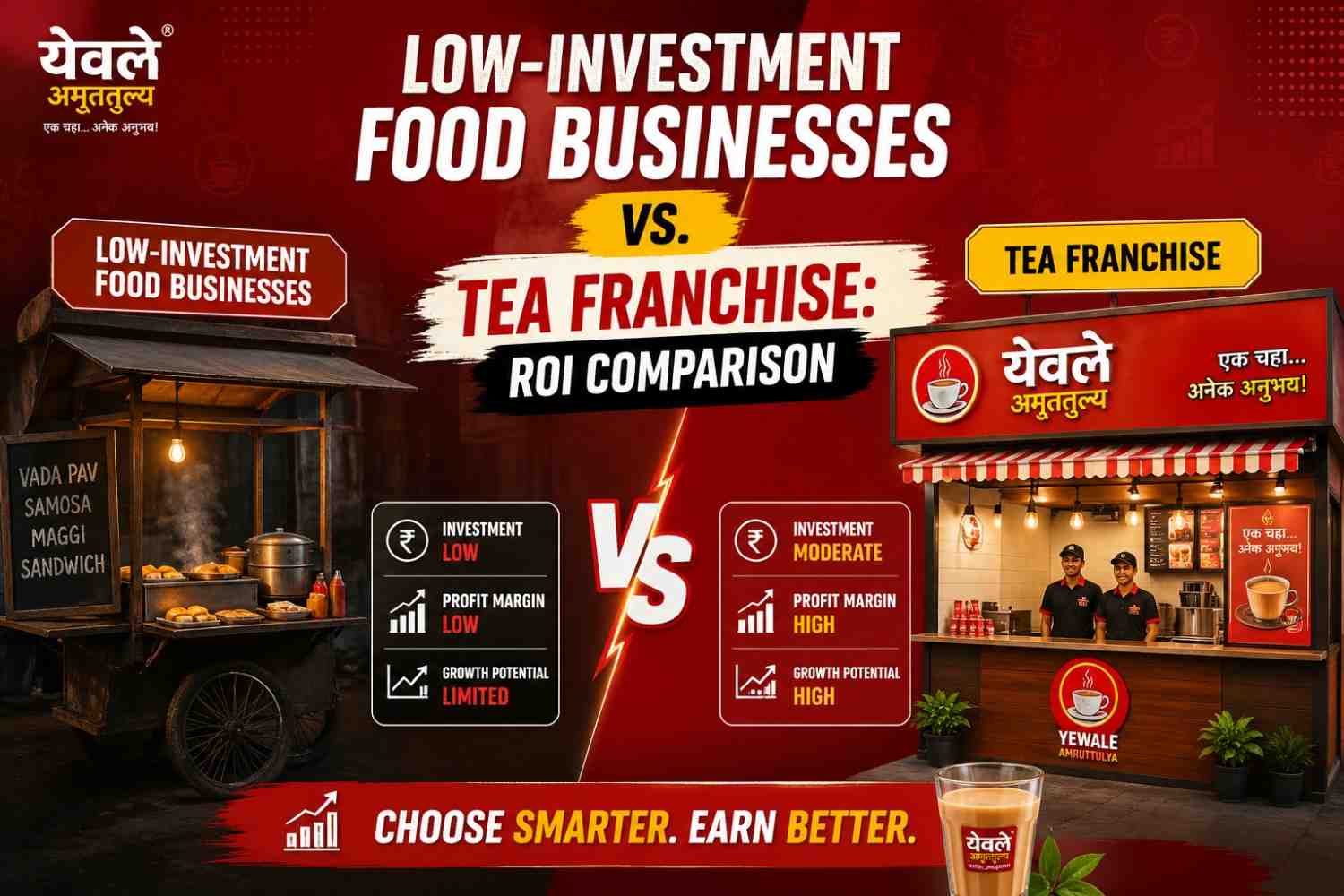
ROI Comparison at a Glance
The following comparison uses realistic estimates across five popular low-investment food business categories:
| Business Type | Avg. Investment | Daily Revenue Potential | Repeat Purchase Rate | Break-Even Timeline | Scalability |
| Juice / Smoothie Bar | 3 – 5 lakh | 2,500 – 5,000 | Low (seasonal) | 18 – 28 months | Moderate |
| Pav Bhaji / Snack Stall | 1.5 – 3 lakh | 2,000 – 4,500 | Moderate | 12 – 20 months | Low |
| Sandwich / Fast Food Kiosk | 2 – 4 lakh | 2,000 – 4,000 | Low to Moderate | 16 – 24 months | Low |
| Vada Pav Chain Outlet | 2 – 4 lakh | 3,000 – 6,000 | Moderate to High | 10 – 18 months | Moderate |
| Yewale Amruttulya Franchise | 3 – 5 lakh | 8,000 – 15,000 | Very High (daily habit) | 6 – 10 months | High |
Revenue and break-even figures are indicative estimates based on market patterns. Actual performance depends on location, execution, and local demand. Daily revenue for Yewale reflects a well-run outlet at a good location from month three onward.
Back to Prashant's Notebook
If Prashant were to sit down with this data and a clear head, the notebook would look different by the end of the conversation. The question would shift from which business makes the most money per cup to which business has the most customers returning without being asked.
Every food business on his list can work. Every one of them has produced stories of success. But the variables that determine whether they work in his city, at his location, with his operating capacity, are not equally forgiving across all five options.
A chai franchise built around a daily habit and a recognized brand compresses two of the hardest variables in small food retail: the time it takes to build trust, and the time it takes to build routine. Both of those are already built in. What remains is execution.
And execution is the one variable that Prashant actually controls.
If the numbers point to one direction and your instinct agrees, what exactly are you waiting to confirm?
Yewale Amruttulya | India's Trusted Chai Franchise
yewaleamruttulya.com
