
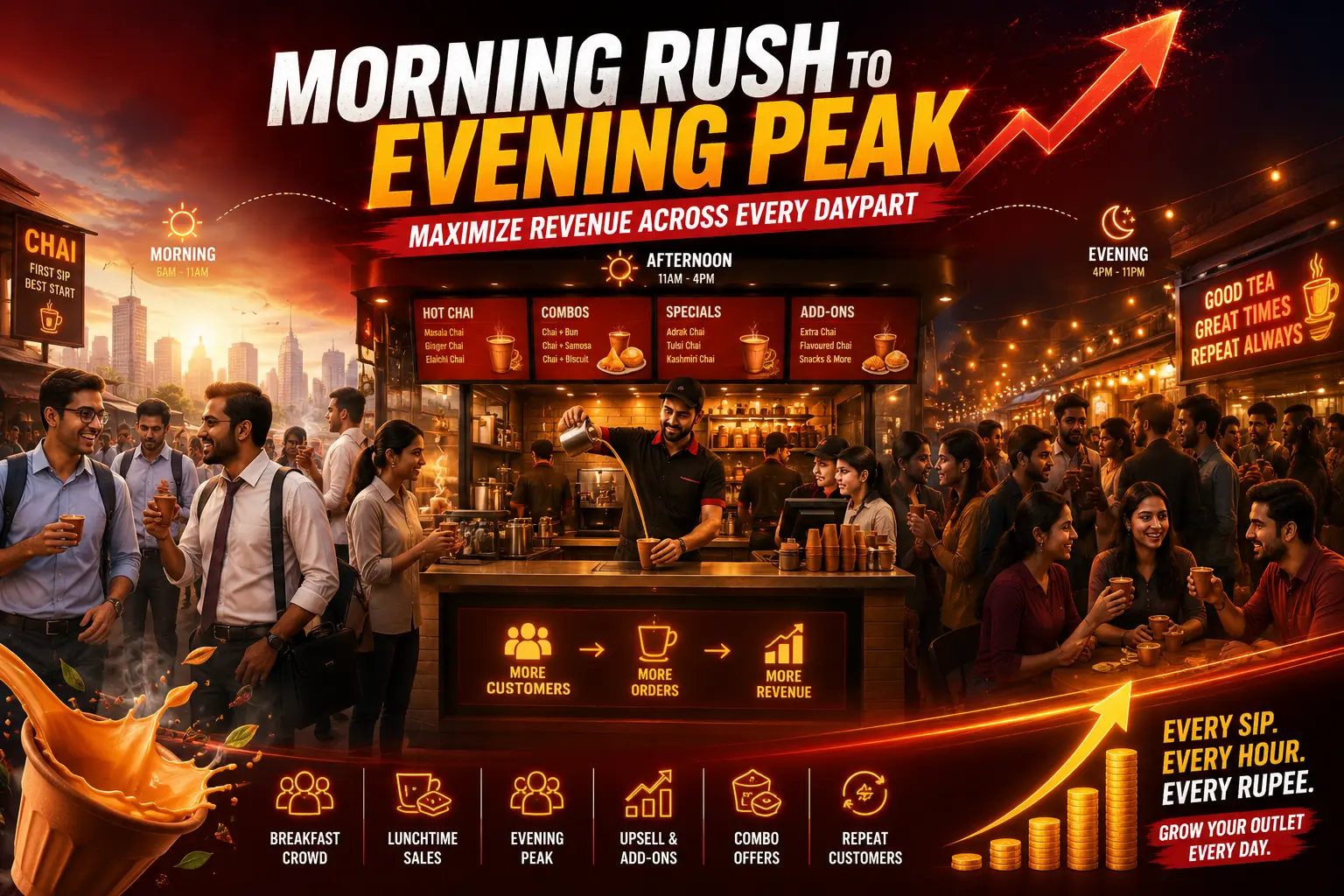
Two Outlets. Same City. Same Brand. Very Different Incomes.
Arun and Suresh both opened Yewale Amruttulya outlets in the same city within three months of each other. Same brand. Same menu. Roughly similar locations, both near office areas with decent footfall.
After six months, Suresh was pulling in nearly 40% more revenue per day than Arun.
Same product. Same city. Very different numbers.
When someone sat down and looked at the data, the difference came down to one thing: Suresh understood that a tea outlet does not have one peak hour. It has six distinct customer windows across the day, each with its own type of customer, its own buying behavior, and its own revenue potential.
Arun was running a great evening outlet. Suresh was running a great all-day outlet. That gap in thinking added up to lakhs over the year.
Here is what most tea outlet owners miss: the morning rush and evening peak account for roughly 60% of daily revenue. But the other 40% happens between those windows, and it is almost entirely untapped at most outlets.
This blog breaks down exactly how to build a tea outlet that earns from 6:30 AM to 10:00 PM, using Yewale Amruttulya's full menu and a daypart strategy that most franchise owners never think about.
What Is a Daypart Strategy and Why Your Tea Outlet Needs One
In the food and beverage industry, a daypart is a defined time window in the day that attracts a specific type of customer with a specific set of needs. McDonald's thinks about breakfast, lunch, and dinner as separate businesses. Their menu, promotions, staffing, and even counter displays shift across these windows.
A tea outlet is not a restaurant. It does not need that level of complexity. But it does need to recognize that the person who walks in at 7 AM wants something different from the person who walks in at 5 PM, and the outlet that serves both well earns significantly more than the one that only serves one well.
According to Kantar's Foodservice Trends 2024 analysis, evening meal occasions are growing at 5.7% year-on-year and represent one of the largest untapped revenue opportunities for quick-service food and beverage brands. Meanwhile, the afternoon window, specifically the 3 PM slot, is what global QSR brands are actively investing in to capture mid-day spending that most outlets currently miss.
For a tea outlet in India, the opportunity is even clearer. Indians drink tea two to three times per day as a daily habit. That means your customer is not visiting once. They are visiting throughout the day, at different times, with different intentions. Your job is to be the right option for each of those visits.
The Revenue Gap Between a One-Peak and Multi-Peak Outlet
An outlet that only capitalizes on the morning and evening rush captures about 60% of its potential daily revenue. An outlet that actively works all six dayparts captures close to 90% or more. On a daily revenue base of ₹7,000, that difference is ₹2,100 per day, or roughly ₹63,000 per month, sitting on the table uncollected.
That is not a small number. Over a year, it is more than ₹7.5 lakh in additional revenue that costs nothing extra in rent, staff, or investment. It is simply the revenue that comes from understanding who walks in at every hour and being ready for them.
The Yewale Outlet Daypart Map: Six Windows, Six Opportunities
Here is a practical breakdown of how a well-run Yewale Amruttulya outlet earns across the full operating day.
| Time Window | Customer Type | Primary Order | Revenue Opportunity | Priority Action |
| 6:30 to 9:00 AM(Morning Rush) | Commuters, workers, students | Cutting chai, Ginger Tea, Spongy Cake | High volume, fast transactions | Speed + snack display stocked |
| 9:00 AM to 12:00 PM(Mid-Morning) | Office workers on break, homemakers | Masala Chai, Almond Milk, Cream Roll | Steady, repeat visitors likely | Loyalty prompt, snack upsell |
| 12:00 to 3:00 PM(Afternoon Lull) | Students, casual visitors | Cold Coffee, Ice Tea, Limbu Sarbat | Volume dips, beverage variety wins | Seasonal push, cool drinks display |
| 3:00 to 5:00 PM(Office Break Rush) | Corporate employees, college groups | Cutting chai, Bakarwadi combo | High attach rate for snacks | Combo pricing visible at counter |
| 5:00 to 8:00 PM(Evening Peak) | Families, workers going home, regulars | Yewale Special, Jaggery Cream Roll | Highest daily revenue window | Full stock, every item displayed |
| 8:00 to 10:00 PM(Night Tail) | Young adults, couples, late commuters | Turmeric Milk, Black Tea, Spongy Cake | Smaller volume, higher per-visit spend | Premium pairing suggestions |
Each of those six windows has its own customer mindset. The morning rush customer is in a hurry. The office break customer wants to step away and pause. The evening peak customer is unwinding after a long day. The night tail customer often has more time and is open to premium suggestions. Recognizing these differences and responding to each one with the right prompt, the right display, and the right product is what separates a ₹5,000-per-day outlet from a ₹8,000-per-day outlet.
Revenue by Daypart: What the Numbers Look Like Across a Full Day
Here is a realistic revenue model for a mid-performing Yewale outlet in a city with mixed residential and commercial footfall. These figures are conservative estimates based on typical customer counts and average spend across each daypart.
| Daypart | Avg. Daily Customers | Avg. Spend Per Visit | Est. Daily Revenue | % of Daily Total |
| Morning Rush (6:30-9 AM) | 60 to 70 | ₹20 | ₹1,300 to ₹1,400 | ~22% |
| Mid-Morning (9 AM-12 PM) | 40 to 50 | ₹25 | ₹1,000 to ₹1,250 | ~18% |
| Afternoon Lull (12-3 PM) | 25 to 35 | ₹22 | ₹550 to ₹770 | ~10% |
| Office Break (3-5 PM) | 45 to 55 | ₹30 | ₹1,350 to ₹1,650 | ~22% |
| Evening Peak (5-8 PM) | 65 to 80 | ₹35 | ₹2,275 to ₹2,800 | ~38% |
| Night Tail (8-10 PM) | 20 to 30 | ₹28 | ₹560 to ₹840 | ~10% |
| Total Daily (est.) | 255 to 320 | ~₹7,035 to ₹8,710 | 100% |
The evening peak window, 5 PM to 8 PM, highlighted in the table, is the single largest revenue window at roughly 38% of daily income. But notice that the combined morning rush and office break together match or exceed it. The afternoon lull and night tail together add another 20%. These are the windows most outlets under-invest in, and they represent the clearest path to revenue growth without any increase in fixed costs.
What most people do not realize is this: the afternoon lull is not low-revenue because demand does not exist. It is low-revenue because most outlets do nothing different for that window. A seasonal beverage display, a different product spotlight, or a simple visual prompt is often all it takes to shift those numbers.
The Morning Rush: 6:30 to 9:00 AM
Who Is Walking In and What Do They Need?
The morning customer is on a mission. They have 3 to 5 minutes. They want their chai, they want it now, and they may grab something small to eat if it is directly in front of them. Speed is the primary value at this hour.
The morning rush builds the foundation of your daily revenue. It also builds your regular customer base. The people who come every morning become your most loyal customers, because morning chai is a ritual, and rituals are incredibly hard to break once formed.
How to Maximize Morning Revenue
- Speed first: Morning customers hate waiting. Keep the chai-making process streamlined. One extra minute of wait time can cost you a regular customer permanently.
- Spongy Cake at eye level: The morning customer has often skipped a full breakfast. A Spongy Cake sitting at the counter requires zero convincing. They see it, they want it, they buy it.
- Ginger Tea as a visible option: Many morning customers are health-conscious about their first drink of the day. Ginger tea positioned as a 'morning clarity' option converts well at this hour.
- Pre-warm for predictable demand: By 6:30 AM, you know roughly how many morning regulars are coming. Pre-warm the right quantities so speed is never compromised.
The Afternoon Lull: 12:00 to 3:00 PM
The Most Under-Exploited Window in a Tea Outlet's Day
Most tea outlet owners accept the afternoon dip as an unavoidable reality. Footfall is lower. Orders are fewer. The team cleans up and waits for the evening rush.
That is the wrong way to think about it.
The afternoon window is not naturally low-revenue. It is low-revenue because it is the most occasion-sensitive part of the day. People visit in the afternoon when they have a reason: a break from work, a social meeting, or a specific craving. A tea outlet that gives people a reason to walk in during the afternoon will see that window come alive.
According to Mordor Intelligence's India QSR Market report, bakery and snack items cater to all-day consumption occasions including mid-morning snacks and afternoon tea. Baked goods deliver gross margins of 40% to 50%, which means the afternoon window, when managed with the right product spotlight, is actually one of the highest-margin hours of the day.
How to Activate the Afternoon Lull
- Cold beverages front and center in summer: Cold Coffee, Ice Tea, and Limbu Sarbat should be your first visual during the April to June window. The afternoon heat is your marketing.
- Combo pricing on display: A 'Chai + Bakarwadi' combo price visible at the counter during the afternoon creates a reason to visit that feels like value. People who might not have stopped will stop for a combo.
- Leverage student footfall: If you are near a school or college, the 12:30 to 2:00 PM window is a distinct micro-rush. A dedicated student combo at an accessible price point captures this entirely.
- Seasonal product spotlight: Rotate what is prominently displayed in the afternoon. Turmeric Milk in the cooler months. Limbu Sarbat in summer. Almond Milk for wellness-oriented mid-day visitors. Each rotation gives regulars a new reason to order.
The Evening Peak: 5:00 to 8:00 PM
Your Highest Revenue Window. Are You Ready for It?
The evening peak is where most outlets earn their largest single chunk of daily revenue. It is also where most outlets make the most mistakes, because they treat it like a bigger version of the morning rush instead of a completely different customer occasion.
The evening customer is not in a hurry. They are unwinding. They have survived the day and they want something that feels like a reward. The Yewale Special Chaha, the Jaggery Cream Roll, the Bakarwadi with an extra cup: these are not just products at this hour. They are the emotional payoff of a long day.
The habitual nature of evening chai is well-documented. FranchiseBazar's 2026 tea franchise analysis notes that tea consumption is part of evening rituals for most Indians, building daily predictable footfall that café formats simply cannot replicate. This is your single biggest competitive advantage during the 5 to 8 PM window.
How to Maximize the Evening Peak
- Full snack display, fully stocked: Nothing kills evening revenue faster than a half-empty display shelf. Restock before 4:30 PM without fail. A full, well-lit display counter does more marketing than any poster.
- Jaggery Cream Roll as the 'exclusive' reminder: Evening customers have more time to notice and choose. A small counter card or verbal mention that the Jaggery Cream Roll is available only here is an evening conversion trigger.
- Family-oriented pairing suggestions: Evening often brings family groups. A suggested combo for two, chai plus snack for each person, increases average ticket size without any hard selling.
- Dwell time as a second-order revenue tool: Customers who sit and eat a snack stay longer. Customers who stay longer order a second cup. Never rush an evening customer. The extra cup of chai they order is pure profit because you have already recovered all fixed costs from the first order.
The Complete Yewale Menu Mapped Across Every Daypart
Here is a full reference map of Yewale Amruttulya's menu items matched to their strongest daypart and customer occasion.
| Yewale Product | Best Daypart | Customer Occasion | Revenue Type |
| Cutting Chai | Morning, Evening | Daily habit, commute fuel | Volume driver |
| Ginger Tea | Morning, Monsoon months | Wellness ritual, morning clarity | Repeat purchase |
| Masala Chai (Yewale Special) | Evening peak | End-of-day unwind | Premium feel, emotional buy |
| Black Tea | Morning, Night tail | Light option, health-conscious | Steady daily |
| Turmeric Milk | Evening, Night | Post-dinner wellness | Seasonal spike |
| Almond Milk | Mid-morning | Nutrition-conscious customers | Premium margin |
| Cold Coffee | Afternoon, Summer | Beat the heat, energy boost | Seasonal revenue |
| Limbu Sarbat / Ice Tea | Afternoon, Summer | Refreshment, casual visit | Summer spike |
| Cream Roll | All day | Impulse buy, visual trigger | High attach rate |
| Jaggery Cream Roll | Evening, weekends | Exclusive indulgence | Loyalty and repeat |
| Spongy Cake | Morning, Afternoon | Light breakfast substitute | All-day steady |
| Bakarwadi | Evening, Office break | Cultural snack, chai pairing | Emotional loyalty |
The table above shows something important: there is no hour in the day when the Yewale menu does not have the right product for the customer walking in. The gap is never the menu. It is always whether the franchise owner is actively presenting the right product at the right time.
6 Operational Habits That Build a Multi-Daypart Tea Outlet
1. Rotate Your Counter Display by Time of Day
What sits at the front of your display at 7 AM should not be the same as what sits there at 3 PM. Morning front: Spongy Cake and Ginger Tea. Afternoon front: Cold Coffee, Ice Tea, or a combo board. Evening front: Jaggery Cream Roll and Bakarwadi. This one habit alone can add meaningful revenue across the day.
2. Staff Your Peak Windows, Not Just Your Opening Hours
Most outlets staff based on operating hours. Smart outlets staff based on daypart intensity. Have your most efficient and communicative staff member on the counter during the 7 to 9 AM and 5 to 8 PM windows. These are the hours where customer experience directly converts into regular visits.
3. Use the Slow Hours to Prepare for the Busy Ones
The 12 to 3 PM window is not wasted time. It is preparation time. Restock snacks. Clean and reset the display. Brief your staff on the evening push. When the 3 PM office break rush arrives, you are already ready.
4. Track Which Products Move in Which Window
This does not require complex software. A simple daily log of which items sold in which time block tells you within two weeks what your outlet's daypart pattern looks like. Once you know that, you can stock smarter, prompt more effectively, and focus energy on the windows where your specific location has the most untapped potential.
5. Build Regulars in Every Daypart, Not Just One
Tea consumption is habitual, and data from franchise research confirms that most Indians consume tea two to three times per day. A customer who visits you in the morning and again in the evening is worth twice as much as one who visits only once. Every morning regular is a potential evening regular. Prompt it. Remind them. Build the habit across two dayparts, not one.
6. Capitalize on Seasonal Shifts Across All Dayparts
Summer changes the entire afternoon window. Monsoon changes the morning window, when people often want something warmer and more comforting than usual. Winter evenings are your single biggest opportunity for Turmeric Milk and premium chai pairings. The menu already has the right products for every season. Your job is to put them front and center at the right time of year.
Want a tea business model built to earn across every hour of the day? Explore the Yewale Amruttulya tea franchise under 8 lakhs and see how a multi-daypart outlet works from day one.
Key Takeaways
- Six windows, not one: A tea outlet has six distinct customer windows across the day, each with its own customer type, buying behavior, and revenue potential.
- Evening peak is biggest, but not the whole story: The 5 to 8 PM window drives roughly 38% of daily revenue. But the morning rush, office break, and afternoon windows together drive the other 62%.
- The afternoon lull is a choice, not a reality: Most outlets accept lower afternoon revenue without doing anything about it. Seasonal beverage displays, combo pricing, and product rotation can activate this window significantly.
- Product and daypart alignment: Yewale's full menu of 25+ products is already mapped across all dayparts. Cream Rolls for the morning impulse buyer. Bakarwadi for the evening regular. Cold Coffee for the summer afternoon visitor. The products exist. The question is whether you are presenting them at the right time.
- Dwell time drives second-cup revenue: Every snack item sold extends customer dwell time. Longer stays directly increase the probability of a second cup order, which is often pure profit after fixed costs are covered.
- Operational habits matter more than luck: Rotating the counter display by time of day, staffing peak windows properly, and tracking which products move in which window are habits that compound into significant revenue differences month over month.
Arun eventually figured out what Suresh knew from the start. The outlet does not rest between the morning rush and the evening peak. It works, in a different gear, with a different product mix, for a different customer. Every hour is an opportunity if you treat it like one.
Which daypart at your outlet is the most under-performing right now, and what is the one product or display change you could make this week to start shifting it?
