
A Cup of Chai in Lucknow That Tasted Like Pune
Vikram grew up in Pune. For fifteen years, his morning started the same way: a walk to the corner chai stall, a small glass of strong, milky, slightly sweet cutting chai, and five minutes of quiet before the day began.
Then his company transferred him to Lucknow.
He spent his first three weeks trying every chai stall in his new neighbourhood. The tea was good, sometimes excellent. But it was not quite right. Something about the spice balance, the strength, the way the milk was folded in, felt different.
He was not imagining it. He was missing a specific style of chai: the Maharashtrian way. Bold, aromatic, just sweet enough, served fast and hot in a small glass that you hold with both hands on a cold morning.
Two years later, a Yewale Amruttulya outlet opened near his office in Lucknow. On the first morning he walked in, he ordered a cutting chai, took one sip, and texted his wife back in Pune: 'Finally found it.'
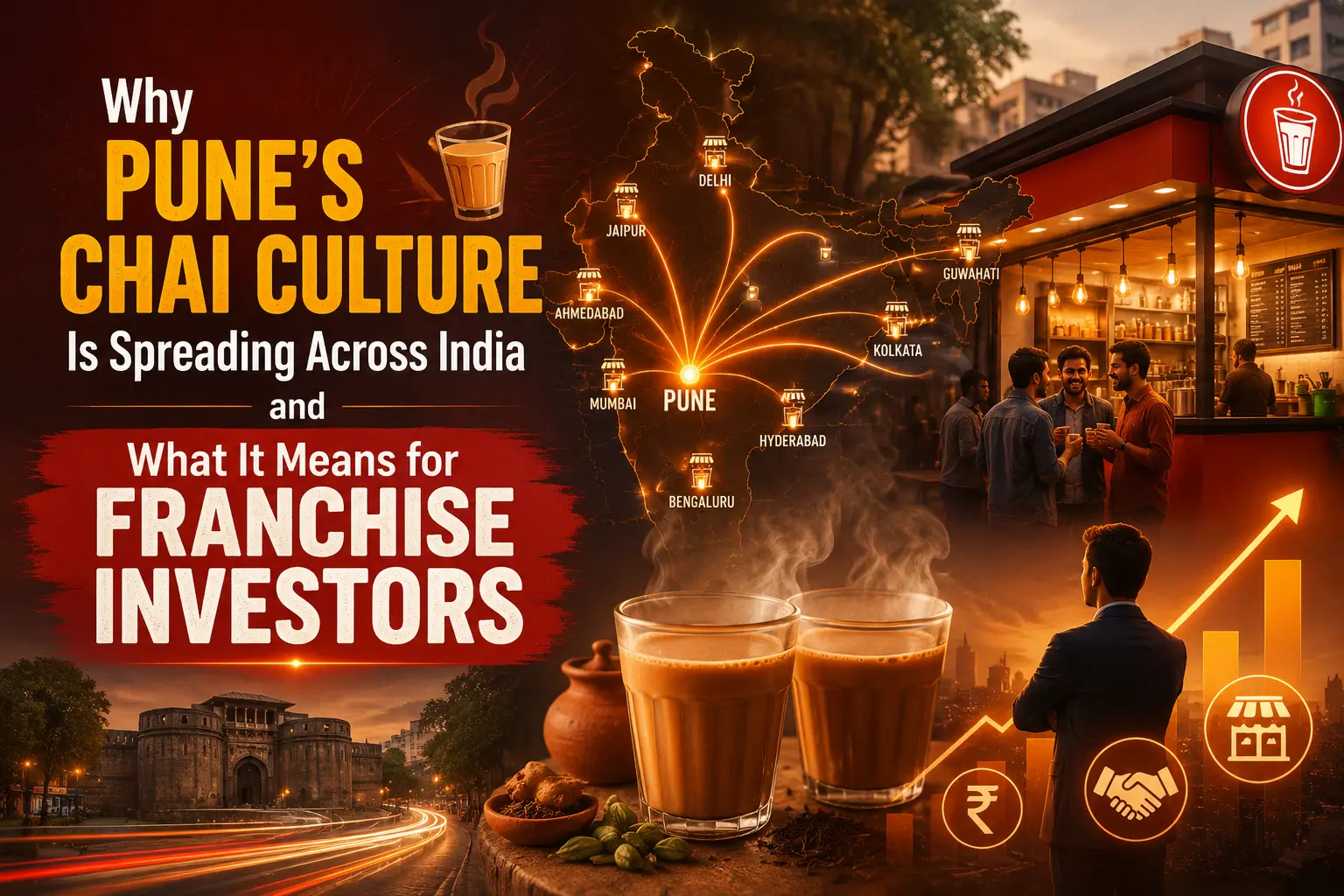
Here is what most franchise investors miss: Pune's chai culture is not staying in Pune. It is traveling with the millions of Maharashtrians who move to other cities every year for work, education, and opportunity. And every one of them is looking for a cup of chai that tastes like home.
This blog explains exactly why Pune's approach to chai is becoming a national standard, how that cultural shift translates into a franchise opportunity, and why 2025 is the most important year in that story.
What Makes Pune's Chai Culture Distinct
India has a tea culture in every state. Assam has its bold, garden-fresh brew. Punjab has thick, highway dhaba chai. West Bengal has its mishti cha. Rajasthan has masala chai loaded with spices. Each is deeply regional and deeply personal.
But Pune's version has a specific character that travels particularly well.
According to Tea and Hope's national chai culture analysis, Maharashtra popularised cutting chai: a small glass of strong tea enjoyed during quick breaks, especially popular in busy cities like Mumbai and Pune. Unlike larger cups that cool quickly and demand more time, the cutting chai format fits the pace of modern life perfectly.
Research from Forgotten Flavours on India's regional chai traditions notes that in Mumbai and Maharashtra, chai is often made with jaggery instead of sugar, giving it an earthier sweetness. This specific flavour profile, bold, slightly earthy, milky but not heavy, has proven to appeal across regions and demographics.
Three things make Pune's chai approach particularly transferable to other markets.
1. The Cutting Chai Format Is Built for Modern Life
A cutting chai is small, quick, and affordable. You can drink it standing at a counter in three minutes. You can share one with a colleague on a break. You can have two during a morning commute. This format suits every Indian city's pace, not just Pune's. As work culture modernizes across Tier 2 and Tier 3 cities, the demand for exactly this kind of quick, satisfying, affordable tea moment is rising everywhere.
2. Jaggery Chai Connects Across Regional Tastes
Jaggery is used in cooking across almost every Indian state. Its familiarity means that a jaggery-sweetened chai feels both novel and instantly comfortable to someone from Gujarat, Rajasthan, or Andhra Pradesh. It is different from what they know but not so different that it requires any adjustment. This is a cultural overlap that makes Maharashtra's chai style unusually portable.
3. The Social Ritual Is Universal
As Golden Tips Tea's cultural history of Indian chai notes, tea transformed from a commodity into a social equaliser and emotional constant, deeply embedded in India's lifestyle, economy, and identity. The Pune chai stall culture, a quick stop, a familiar face, a few minutes of community, mirrors a ritual that every Indian city already practices. It just needs a branded, consistent version to crystallize it.
How Pune's Chai Culture Is Spreading: The Migration Effect
Every year, hundreds of thousands of people from Maharashtra move to other Indian cities for work. IT professionals to Bengaluru and Hyderabad. Students to Delhi and Pune itself. Factory workers to Surat and Ahmedabad. Government employees across every state capital.
Every one of them carries a chai preference with them.
This is not a small demographic. Maharashtra is India's second most urbanized state with over 50% of its population in urban areas. Its professional diaspora is spread across every major city in the country. And as that diaspora grows, it creates pockets of demand for Maharashtrian chai wherever it settles.
According to AVT Beverages' study of regional chai traditions, chai tapris outside tech parks and offices are popular hangouts and de-stress zones. The culture of quick, communal chai breaks is spreading into workplaces across India as Maharashtra-headquartered companies open offices in other cities, bringing their chai habits with them.
But the spread is not only through migration. Social media has accelerated it significantly. Reels of Pune cutting chai stalls, videos of gully chai culture, and content about authentic Maharashtra street food have made cutting chai and Yewale-style chai culturally aspirational to young urban Indians across the country. The authentic is becoming desirable precisely because it is not available everywhere yet.
What most people do not realize is this: cultural diffusion of food preferences typically precedes franchise expansion by five to ten years. Chai's cultural spread across India is already well underway. The organized franchise infrastructure is still catching up. That gap is where franchise investors make their best returns.
The Market Numbers: Why Right Now Is the Right Time
The cultural spread of Pune's chai style is not just a social trend. It is showing up in market data in ways that directly affect franchise investment decisions.
| Market Indicator | Current Value (2025) | Projected Value | Growth Rate |
| India tea market | USD 12,140 million | USD 20,459 million by 2033 | CAGR 6.8% |
| India tea franchise market | ~INR 43,000 crore (2025) | INR 43,000 crore+ by 2027 | CAGR 8–12% |
| India café franchise sector | INR 5,200–5,600 crore | Rapid organized expansion | CAGR 8–12% |
| India QSR market | USD 8.7 billion (2024) | USD 16.3 billion by 2033 | CAGR 7.22% |
| Tea consumed annually in India | 837,000+ tonnes | Steady annual increase | Demand floor: guaranteed |
| Tier 2 and 3 share of GDP growth | 45% by 2025 (BCG) | Primary growth engine | 2.5% population growth |
Sources: Grand View Research India Tea Market | IMARC Group India QSR Market | FranchiseBazar Tea Franchise India 2025 | BCG Tier 2 and 3 GDP contribution
Three numbers in that table deserve special attention for a franchise investor.
First, the India tea franchise market is on track to reach INR 43,000 crore by 2027. That is not niche revenue. That is a mainstream market growing rapidly. And within it, the organized branded segment is expanding significantly faster than the unorganized local stall sector.
Second, Tier 2 and Tier 3 cities account for 45% of India's GDP growth by 2025. This is the geographic zone where the franchise opportunity is largest, costs are lowest, and competition from organized brands is still minimal.
Third, India consumes over 837,000 tonnes of tea per year. That consumption is not concentrated in metros. It is distributed evenly across the country, which means the demand floor for a well-placed tea outlet exists in practically every Indian city of meaningful size.
Chai Culture Across India: Where the Opportunity Is by Region
Here is a practical investor's view of how Pune's chai culture maps onto India's regional tea landscape, and what each region means for a franchise investor in 2025.
| Region | Local Chai Style | Why Maharashtra Style Is Winning | Investor Signal |
| Maharashtra (Pune, Mumbai) | Cutting chai, jaggery chai, masala chai | Home ground. Deep brand recognition. | High loyalty, repeat customers |
| North India (Delhi, UP, Punjab) | Kadak chai, kulhad chai, dhaba chai | Organized branding and consistency missing | Brand differentiation opportunity |
| Gujarat | Sweet, strong cutting chai | Similar taste profile to Pune chai | Strong cultural fit, fast adoption |
| Madhya Pradesh and Rajasthan | Masala chai, strong milk tea | Premium organized experience scarce | Large underserved middle class |
| South India (Telangana, Karnataka) | Filter coffee dominant, but chai growing | Chai demand rising among youth and migrants | Early-mover advantage |
| Tier 2 and 3 pan-India | Local unbranded stalls | Branded chai = novelty, quality signal | Highest growth opportunity |
The table above reveals something that most franchise market analyses miss. The best franchise opportunity is not in cities where chai culture is already established. It is in cities where chai culture exists in an unorganized form and branded, consistent quality is still largely absent. Those are the markets where a Yewale outlet is not competing on price. It is competing on trust, consistency, and experience, all advantages that an established 40-year brand carries from day one.
The Yewale Amruttulya Expansion: From Pune Outward
The spread of Pune's chai culture and the Yewale expansion story are almost perfectly aligned. The brand started where the culture was strongest, built 40 years of proof in Maharashtra, and is now following the exact same geographic migration patterns that Maharashtrian professionals have traced across India.
According to Yewale Amruttulya's own franchise expansion strategy, Yewale aims to open 200 new outlets across Tier 2 and Tier 3 cities in 2025 specifically. This is not speculative expansion. It is a deliberate strategy to follow the demand that migration and cultural diffusion have already created in those markets.
What this means for an investor is straightforward. When Yewale expands into a new city, it is not asking that city to discover chai. It is arriving in a city that already has chai drinkers who have been waiting for a branded, consistent, authentic version of the Maharashtrian chai experience they have encountered through colleagues, travel, or social media.
That waiting demand is what makes a new Yewale outlet profitable faster than most food and beverage franchises in the same market.
The 295 Maharashtra Outlets: What That Number Proves
Of Yewale's 650+ outlets, 295 are in Maharashtra alone. That concentration is not a limitation. It is proof. When a brand can sustain nearly 300 outlets in a single state, it means the product quality, supply chain, and operational model are robust enough to scale. The existing Maharashtra network is the evidence base that makes expansion into other states credible to any investor doing their due diligence.
The Franchise Investor's City Guide: Where to Open in 2025
For a first-time franchise investor evaluating where to place a Yewale outlet, the cultural spread data points to specific types of cities rather than specific individual cities.
| Investor Location | Current Market Condition | Yewale Advantage | Action Now |
| Pune / Maharashtra cities | Already proven, brand known | Established demand, loyal base | Expand existing market |
| Nagpur, Aurangabad, Nashik | Partial brand presence, growing | First-to-scale advantage | Capture before saturation |
| North India Tier 2 (Indore, Jaipur, Lucknow) | Unorganized chai stalls dominant | Premium branded experience = differentiation | First-mover window open |
| South India Tier 2 (Hyderabad, Mysuru) | Coffee dominant, chai demand rising | Appeal to Maharashtra migrants + youth | Niche with high growth |
| New Tier 3 cities across India | Almost no organized chai brands | Lowest competition, highest loyalty potential | Widest open window |
The First-Mover Principle and Why It Compounds
In food and beverage franchising, the outlet that enters a market first and builds a loyal morning-regular customer base has an enormous structural advantage over later entrants. Morning chai customers are among the most habitual consumers in any F&B category. Once a customer establishes a routine of visiting a specific outlet every morning, that habit is extremely hard to displace.
This means that in a Tier 2 city where Yewale has not yet arrived, the investor who opens the first outlet is not just opening a business. They are establishing a daily ritual for hundreds of people, and that ritual compounds into loyal revenue for years.
As Franchise India's Tier 2 and 3 city café analysis confirms, café culture in India is growing fast, not just in big cities but also in smaller towns where people in Tier 2 and Tier 3 cities are now looking for quality places to meet, relax, and enjoy a branded beverage experience. The demand for organized tea outlets in these markets is structurally underserved.
Why Culturally Driven Demand Is the Most Durable Form of Footfall
There are two types of customer footfall in the food and beverage business. Footfall driven by novelty, where customers come to try something new. And footfall driven by habit, where customers come because it has become part of their daily routine.
Novelty footfall is high at the start and fades. Habit footfall is slower to build but essentially permanent once established.
Chai is almost uniquely positioned to generate habit footfall. As a daily consumption product tied to morning and evening rituals, a great chai outlet does not need marketing to maintain its customer base. It needs consistency. And as long as the quality and experience remain the same, the customers keep coming.
This is confirmed by Outlook Traveller's World Tea Day analysis, which notes that chai is deeply embedded in Indian daily life, from morning rituals to office breaks, connecting people across generations and backgrounds. This cultural embedding is what makes tea different from every other food franchise category at this investment level.
When Pune's chai culture travels to a new city and a Yewale outlet provides the authentic version of that experience, the cultural familiarity converts quickly into daily habit. And daily habit, at scale, is what makes a franchise consistently profitable year after year.
Want to bring Pune's chai culture to your city with 40 years of brand backing? Explore the Yewale Amruttulya tea franchise under 8 lakhs and be the first in your city to serve authentic Maharashtrian chai.
Key Takeaways
- Pune's chai culture is portable: Cutting chai, jaggery chai, and the Maharashtrian chai ritual travel with every Pune professional who moves to another Indian city. That creates existing demand in new markets before the franchise even arrives.
- The market timing is right: India's tea franchise market is heading toward INR 43,000 crore by 2027. The organized, branded segment is growing faster than the unorganized sector. The gap between cultural demand and organized supply is closing, and investors who enter now are on the right side of that gap.
- Tier 2 and 3 cities are the primary opportunity: These cities represent 45% of India's GDP growth, have significantly lower operating costs than metros, and currently have very few organized chai brands competing for customers who already drink tea multiple times a day.
- First-mover advantage in chai is unusually durable: Morning chai is a habit, and habits are extremely hard to displace once formed. The outlet that arrives first and builds a loyal morning regular base holds that advantage for years.
- Yewale's expansion strategy follows cultural demand: The 200 new Tier 2 and Tier 3 outlets planned for 2025 are going exactly where the cultural migration of Maharashtrian chai preferences has already created waiting demand.
- Culturally driven footfall is the most durable revenue: Unlike novelty-based food concepts, chai's daily ritual nature means that consistent quality converts new customers into daily regulars faster and more permanently than almost any other F&B product.
Vikram is still in Lucknow. The Yewale outlet near his office now has 200 morning regulars. He is one of them, every single day, with the same order: one cutting chai and a bakarwadi.
He did not need convincing. The culture traveled with him. The outlet just needed to be there.
In your city right now, how many people are looking for a cup of chai that tastes like the one they had in Pune or Mumbai? And is there a branded, consistent outlet serving them that experience today?
