
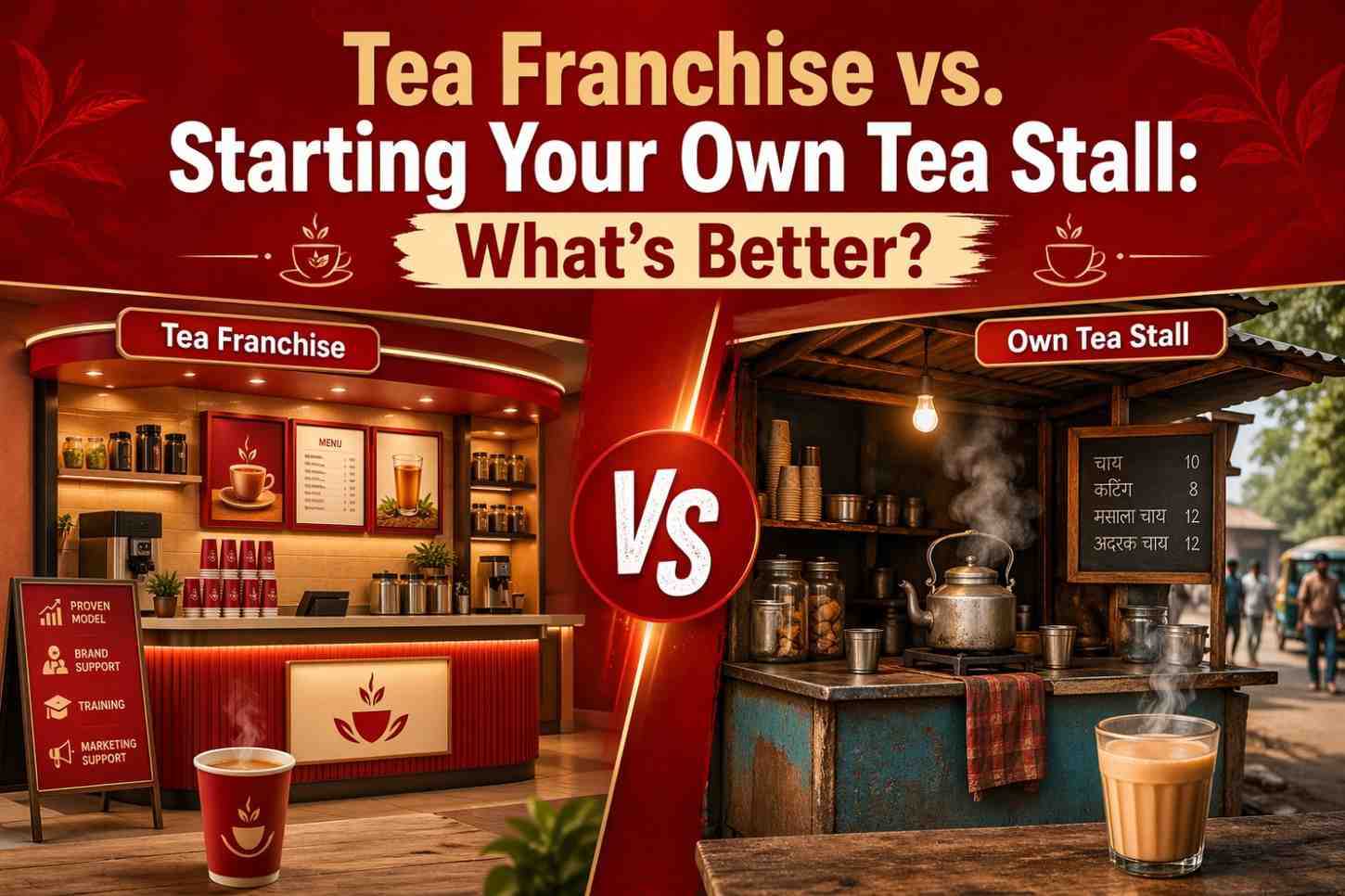
Two Stalls. Same Street. Very Different Stories.
Nagpur. 8:40 in the morning. A busy stretch just outside a government office compound.
On one side of the road, a young man named Rajan has set up a tea stall. He has been here for eleven months. The plastic banner he made at a local print shop is starting to peel at the corners. He uses a recipe his mother taught him, a good recipe, but it changes slightly depending on which milk vendor he gets that morning. Some days it is perfect. Some days it is close.
On the other side, a Yewale Amruttulya outlet opened six weeks ago. The signage is clean. The counter is identical to one you might have seen in Pune or Aurangabad. At 8:40 AM, there is a line of seven people. One of them was Rajan's customer until last month.
Rajan is not a bad businessman. He works hard, opens on time, and knows most of his regulars by name. But something is not adding up for him, and he is not entirely sure what it is.
The difference between the two stalls is not the tea. It is the system behind the tea.
India Has Millions of Chai Stalls. Very Few Have a System.
There are an estimated twelve million tea stalls operating across India. They are everywhere: outside every hospital, beside every school gate, at the corner of every market lane. Chai is the most consumed beverage in the country, and the demand has never been in question.
And yet, the average independent tea stall in India does not survive past three years. According to small business studies on the Indian street food sector, the failure rate of unbranded food and beverage carts within the first twenty-four months hovers above fifty percent. The reasons are predictable: inconsistent product quality, no marketing advantage, thin margins, high dependency on footfall that takes years to build.
Meanwhile, the organized chai retail segment, which includes franchise models, is growing at over twelve percent annually. Not because the product is dramatically better. But because the business model underneath it is structured to survive the things that quietly kill independent stalls.
There is a question that every aspiring tea entrepreneur asks at some point: should I start my own thing or take a franchise? It sounds like a question about money. But it is actually a question about systems, time, and the cost of uncertainty.
Both paths serve chai. Only one of them has a blueprint.
Why the Decision Matters More Than It Seems
Most people approach this choice the way they would compare two products on a shelf: price, features, gut feeling. That is the wrong framework.
The real question is not which option costs less upfront. It is which option reduces the number of things you have to figure out on your own, and at what cost.
Starting your own stall means you are building three things simultaneously: a product, a brand, and a business process. Each of these requires a different kind of knowledge. Most first-time entrepreneurs are good at one, decent at another, and completely unprepared for the third. The one they are unprepared for is usually the business process, and that is the one that quietly determines whether the stall survives.
A franchise model separates these three challenges. The product is already developed and tested. The brand already has equity. What the franchisee builds is the local execution, which is the part they are actually closest to and best equipped to handle.
This is not a small distinction. It is the entire difference between starting from scratch and starting from a base.
Independence and isolation are not the same thing. A franchise gives you the first without forcing you into the second.
Five Differences That Actually Change the Outcome
1. The Brand Does the First Thirty Days of Work for You
When you open an independent stall, your first month is spent converting strangers into first-time customers. This takes time, consistency, and luck. A well-placed stall might take three to six months to build a reliable daily footfall.
A Yewale Amruttulya outlet in the same location starts with a different dynamic. The name is already familiar to a large portion of the city. People who have drunk Yewale chai in another part of town do not need convincing. They just need to know there is one nearby. The brand does the introduction. The franchisee does the operation.
In business, the cost of customer acquisition is real and often underestimated. A franchise model shifts much of that cost from the individual owner to the brand at large. The franchisee benefits from marketing and recognition that they did not have to build or pay for independently.
2. Consistency Is a Competitive Advantage, Not Just a Quality Metric
Rajan's chai is genuinely good on most days. But on the days it is slightly different, a customer notices. They may not say anything. They may not even consciously register it. But the next time they are choosing between Rajan's stall and the Yewale outlet across the road, that small uncertainty tilts the scale.
Standardized recipes, supplier networks, and preparation protocols are not just about maintaining quality. They are about eliminating the micro-decisions that create inconsistency. In an independent stall, the owner makes dozens of small judgment calls every day: how much ginger, which masala batch, how long to simmer. In a franchise, those decisions are already made. The result is the same cup, every time.
Consistency is what converts a first-time customer into a regular. And regulars are the only metric that really matters in a chai business.
3. Training and Support Compress Your Learning Curve
The typical independent tea stall owner learns by doing. Trial and error over months teaches them what works and what does not. This is a valid education, but it is expensive in both time and early losses.
A franchise model like Yewale Amruttulya provides onboarding training, operational support, and ongoing guidance. The franchisee enters with a compressed version of the knowledge that took the brand years to accumulate. Mistakes that typically cost independent operators their first six months of profit are avoided because someone else already made them, documented them, and built a process to prevent them.
This is especially important for first-time business owners. The learning curve is still there, but it is much shorter and much less costly.
4. Independent Stalls Have More Freedom. Franchise Owners Have More Focus.
This is the honest tradeoff, and it deserves to be stated plainly. When you own an independent stall, you decide everything: the name, the menu, the packaging, the hours, the promotions. If you have strong instincts and a clear vision, that freedom is genuinely valuable.
But freedom without structure creates a different kind of burden. The independent stall owner is always building and always deciding. Every day brings a new set of questions that have no established answer. Over time, this wears down even capable operators.
A franchisee operates within a system. The big decisions are already made. The focus narrows to what actually drives daily success: location execution, customer service, and local relationship-building. For most people running a single outlet, narrower focus produces better outcomes than unlimited options.
5. Scalability Is Built into the Franchise Model from the Start
Most independent tea stall owners who succeed at one location face a wall when they try to open a second. The product was personal to them. The process lived in their head. Teaching it to someone else, replicating the exact experience in a different location, turns out to be far harder than expected.
Franchise systems are designed to be replicated. The same training, the same supplier network, the same operational manual that made the first outlet work, makes the second outlet work just as reliably. For a franchise owner who wants to grow beyond one location, the system is already built for it. The independent stall owner has to build that system themselves, usually after years of single-outlet operation.
The Numbers Behind the Choice
Consider two people starting a tea business in the same Tier 2 city at the same time. The first opens an independent stall with an investment of two to three lakh rupees. The second opens a Yewale Amruttulya franchise.
The independent stall owner spends the first three months figuring out the recipe, building footfall, and adjusting pricing. Revenue in this period is low and unpredictable. By month six, if things go reasonably well, daily sales might reach two hundred cups at an average of forty rupees, generating around eight thousand rupees per day or roughly two lakh forty thousand rupees per month.
The franchise owner, starting with a recognized brand and standardized operations, often reaches two hundred to two hundred fifty cups per day within the first four to six weeks. At an average ticket of sixty to seventy rupees including snacks, monthly revenue runs between four lakh and four lakh fifty thousand rupees. The higher ticket size reflects the brand premium that customers associate with a known name.
The gap is not just in volume. It is in time. The franchise owner reaches operational stability two to three months faster. In a business where each month of lower revenue is a real cost, that time difference is also a financial difference.
Both paths can be profitable. But one reaches profitability faster, with less uncertainty, and with a clearer roadmap to a second outlet.
Side by Side: How the Two Models Compare
The table below maps key factors across both options to help you make a clear, informed decision:
| Factor | Own Tea Stall | Tea Franchise (Yewale) | Advantage |
| Brand Recognition | Zero on Day 1 | Immediate, proven trust | Franchise |
| Setup Time | 3 to 6 months | 30 to 45 days | Franchise |
| Recipe & Training | Self-developed, trial & error | Standardized, supported | Franchise |
| Customer Acquisition | Slow, word of mouth only | Brand pulls walk-ins from Day 1 | Franchise |
| Risk of Failure | Higher (no system backup) | Lower (proven model) | Franchise |
| Investment Control | Flexible, can start small | Fixed structure, planned ROI | Own Stall |
| Creative Freedom | Full ownership of decisions | Within brand guidelines | Own Stall |
| Scalability | Difficult without a system | Replicable across locations | Franchise |
This comparison reflects general market patterns. Individual outcomes depend on location, execution, and local market conditions.
What Rajan Figured Out, Eventually
Three months after the Yewale outlet opened across from his stall, Rajan did something unexpected. He walked in, ordered a cutting chai, and sat down for a few minutes.
He was not there to spy. He was watching. How the counter was laid out. How quickly orders moved. How customers paid and left without any friction. How the person behind the counter did not seem to be making a hundred decisions at once.
Later he said something worth considering: it is not that they are doing something I cannot do. It is that they already know what to do. I am still figuring it out.
This is the honest reality of the choice between starting your own stall and taking a franchise. The independent path is not wrong. It is simply harder in ways that are not always visible at the start. The franchise path does not remove risk. It removes the risk of having to invent the wheel.
For most people who want to build a sustainable, scalable tea business in India right now, the question is rarely about the quality of the tea. The tea can be great either way. The question is whether you want to spend the first two years building the system, or the first two years running it.
You know your answer. What is stopping you from acting on it?
Yewale Amruttulya | India's Trusted Chai Franchise
yewaleamruttulya.com
