
She Wasn't Looking for Chai. She Was Looking to Feel Better.
Meghna stopped at her usual Yewale outlet in Nagpur on a cold, congested-throat kind of evening, the sort where a regular cutting chai did not feel like quite the right order. She almost skipped her tea break altogether, then noticed Ginger Tea listed on the counter board, something she had walked past a hundred times without really registering. She asked for that instead, mostly on instinct.
It helped, or at least it felt like it did, the warmth and the sharp ginger bite doing exactly what she wanted on a day she felt slightly under the weather. She came back for the same order three more times that week, and started mentioning to colleagues that the outlet did a proper ginger tea, not just the regular one with a pinch of ginger in it. None of this required Yewale to launch anything. The Ginger Tea had been on the menu the entire time. What changed was that, for a moment, it stopped being background and started being the reason she walked in.
India's Beverage Habits Are Shifting From Taste-First to Benefit-First
There is a real, well-documented shift happening in what Indian consumers want from a beverage, and it works directly in favour of a menu like Yewale's. India's functional beverages market, drinks people choose specifically for a wellness benefit rather than taste alone, reached roughly ₹65,900 crore in 2025 and is projected to grow to about ₹1.8 lakh crore by 2034, a compound annual growth rate of 10.74%. The ingredients driving that growth are not exotic imports; they are turmeric, ginger, tulsi, and jaggery, the same everyday ingredients that have always been part of Indian tea-making, now being actively sought out rather than taken for granted.
This same shift is visible inside the tea category itself. India's tea market, valued at roughly ₹1.13 lakh crore to ₹1.16 lakh crore in 2025 depending on the source, is expected to grow past ₹1.4 lakh crore by 2034, and industry trend reports specifically note that heading into 2026, Indian consumers are increasingly choosing tea blends associated with immunity support, digestion, and relaxation over blends chosen for taste alone. A cup of chai is no longer just a break in the day; for a growing share of customers, it is a small, deliberate wellness choice.
(Figures converted from USD at an approximate rate of ₹95.5 per US dollar, August 2026.)
| Wellness Beverage Data Point | Figure (INR) | Source |
|---|---|---|
| India functional beverages market, 2025 | ₹65,900 crore, growing to ₹1.8 lakh crore by 2034 (10.74% CAGR) | IMARC Group |
| India tea market, 2025 | ₹1.13-1.16 lakh crore, growing past ₹1.4-1.9 lakh crore by 2033-34 | IMARC Group / Grand View Research |
| Consumer shift in tea preference heading into 2026 | Growing demand for blends associated with immunity, digestion, and relaxation over taste alone | Alexa Tea, 2026 |
| Key ingredients driving the shift | Turmeric, ginger, tulsi, jaggery, and other everyday Ayurvedic staples | IMARC Group / Coherent Market Insights |
What's Already on the Yewale Menu for This Moment
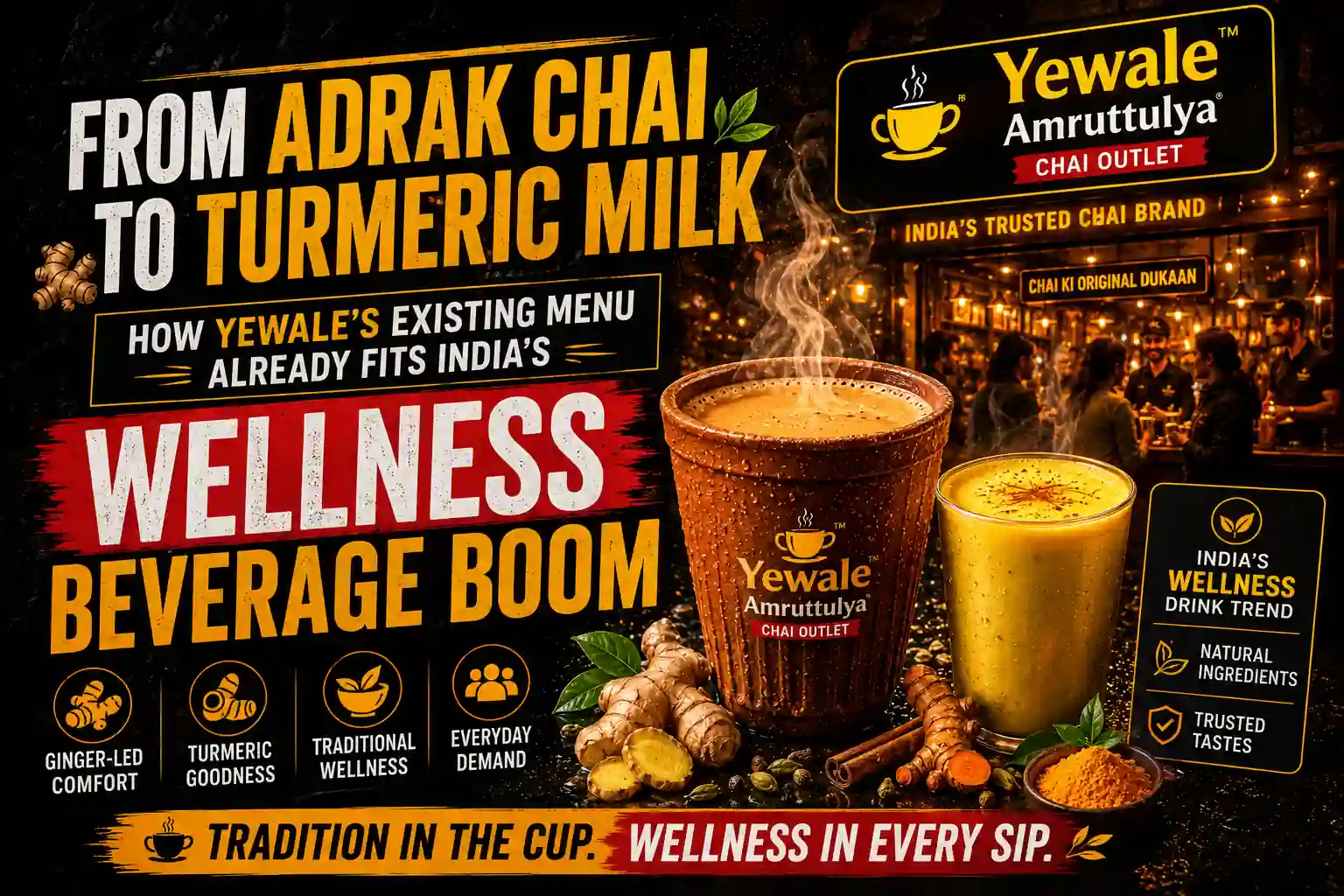
The most useful part of this trend, for an existing franchisee, is that almost nothing needs to change on the supply side. Yewale's menu already includes Ginger Tea, Jaggery Tea, and Turmeric Milk alongside the regular chai, each built on exactly the ingredients consumers are now actively seeking out. These items have typically been positioned as simple variety on the menu board. The opportunity in 2026 is to reposition them, gently and honestly, as the outlet's answer to a customer looking for something more than a regular cup, without turning the counter into a pharmacy or making promises the tea cannot keep.
| Menu Item | Everyday Ingredient | Why It Fits the Trend |
|---|---|---|
| Ginger Tea | Fresh ginger | A traditional go-to for cold weather and a scratchy throat, matching rising demand for ginger-based drinks |
| Jaggery Tea | Jaggery instead of refined sugar | Appeals to customers actively moving away from refined sugar in everyday beverages |
| Turmeric Milk | Turmeric | Turmeric is one of the most consistently cited ingredients across India's wellness beverage growth |
How to Talk About It Honestly, Without Overpromising
The right way to lean into this trend is careful, and worth getting right. These are traditional ingredients that Indian households have relied on for generations, and it is fair and accurate to say that customers commonly turn to ginger, turmeric, and jaggery for comfort and wellbeing, particularly during the colder, post-festival months. It is not accurate, and not advisable, to claim that any menu item cures or treats an illness, or to make specific medical promises at the counter or in marketing. A counter card that says “our Ginger Tea, made the traditional way, for the days you want something warm and comforting” does honest, effective work. A claim that a drink boosts immunity in a measurable sense does not belong on a chai counter, and it exposes the outlet to more risk than the extra sale is worth.
Positioning the Wellness Corner at the Counter
- Give Ginger Tea, Jaggery Tea, and Turmeric Milk their own small, clearly labelled section on the counter board rather than burying them in a long list of regular options.
- Time the push to the season: the weeks after the festival quarter, running into winter, are when customers are most naturally looking for something warm and comforting beyond the usual cup.
- Use simple, honest language on any counter card or social post, describing the tradition behind the ingredient rather than making a specific health claim.
- Train staff to mention these options naturally to a customer who seems unwell or mentions feeling low on energy, the same way Meghna discovered her Ginger Tea, through a small, well-timed suggestion rather than a hard sell.
- Track how often these items sell relative to regular tea through the winter months, cross-checking the full product range on the Yewale website for any seasonal additions worth featuring alongside them.
Key Takeaways
- India's functional beverages market is growing from roughly ₹65,900 crore in 2025 to a projected ₹1.8 lakh crore by 2034, driven by everyday ingredients like turmeric, ginger, tulsi, and jaggery.
- The tea category itself is shifting, with Indian consumers increasingly choosing blends for perceived wellness benefits rather than taste alone heading into 2026.
- Yewale's Ginger Tea, Jaggery Tea, and Turmeric Milk, all listed on the official product menu, already sit squarely inside this trend without requiring any new product development.
- Repositioning these items means honest, tradition-based language, not medical claims, which protects both the customer's trust and the outlet.
- A clearly labelled wellness section on the counter board, timed to the post-festival winter season, is a low-cost way to turn an overlooked menu item into a repeat order.
Meghna still orders the regular chai most days. But on the days she doesn't feel quite herself, she knows exactly what to ask for now, and so does the counter staff before she finishes the sentence.
How many items on your menu are already doing this kind of work, quietly, waiting for a customer to notice them for the first time?
