
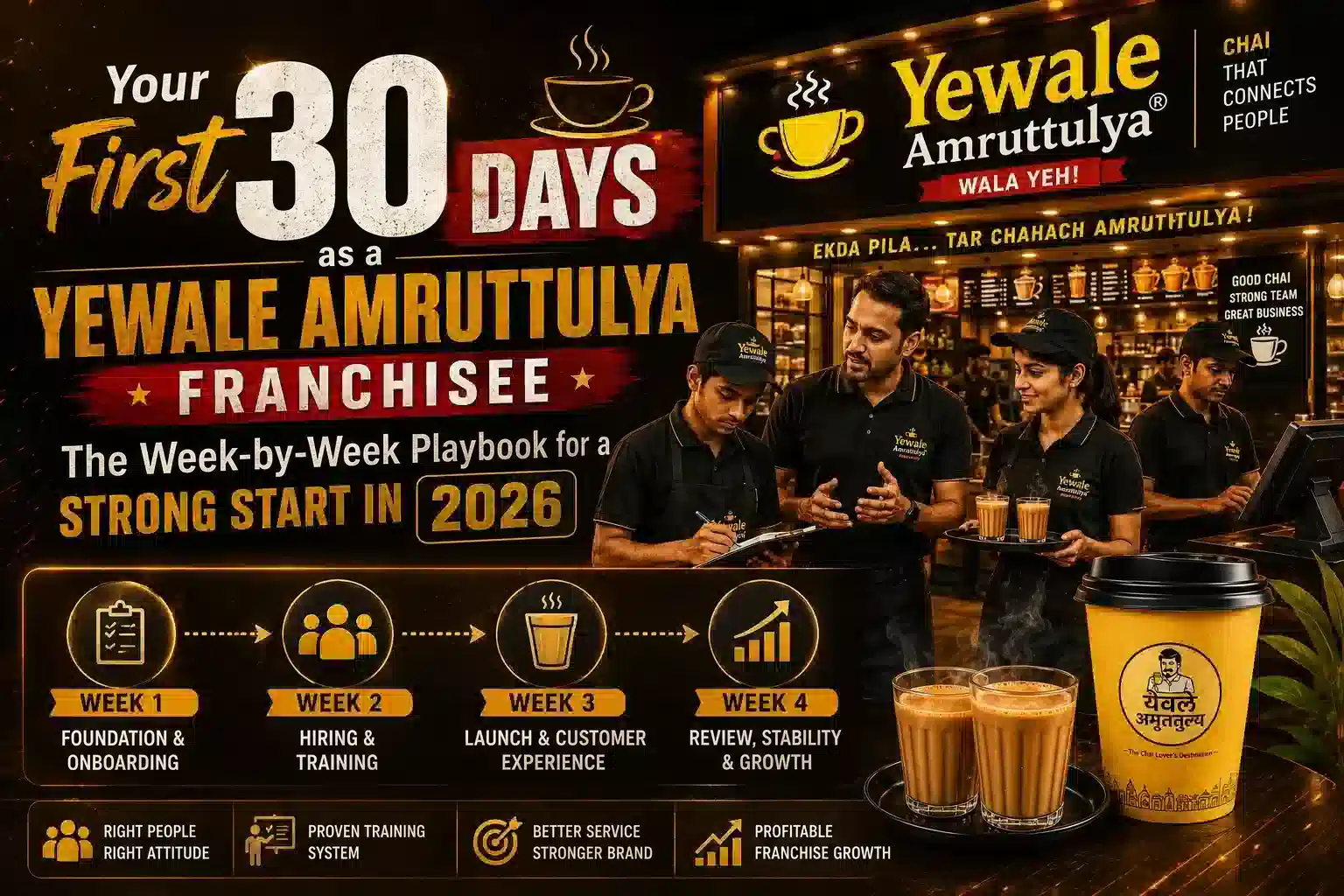
The First Cup He Served Cost Him Nothing. The Regular It Created Was Worth Thousands.
Nikhil had spent four months getting his Yewale Amruttulya outlet ready in Kolhapur. Lease signed, setup done, staff trained, display ready. He had rehearsed the opening in his head a dozen times.
On day one, before he even officially opened, a man walked past the freshly painted shutter and peered in. Nikhil was inside still arranging the counter.
He invited the man in. Made him a cup of chai on the spot. Free. No transaction, no pitch, just: sit, drink, tell me what you think.
The man was a manager at the textile warehouse two lanes away. He came back the next morning with seven colleagues. All paid. All regulars within the week.
Nikhil calls that free cup the best ₹18 he never charged.
Here is what the most successful franchise launches in 2026 consistently show: the first 30 days are not about maximizing revenue. They are about building the habits, relationships, and systems that will generate revenue for the next five years. The owner who treats the first month as a foundation-laying period consistently outperforms the one who treats it as a revenue sprint.
This blog gives you the complete week-by-week playbook for the first 30 days of a Yewale Amruttulya franchise, what to do, what to track, what mistakes to avoid, and what the data says about why each step matters.
Before Day One: The Final Week Checklist
The first 30 days start before you open the shutter. The week before launch is when small preparation gaps become operational surprises on opening morning. Run through these confirmations in the final seven days.
- Supply stock confirmation: All ingredients, snack inventory, packaging, and consumables are physically in hand and checked against your opening requirements. Assume you will sell 30% more than expected on Day 1 and stock accordingly.
- Staff dry run: Your team has served simulated orders at least twice before serving a real customer. Speed, process adherence, and counter behaviour have all been practiced, not just discussed.
- Counter display walk-through: Your display is set exactly as trained, with snacks at eye level and the most visually appealing items at the front. Ask someone who has never seen your outlet to stand at the door and tell you what they notice first.
- Google Business Profile claimed: Your outlet is listed on Google with the correct address, hours, phone number, and at least one photo. In 2026, over 80% of consumers search local businesses online before visiting for the first time.
- Utilities and payments confirmed: Gas, water, electricity, and UPI payment capabilities are all tested and working. A payment failure on opening day creates a disproportionately negative first impression.
- One personal introduction round done: You have visited at least five nearby businesses, offices, or institutions before opening day and introduced yourself and your outlet informally.
Week 1: Plant the Seeds of Your Regular Customer Base
The most important thing about Week 1 is not how much revenue you generate. It is how many people walk away with a reason to come back. A customer who came, liked it, and has a reason to return is worth far more than a customer who came, bought, and forgot.
| Day | Priority Tasks | Why It Matters |
| Day 1 | Meet every local regular and nearby business owner personally. Hand out free sample cups to the first 50 visitors. | First impressions compound. The person who remembers how you opened is the one who becomes a daily regular. |
| Day 2 to 3 | Set your counter display as taught. Snacks at eye level. Chai menu clearly visible. No clutter. | Visual merchandising drives impulse sales. A clean, well-lit display does passive selling round the clock. |
| Day 4 to 5 | Observe your peak hours closely. Track approximate cup count in morning, afternoon, and evening windows. | Your specific footfall pattern becomes clear within the first week. That data shapes every staffing and stocking decision going forward. |
| Day 6 to 7 | Identify your five best early regulars. Greet them by name if possible. Note what they order. | Loyalty research consistently confirms that customers who are personally recognized become exponentially more likely to return and refer. |
The Free Sample Strategy: Why It Still Works in 2026
New franchise launch guidance consistently includes early sampling as a cost-effective footfall builder. The logic is straightforward: the marginal cost of one cup of chai is ₹3 to 5. The potential lifetime value of a daily regular is tens of thousands of rupees over a year. Offering 50 free cups in the first week to bring in 10 new regulars is one of the highest-return investments available to a new franchisee.
The 2026 launch playbook from franchise operations experts confirms this: pre-launch sampling and day-one offers build the word-of-mouth momentum that sustains footfall growth in the critical second and third weeks, when opening-day novelty fades and actual habits begin forming.
Week 2: Build Your Local Network and Digital Presence
By the start of Week 2, you know roughly what your footfall pattern looks like and who your early regulars are. Week 2 is about extending that base outward, into the surrounding businesses and onto digital platforms where new customers in 2026 first discover local options.
| Day | Priority Tasks | Why It Matters |
| Day 8 to 10 | Set your fixed weekly staff schedule. Confirm timing, roles, and responsibilities with every team member. | Schedule predictability is the single most cited reason hourly staff stay or leave. Set this habit early. |
| Day 11 to 12 | Walk your 200-metre radius. Visit nearby offices, colleges, clinics, and shops. Introduce yourself and your outlet. | Relationship marketing within walking distance produces compounding footfall with zero advertising cost. |
| Day 13 to 14 | Create your Google Business Profile if not done. Confirm your outlet address, hours, and photos are accurate. | Over 80% of consumers search for local businesses online before visiting in 2026. A complete GBP listing directly drives new walk-in customers. |
The 200-Metre Radius Principle
Research on neighbourhood business loyalty consistently shows that the majority of a chai outlet's daily customer base comes from within a 200 to 500-metre walking radius. This means that every office, shop, clinic, school, and residential building within that radius is a potential source of regulars. Walking that radius in Week 2, introducing yourself personally, and handing out a simple card or WhatsApp contact takes two hours total and can produce footfall that no advertising budget would replicate at the same cost.
Why Google Business Profile Matters More Than Instagram in 2026
Many new franchise owners in 2026 prioritize Instagram over Google, because Instagram feels more active. But the data tells a different story for local, walk-in businesses. Google Search and Google Maps remain the primary discovery channel for local food and beverage businesses. A customer who searches 'chai near me' or 'tea outlet Kolhapur' on Google at 6:45 AM is an extremely high-intent, immediate visitor. A complete, photo-rich Google Business Profile captures that customer. An Instagram post does not.
Week 3: Optimize What You Have Learned
By Week 3, you have two weeks of real-world data. You know which hours are strongest and which are slow. You know which snacks move and which sit. You know which staff interactions generate return visits and which feel transactional. Week 3 is the first genuine optimization window.
| Day | Priority Tasks | Why It Matters |
| Day 15 to 17 | Evaluate which snack items are moving fastest. Adjust display prominence and restock rhythm accordingly. | Data-driven display decisions maximize snack revenue, which contributes up to 30% of daily totals in well-run outlets. |
| Day 18 to 19 | Run your first simple local WhatsApp promotion. Share your outlet location, menu, and a simple opening offer through WhatsApp status and local groups. | WhatsApp reach in Tier 2 and 3 Indian cities often exceeds Instagram. A single well-timed status post can bring in 10 to 15 new walk-ins within hours. |
| Day 20 to 21 | Review your first two weeks of rough daily revenue. Calculate your actual cost-to-revenue ratio against your projection. | Catching a gap between projection and reality in week three allows you to course-correct in week four, not month six. |
WhatsApp Marketing: The Underrated 2026 Outreach Channel for Tier 2 Cities
WhatsApp status reaches contacts who already know you or your area. In smaller Indian cities, neighbourhood business groups on WhatsApp remain highly active and genuinely engaged. A single post with your outlet photo, location pin, and an opening week offer, shared across three or four relevant local groups, consistently produces immediate walk-in conversions. This costs nothing and takes 15 minutes.
The Revenue Review Conversation You Must Have in Week 3
Most new franchise owners are either pleasantly surprised by their first two weeks of revenue or quietly worried that numbers are lower than expected. Either way, the Week 3 revenue review is critical because it gives you time to course-correct before the end of Month 1. The questions to ask are specific: Which daypart is underperforming? Is it a footfall problem, a display problem, or a product visibility problem? What one change, tested this week, would tell me if the issue is fixable quickly?
Week 4: Set the Foundation for Month 2 and Beyond
Week 4 is the transition week. The opening novelty has fully faded. What you are left with is your real baseline: the footfall, revenue, and customer patterns that will define your outlet's performance in the months ahead. Week 4's job is to assess that baseline honestly and set the intention for Month 2.
| Day | Priority Tasks | Why It Matters |
| Day 22 to 24 | Identify your three weakest revenue hours. Plan one specific change for each: adjusted display, a product push, a verbal prompt from staff. | Targeting your three slowest windows with a specific intervention is far more effective than broadly hoping footfall improves. |
| Day 25 to 27 | Have a 5-minute individual check-in with each staff member. Ask: what is working? What is frustrating? What would make their job easier? | HR research shows 60 to 90 days is when attrition signals become visible. Catching them at day 25 is still early enough to fix them. |
| Day 28 to 30 | Set your Month 2 targets: daily cup goal, snack attachment rate goal, one new regular customer to convert per day. | A business without explicit targets drifts. Writing down specific Month 2 goals at the end of Month 1 is the simplest possible version of strategic planning. |
Setting Month 2 Targets: Simple but Non-Negotiable
The most consistent finding across new franchise operator research is that franchisees who set explicit, written targets at the end of Month 1 outperform those who operate on instinct alone. The targets do not need to be complex. A daily cup goal. A snack attachment rate target. A number of new regulars to identify per week. Three measurable intentions for Month 2, written on paper and reviewed weekly, are more valuable than any sophisticated business plan.
The 6 Most Common First-Month Mistakes and How to Avoid Them
| Mistake | What Actually Happens | What to Do Instead |
| Overstocking all items from day one | Wastage in week one, cash flow pressure before revenue builds | Start with core items, add variety based on actual demand signals from the first week |
| Waiting for customers to find you | Slow first two weeks that discourage the owner before momentum builds | Actively introduce yourself to every nearby business and office in the first two weeks |
| Ignoring the afternoon lull as permanent | Leaving 10% to 15% of daily revenue potential uncaptured every day | Try one specific afternoon product push each week until you identify what activates that window |
| Trying to out-discount nearby tapris | Margin erosion, and customers who come only when you discount | Compete on consistency and cleanliness, not price. Let the brand identity do the differentiation |
| Skipping daily revenue tracking in the first month | No baseline to measure against, no early warning if something is wrong | A simple daily cup count and cash summary takes 10 minutes and creates the most valuable data of your first year |
| Assuming the first week represents normal operations | Panic when week two is lower, or overconfidence if week one was unusually high | The first 30 days are the baseline-building period. Real patterns emerge in months two and three |
Why the First Month Is Not a Revenue Sprint
Industry data on QSR franchise launches confirms that break-even for tea franchises typically occurs between months 7 and 11 depending on location quality, according to Yewale's own 2026 ROI analysis. This means the first month's job is not to hit profit. It is to build the customer base, systems, and habits that will produce profit consistently from month four onward. Measuring Month 1 against a profit expectation sets up unnecessary anxiety. Measuring it against a relationship-building and system-building standard tells you whether the franchise is on the right trajectory.
What to Actually Measure in Your First 30 Days
Data is only useful if you collect it and act on it. Here are the six metrics worth tracking carefully in Month 1, what they tell you, and what a healthy number looks like at the end of 30 days.
| Metric | How to Track It | What a Good Number Looks Like at Day 30 |
| Daily cup count | Manual tally at end of each day split by morning, afternoon, evening | 200 to 250+ cups/day for a good footfall location |
| Snack attach rate | Snack items sold divided by total beverage orders | 25% to 35% (1 in 3 to 4 chai customers also buys a snack) |
| New regulars identified | Staff to note names or faces of repeat visitors informally | At least 15 to 20 customers visiting 3+ times in Month 1 |
| Revenue vs. projection | Daily cash total vs. your pre-launch forecast | Within 80% of projection by end of Week 4 is a healthy trajectory |
| Staff stability | Any exits, any warning signs | Zero exits, all shifts covered without last-minute scrambling |
| Peak hour performance | Cups served per hour during morning and evening rush | 40 to 60 cups per hour at full capacity for a 2-staff outlet |
None of these metrics require sophisticated software. A small notebook behind the counter, updated once per shift, produces enough data to make every important decision in your first month. The franchisee who tracks these six things consistently for 30 days understands their outlet better at the end of Month 1 than most outlet owners understand theirs after six months of operating blind.
Ready to start your own journey? Explore the Yewale Amruttulya tea franchise under 8 lakhs and begin building your first 30 days with a 40-year brand behind you.
Key Takeaways
- The first 30 days are foundation, not revenue sprint: The habits, relationships, and systems you build in Month 1 determine your revenue trajectory for years, not the cup count in Week 1.
- Free sampling is the highest-ROI launch investment: The marginal cost of 50 free cups is trivial. The daily regular that each converted visitor can become is worth tens of thousands over a year.
- Your 200-metre radius is your most important market: The majority of your regulars will come from within walking distance. Introducing yourself personally to every nearby business in the first two weeks produces compounding footfall at zero cost.
- Google Business Profile before Instagram: For a walk-in chai outlet, being discoverable on Google Search and Maps at 6:45 AM captures higher-intent customers than any social media post.
- WhatsApp outreach works in Tier 2 and 3 cities: Local WhatsApp groups and status posts remain one of the most effective zero-cost marketing channels for neighbourhood food businesses in smaller Indian cities.
- Track six simple metrics daily from Day 1: Cup count, snack attach rate, new regulars, revenue vs. projection, staff stability, and peak-hour pace. Thirty days of this data is your single most valuable business asset entering Month 2.
- Write Month 2 targets at the end of Month 1: Three specific, measurable goals written on paper at Day 30 are worth more than any business plan prepared before opening.
Nikhil's outlet passed 300 daily cups in Month 3. He attributes the trajectory entirely to the discipline of the first 30 days: who he spoke to, what he tracked, which habits he built before revenue pressure made it tempting to cut corners.
The warehouse manager still comes every morning. He brings different colleagues now. The free cup Nikhil served on Day 1 has probably generated more revenue than any single other decision he made in that first month.
If you opened your outlet tomorrow and could only do three things in the first week to build your foundation for the next five years, which three would you choose?
