
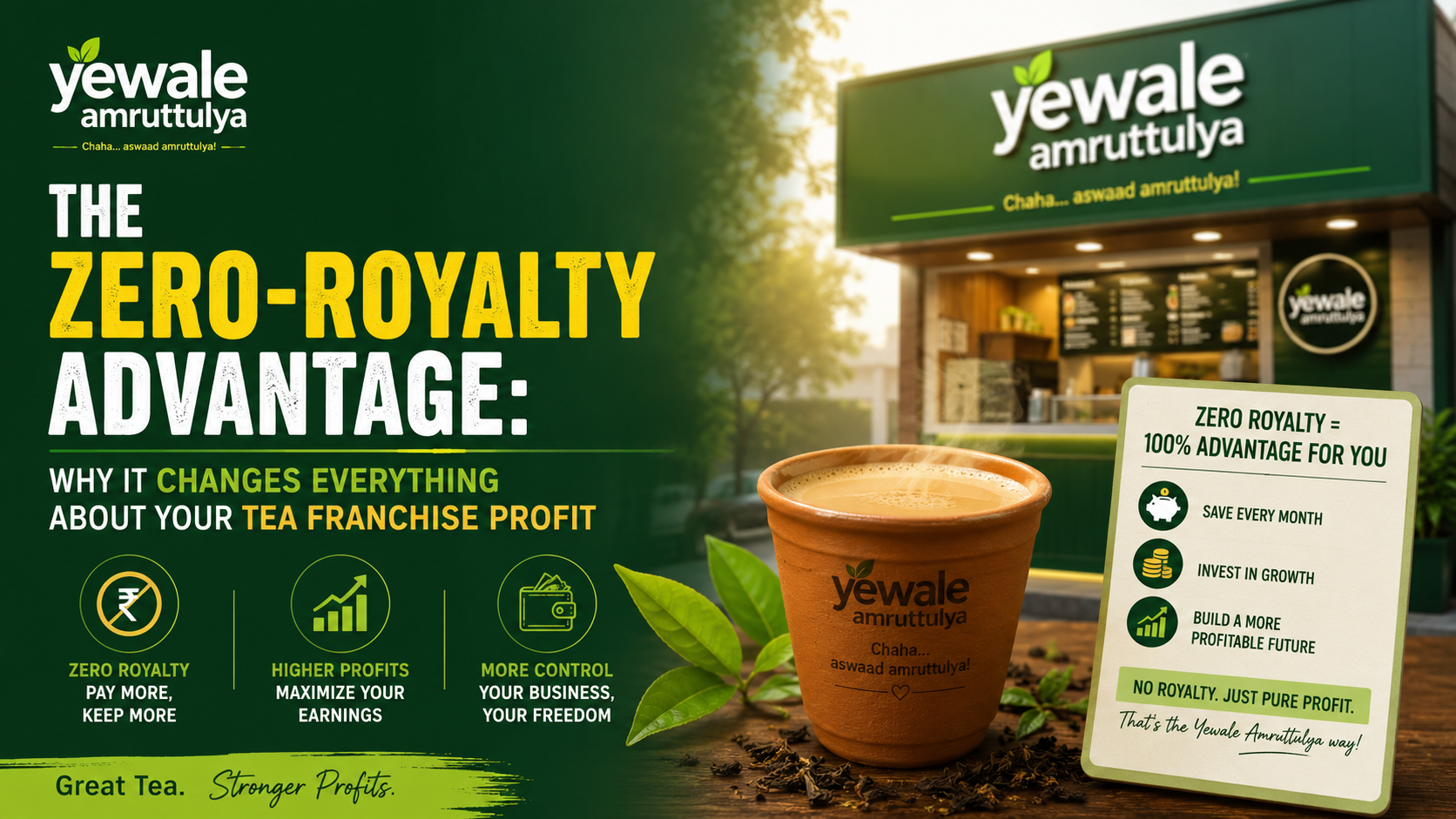
He Read the Agreement on Page One. He Nearly Missed the Most Important Number on Page Nine.
Prashant had been looking at tea franchises for three months. He had shortlisted two options. Both looked similar on the surface. Similar investment. Similar brand presence. Similar location suitability for his hometown in central Maharashtra.
He compared them side by side: investment amount, setup cost, training, product quality. Everything checked out roughly the same.
Then his accountant friend sat down with him and opened both agreements to one specific line: the royalty clause.
Option A: 6% of monthly gross revenue, payable every month, for the entire duration of the franchise agreement.
Option B: Zero. No monthly royalty. Ever.
His accountant took out a calculator. On Prashant's projected revenue of ₹2 lakh per month, Option A would cost him ₹12,000 every single month, whether business was good or slow. Over five years, that was ₹7.2 lakh gone. Money he had earned, money he had served chai for, that would never reach his own pocket.
Here is the number most franchise comparison websites never show you: at a modest ₹2 lakh monthly revenue, a 6% royalty costs a franchisee over ₹7 lakh across five years. At a zero-royalty franchise, that entire amount stays with the business owner.
Prashant chose Option B.
This blog explains exactly why the royalty structure of a franchise is one of the most important financial decisions you will make, and why zero royalty changes the profit equation in ways that compound significantly over time.
What Is a Franchise Royalty Fee and Why Does It Matter So Much?
A franchise royalty fee is a recurring payment that a franchisee makes to the franchisor, typically calculated as a percentage of the outlet's gross monthly revenue. It is separate from the initial franchise fee you pay to get started. It is a recurring cost that continues for as long as you operate under the brand.
According to FranConnect's 2024 franchise fee analysis, the average franchise royalty fee globally ranges between 4% and 12% of gross sales. In the Indian food and beverage franchise sector specifically, royalty fees typically range from 5% to 10% of monthly revenue, according to BossWallah's 2025 franchise cost guide.
The Gerson Advisory research on franchise fee impact confirms that 94% of franchises charge an ongoing royalty, with an average of 6% of monthly revenues. This means that zero-royalty franchises represent a rare but meaningful exception in the franchising landscape.
For a first-time franchisee, the royalty percentage can look small on paper. Six percent. It sounds minor. But the way royalty fees actually work is far more significant than the percentage suggests, and most people only understand it fully after their first year of operation.
The Critical Detail Most New Franchisees Miss: Royalty Is Charged on Revenue, Not Profit
This is the part that surprises most people the first time they see it in an agreement. Royalty is calculated on your gross revenue, not on your net profit. This means that even in a month where your margins are squeezed by high ingredient costs, or a slow week, or a rent increase, the royalty payment remains the same.
If your outlet generates ₹2 lakh in revenue but your operating costs are high that month and your actual profit is only ₹60,000, you still owe 6% of ₹2 lakh. That is ₹12,000 going out the door regardless of what came in.
In a zero-royalty model, that ₹12,000 stays with you. Every single month. No exceptions. No slow-month concessions.
The Real Cost of a Royalty Fee: What It Looks Like at Different Revenue Levels
Most franchise comparison content shows you the entry cost. Very few show you the ongoing royalty drain. Here is what the numbers actually look like across different monthly revenue scenarios.
| Monthly Revenue | Royalty @ 4% | Royalty @ 6% | Royalty @ 8% | Royalty @ 0% (Yewale) |
| ₹1,50,000 | ₹6,000 | ₹9,000 | ₹12,000 | ₹0 |
| ₹2,00,000 | ₹8,000 | ₹12,000 | ₹16,000 | ₹0 |
| ₹2,50,000 | ₹10,000 | ₹15,000 | ₹20,000 | ₹0 |
| ₹3,00,000 | ₹12,000 | ₹18,000 | ₹24,000 | ₹0 |
| Annual drain (₹2L/mo avg) | ₹96,000 | ₹1,44,000 | ₹1,92,000 | ₹0 saved |
The table makes one thing very clear. The higher your revenue grows, the more expensive a royalty-bearing franchise becomes. A successful outlet earning ₹3 lakh per month loses ₹18,000 to ₹24,000 every month to royalty, depending on the rate. That is ₹2.16 lakh to ₹2.88 lakh per year. And it never stops.
According to Franchise Ki's 2025 industry comparison, QSR franchises typically charge 4% to 8% of gross sales in royalty. Given that QSR profit margins generally sit between 6% and 9%, a 6% royalty fee can consume more than half of the margin at the lower end. This is why royalty structure is not a minor footnote in a franchise agreement. It is a core profitability variable.
The Five-Year Picture: How Royalty Compounds Against You Over Time
Here is the number that changes how most people think about franchise fees. Not the monthly cost. The five-year total.
| Year | Cumulative Revenue(₹2L/mo) | Royalty Paid @ 6% | Royalty Paid @ 0%(Yewale) | Extra Profit Keptwith Yewale |
| Year 1 | ₹24,00,000 | ₹1,44,000 | ₹0 | ₹1,44,000 |
| Year 2 | ₹24,00,000 | ₹1,44,000 | ₹0 | ₹2,88,000 (total) |
| Year 3 | ₹24,00,000 | ₹1,44,000 | ₹0 | ₹4,32,000 (total) |
| Year 4 | ₹24,00,000 | ₹1,44,000 | ₹0 | ₹5,76,000 (total) |
| Year 5 | ₹24,00,000 | ₹1,44,000 | ₹0 | ₹7,20,000 (total) |
| 5-Year Total | ₹1,20,00,000 | ₹7,20,000 paid away | ₹0 paid away | ₹7,20,000 retained |
Over five years at a modest ₹2 lakh monthly revenue, a 6% royalty franchise costs you ₹7.2 lakh in royalty payments alone. That is nearly the entire cost of your original investment, paid again, in small monthly slices that feel manageable in isolation but add up to an enormous sum.
At a zero-royalty franchise, every rupee of that ₹7.2 lakh stays in your business. You can use it to open a second outlet. You can build a cash reserve. You can upgrade your location. Or you can simply take it home as profit.
What most people do not realize is this: the zero-royalty advantage is not just about saving money. It is about what you can do with the money you save. The franchisee who keeps an extra ₹12,000 per month for five years has enough to fund a second outlet from that saving alone.
Head-to-Head: Monthly Profit With and Without Royalty
Let us put both models side by side at the same revenue level so the difference is impossible to miss.
| Profit Factor | Traditional Franchise (6% royalty) | Yewale Amruttulya (0% royalty) |
| Monthly revenue (typical outlet) | ₹2,00,000 | ₹2,00,000 |
| Monthly royalty deduction | ₹12,000 | ₹0 |
| Operating costs (est.) | ₹84,000 | ₹84,000 |
| Net monthly profit | ~₹1,04,000 | ~₹1,16,000 |
| Profit margin | ~52% | ~58% |
| Extra profit per month | ₹12,000 more | |
| Extra profit per year | ₹1,44,000 more | |
| Break-even on ₹8L investment | ~8 to 9 months | ~7 to 8 months |
The profit margin gap looks modest in percentage terms, 52% versus 58%. But in rupee terms, the zero-royalty franchisee earns ₹12,000 more every single month. That is ₹1.44 lakh more per year. And because break-even arrives faster, the zero-royalty franchisee starts that compounding advantage sooner.
The Break-Even Speed Advantage
A faster break-even is not just a financial metric. It is a psychological and strategic advantage. When you recover your investment sooner, you operate from a position of strength rather than recovery. You make decisions with confidence rather than anxiety. And you begin building toward expansion while a royalty-bearing franchisee is still working off their original investment cost.
What Smart Franchisees Do With the ₹12,000 They Do Not Pay in Royalty
The zero-royalty saving is most powerful when it is actively used, not just passively retained. Here is what the most growth-oriented Yewale franchisees do with the extra margin they keep every month.
| What You Can Do With ₹12,000/Month Extra | Business Impact |
| Stock more snack variety at the counter | Higher snack attach rate, more impulse revenue |
| Add a small banner or counter display update | Better product visibility, more walk-ins |
| Train a second staff member for peak hours | Faster service, higher customer satisfaction |
| Save toward a second outlet deposit | Expansion in 12 to 18 months instead of 3 years |
| Build a 3-month operating cash reserve | Zero financial stress during slow months |
| Invest in seasonal promotions | Spike revenue during festivals and summer |
Every one of those uses compounds. More snack variety increases monthly revenue. Better display increases attach rates. A second staff member improves customer experience and reduces rush-hour chaos. A second outlet doubles your income base entirely.
The franchisee who treats the zero-royalty saving as a reinvestment fund builds a significantly different business over five years than one who simply pockets it. Both outcomes are better than paying it away in royalty, but the reinvestment path creates the greatest long-term advantage.
How Does a Zero-Royalty Franchise Model Actually Work?
When people hear 'zero royalty,' a common first reaction is skepticism. How does the brand make money if not from royalties? Is there a catch hidden somewhere?
According to One Bite's zero-royalty franchise analysis, zero-royalty franchisors generate income through other streams including the initial franchise fee, mark-ups on raw materials and supply chain products, training fees, branding kits, and setup assistance. Their profit model shifts from revenue sharing to volume-based support services.
This model is actually better aligned with franchisee success than a traditional royalty model. Here is why. In a royalty model, the franchisor earns more when you sell more, but they also earn when you sell less. Their income is not tied to your net profitability. In a zero-royalty model, the franchisor grows by expanding the network, adding more outlets, and benefiting from the volume of supply chain and standardized ingredients flowing through more locations. Their growth depends on your growth, not on your revenue regardless of your cost structure.
The Alignment of Incentives in a Zero-Royalty Model
This alignment matters more than most first-time franchisees realize. When your franchisor earns from expanding the network rather than from your monthly revenue, their incentive is to make your outlet successful enough that you want to open a second one. That is a fundamentally different relationship than one where the franchisor's income continues regardless of whether your outlet is thriving or struggling.
A zero-royalty franchisor needs franchisees who stay, grow, and expand. That requires them to support you with better training, better supply chain, and better operational systems than a royalty-based franchisor who gets paid either way.
Why Zero Royalty Matters Especially in the Tea Franchise Business
Tea franchises operate on high transaction volume and relatively small average ticket sizes. A typical tea outlet might process 250 to 300 transactions per day at an average of ₹18 to ₹25 per transaction. That volume is the strength of the model. But it also means that small percentage deductions have an outsized impact on net income.
According to Franzy's franchise royalty analysis, fast-food and beverage franchises tend to fix royalty rates at around 5% precisely because of high-volume, low-margin sales. Even at 5%, on a tea outlet doing ₹2 lakh monthly, that is ₹10,000 per month that disappears without generating any additional value for the franchisee.
The per-cup economics of tea are strong. Raw material costs run ₹2 to 3 per cup. Retail price runs ₹15 to 20. That margin looks excellent until you subtract a 5% to 8% royalty from every single transaction. At that point, the royalty is effectively consuming a significant portion of the margin on the most affordable items on the menu.
A zero-royalty model preserves the entire per-cup margin for the franchisee. This is especially significant at the entry price points where tea outlets generate the bulk of their volume, the cutting chai, the masala chai, the everyday beverages that drive daily footfall.
Want a franchise where every rupee you earn stays with you? Explore the Yewale Amruttulya tea franchise under 8 lakhs and see what zero royalty means for your monthly income.
Questions Every Franchisee Should Ask Before Signing a Royalty Agreement
If you are evaluating any tea franchise or food and beverage franchise, here are the questions that every smart investor should get answered in writing before signing.
What is the exact royalty percentage and how is it calculated?
Insist on clarity: is it on gross revenue, net revenue, or per unit sold? The calculation method changes the actual cost significantly.
Are there any additional fees beyond royalty?
Many franchises charge a marketing fund contribution of 1% to 3% on top of the royalty. A brand advertising fee. A technology platform fee. These add up and should be calculated into your total cost before comparison.
Does royalty apply even in months of lower revenue?
Most royalty agreements apply the percentage regardless of whether the month was profitable or not. Understand your minimum payment obligations before committing.
What does the royalty actually fund?
Ask specifically: what services, support, or brand building is the royalty financing? If the answer is vague or if you are already receiving those services through other means, the royalty is a pure cost with no corresponding benefit.
What happens if I want to exit the franchise?
Some royalty-bearing agreements have significant exit penalties or minimum royalty commitments that extend beyond your active operating period. Know your exit terms before you sign your entry terms.
Key Takeaways
- Royalty is charged on revenue, not profit: Even in a slow month, a 6% royalty drains 6% of your gross revenue. That happens whether you are profitable or not.
- The five-year math is the number to watch: At ₹2 lakh monthly revenue, a 6% royalty costs ₹7.2 lakh over five years. That is nearly the entire original investment, paid again in slow monthly drips.
- Zero royalty accelerates break-even: A zero-royalty franchisee recovers their ₹8 lakh investment one to two months faster than a comparable 6% royalty model. That advantage compounds from day one.
- ₹12,000 per month reinvested changes a business: Every month, a zero-royalty franchisee has an extra ₹12,000 to reinvest in their outlet. Over a year, that is ₹1.44 lakh available for expansion, staff improvement, or seasonal marketing.
- Zero royalty aligns incentives better: A zero-royalty franchisor needs franchisees to succeed and expand in order to grow their own business. That creates a fundamentally better support relationship than one where the franchisor earns regardless of your outcomes.
- Tea's high-volume model makes zero royalty especially valuable: When most of your transactions are sub-₹25, a 5% to 8% royalty on every sale is a significant margin drain. Protecting that margin at the transaction level is where zero royalty makes the biggest practical difference.
Prashant's outlet completed its first year last month. He did not pay ₹1.44 lakh in royalty. He used that money to stock a wider snack variety, train a second counter staff member, and put the remainder toward a deposit on a second location.
He did not get lucky. He read the agreement carefully, asked the right questions, and chose the model where every rupee he earned stayed in his business.
When you look at the franchise you are considering, have you calculated the total royalty cost over three years, not just the monthly percentage? The answer to that question changes how most people think about their options.
Yewale Amruttulya | Est. 1983 | 650+ Outlets Across India | +91 8181 800800 | info@yewale.com
