
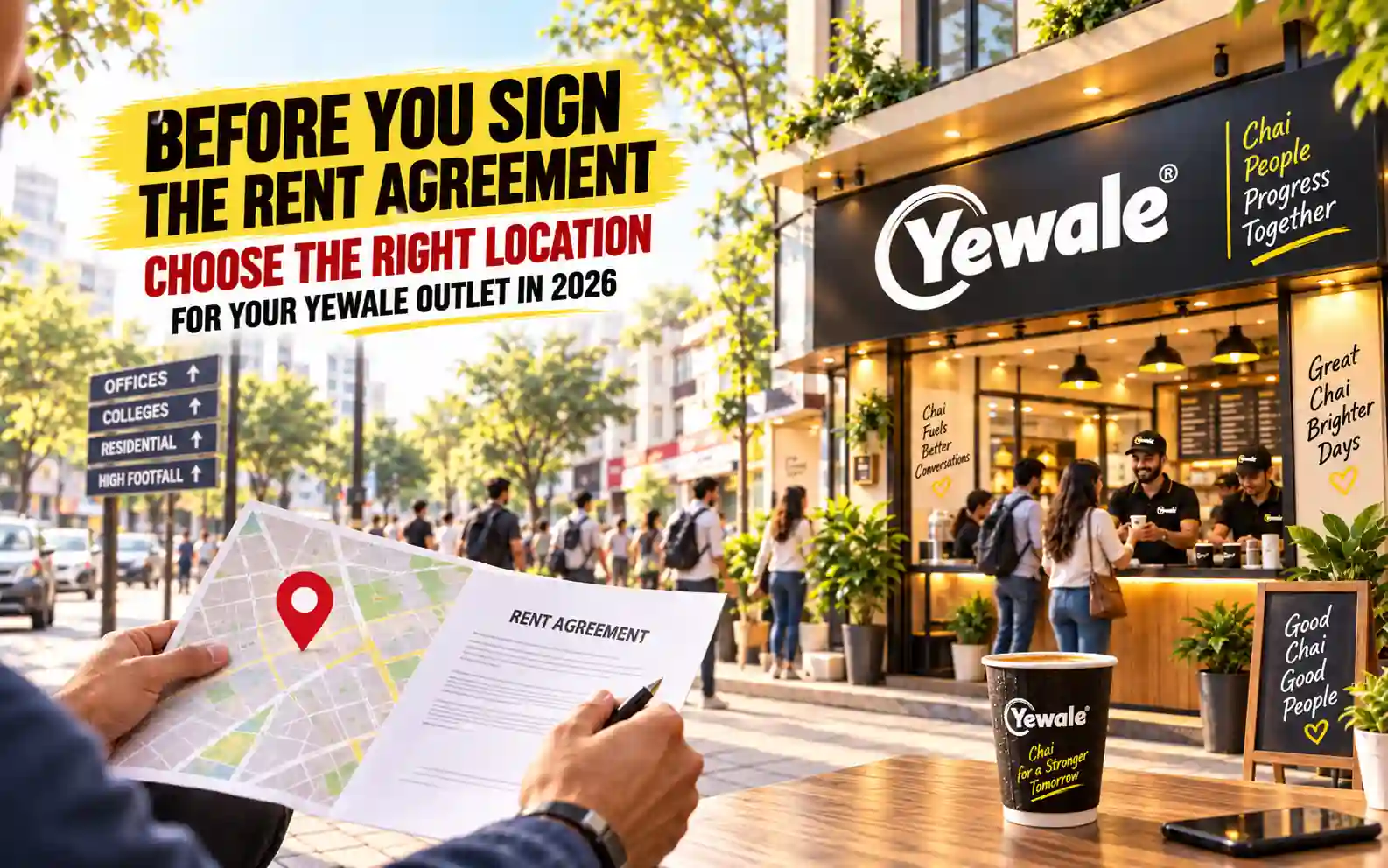
The Lease Can Lock In a Great Location or a Costly Mistake
A shop can look perfect during a five-minute property visit and still be wrong for a tea outlet. The rent may seem affordable, the road may look busy, and the landlord may be ready to sign immediately. But once the agreement is signed, weaknesses such as poor morning footfall, limited visibility, difficult stopping access, weak water supply or restrictive signage clauses become much harder to fix.
For a Yewale Amruttulya outlet, location is not just an address. It determines who sees the outlet, when they see it, how easily they can stop, whether the menu can be served efficiently, and whether the premises can support food-service operations every day.
If you are researching the best tea franchise in India, the brand is only one part of the decision. The site must also fit the franchise model, the local catchment and your actual operating budget.
Yewale’s current franchise investment and location page describes its premium format as suited to high-traffic, high-visibility locations such as malls, high streets, IT parks, business hubs, highways and tourist zones. It also lists approximately 250–400 sq. ft. with water, power and basic ventilation as key space considerations.
The rule for 2026 is simple: do not sign first and validate later. Validate the location first, then negotiate the lease.
Start With the Yewale Format, Not With the Property Broker
A common mistake is to begin with whatever shop is available and then try to force the business into it. Reverse the process. First understand the outlet format and operational needs, then shortlist properties that fit them.
| Site Requirement | What to Confirm Before Paying a Deposit |
| Usable space | Confirm the actual usable area, not only the carpet/built-up figure quoted verbally. |
| Water supply | Check regular availability, storage arrangements and whether food-service use is permitted. |
| Power | Confirm sanctioned load, meter arrangement, backup options and who pays for upgrades. |
| Ventilation | Make sure the layout can support safe beverage preparation and heat management. |
| Frontage and signage | Confirm how much visible frontage you receive and what signage the landlord or complex permits. |
| Access | Check pedestrian approach, two-wheeler stopping, delivery access and whether shutters/access remain available during your planned hours. |
| Food-service suitability | Confirm the premises can legally and practically be used for the proposed food-and-beverage activity. |
Yewale states that its team assists with location finalisation and site assessment. Use the official Yewale Amruttulya franchise page and franchise enquiry/contact page before committing to a lease so that the proposed premises can be reviewed against the current franchise requirements.
The 7-Day Location Audit: Count Before You Commit
Do not judge footfall from one Saturday evening or from a landlord’s estimate. Spend one week observing the site. The goal is not to count every person. It is to understand the repeatable flow of people who are realistically likely to buy tea, beverages or snacks.
| Audit Window | What to Observe | Why It Matters |
| Weekday 7:00–9:30 AM | Office arrivals, commuters, students, drivers, nearby shop staff | Shows morning chai potential and whether the outlet catches people before work or college. |
| Weekday 11:00 AM–1:00 PM | Office breaks, market movement, hospital attendants, local workers | Tests mid-morning and lunch-adjacent demand. |
| Weekday 3:00–6:30 PM | Tea-break traffic, college exits, market shoppers, office shift changes | Reveals the afternoon/evening repeat-demand window. |
| Weekday 7:00–9:00 PM | Residential return traffic, shoppers, delivery activity | Useful for mixed residential-commercial catchments. |
| Saturday/Sunday | Weekend pattern, family traffic, market or tourist movement | Shows whether demand disappears or changes when offices/colleges close. |
Count people passing directly in front of the proposed entrance, not people visible on the opposite side of a divided road who cannot conveniently reach you.
Record how many people already stop nearby for beverages, snacks, cigarettes, transport, banking or short breaks. These stopping behaviours can matter more than raw traffic.
Note rain exposure, afternoon heat, road crossings, construction barriers, one-way traffic and parking restrictions.
Repeat at least two observation periods on different days before drawing a conclusion.
Which Location Types Usually Fit a Tea Outlet?
There is no universally “best” location. The strongest site is the one where recurring daily movement, visibility, access and rent work together. Yewale’s own current franchise information highlights several high-traffic formats worth evaluating.
| Location Type | What Makes It Attractive | What to Check Carefully |
| IT park / business hub | Morning arrivals, scheduled breaks, office groups and bulk-order potential | Weekend weakness, campus access restrictions, parking and delivery rules. |
| College / education zone | High repeat frequency, peer groups, afternoon and evening demand | Vacation periods, hostel rules, price sensitivity and local operating-hour restrictions. |
| Busy high street / market | Visibility, impulse purchases and long trading hours | High rent, loading restrictions, frontage obstruction and seasonal crowd variation. |
| Railway / bus transit corridor | Continuous commuter movement and strong takeaway behaviour | Licensing, access, congestion, municipal restrictions and very small stopping windows. |
| Hospital / clinic cluster | Staff, attendants and visitors create demand across multiple dayparts | Night access, parking, hygiene expectations and whether footfall is actually near your frontage. |
| Highway / tourist zone | Long-distance travellers, family groups and higher snack/beverage bundling potential | Seasonality, safe entry/exit, washroom availability, signage visibility and dependence on vehicles. |
| Mixed residential-commercial area | Potential for morning regulars plus evening family/worker demand | Whether the site is truly on the movement path rather than inside a quiet residential lane. |
Before choosing a city or neighbourhood, use the Yewale Amruttulya store locator to understand the existing network and discuss possible catchment overlap with the franchise team.
Use a 100-Point Site Score Instead of “I Like This Shop”
A simple scoring sheet forces you to compare properties on the same criteria. The weights below are a practical evaluation framework, not a Yewale guarantee or official approval formula.
| Factor | Weight | How to Score It |
| Relevant footfall | 25 | Count repeatable customer-type movement across several dayparts. |
| Visibility and frontage | 20 | Can people see the storefront and signage early enough to decide to stop? |
| Accessibility / stopping convenience | 15 | Pedestrian access, two-wheelers, short stops, deliveries and road crossing. |
| Daypart balance | 10 | Does the location work in more than one tea-consumption window? |
| Rent and occupancy cost | 10 | Can conservative sales comfortably carry rent, CAM and related occupancy charges? |
| Utilities and physical readiness | 10 | Water, power, drainage, ventilation, storage and fit-out practicality. |
| Legal / food-service suitability | 5 | Permitted use, landlord authority, local approvals and FSSAI-compatible surroundings. |
| Catchment fit / network spacing | 5 | Does it serve a distinct customer pool without unnecessary overlap? |
Reject the temptation to give a weak property an inflated score simply because the rent is low or the landlord is offering a quick deal. A cheap site with weak visibility can remain expensive every month if demand never develops.
Do the Rent Math With a Conservative Sales Case
Do not evaluate rent as a standalone number. Calculate total occupancy cost: base rent + common-area maintenance (CAM) + applicable taxes/GST + parking or society charges + signage fees + any recurring facility charges.
Then test at least three sales scenarios:
Conservative case: slower-than-expected opening and modest daily transactions.
Base case: realistic footfall based on your own observation and comparable nearby activity.
Upside case: stronger conversion after the outlet stabilises.
The rent should be survivable in the conservative case, not only affordable in the optimistic case. Avoid presenting a fixed rent-to-revenue percentage as a universal rule because formats, cities, seating, CAM, delivery mix and property economics vary significantly.
For current setup information, review the Yewale premium franchise investment model. The official page states that initial investment starts around ₹8.2 lakh and that final cost can vary with store size, design preferences and location-specific needs.
Match the Catchment to the Yewale Product Mix
Location evaluation should consider what people in the catchment may buy, not only how many people pass. A college-heavy site, office cluster and highway stop can create different product and daypart patterns.
Yewale’s official products range includes Regular Tea, Jaggery Tea, Black Tea, Ginger Tea, Lemon Tea, Cold Tea, Hot and Cold Coffee, Special Masala Milk, Bakarwadi, Cream Roll, Cookies and Spongy Cake, among other items.
| Catchment | Possible Product Behaviour to Test |
| Office / IT hub | Morning tea, afternoon tea breaks, group orders, snacks and corporate bulk enquiries. |
| College / hostel | Frequent low-ticket visits, evening beverages, snack pairings and shareable group orders. |
| Market / high street | Impulse takeaway, family/shopkeeper repeat traffic and longer trading-day demand. |
| Highway / tourist | Takeaway beverages, snacks, family orders and broader daypart demand. |
| Hospital cluster | Repeat staff orders and predictable attendant/visitor breaks, subject to local access. |
These are hypotheses to validate locally, not guaranteed sales patterns. Product availability and approved pricing should always follow current Yewale policies for the specific outlet.
Check Food-Safety Suitability Before Signing
A high-footfall property is still unsuitable if the premises or surroundings create avoidable food-safety problems. FSSAI Schedule 4 states that food establishments should be located away from potential sources of environmental contamination such as smoke, chemical pollutants and objectionable odours, and away from flood-prone areas unless safeguards are provided. Surroundings should be kept clean and adequately drained.
Official reference: FSSAI Schedule 4 - hygienic and sanitary requirements.
Look for drainage problems, sewage odour, chronic waterlogging or open waste immediately beside the premises.
Confirm a dependable potable-water arrangement suitable for the proposed operation.
Check whether storage, cleaning and waste-removal areas can be managed without contaminating food-preparation zones.
Do not assume that an existing retail shop automatically satisfies food-business requirements; verify applicable local permissions and licensing needs.
Before You Sign: 14 Rent-Agreement Clauses to Check
Have the final commercial lease reviewed by a qualified local lawyer or property professional. The checklist below is operational guidance, not legal advice.
| Clause / Issue | What You Need in Writing |
| Permitted use | Clear permission to operate the intended tea / food-and-beverage outlet and related takeaway/delivery activity. |
| Lease term | Start date, possession date, fit-out period, renewal option and expiry date. |
| Rent commencement | Whether rent starts on possession, after fit-out, or on another agreed date. |
| Security deposit | Amount, payment schedule, refund timeline and permitted deductions. |
| Escalation | Exact percentage/amount and when each increase applies. |
| Lock-in | Who is locked in, for how long, and the financial consequence of early exit. |
| Termination | Notice periods, default cure period and circumstances allowing termination. |
| CAM / maintenance | What is included, how it can increase, and whether utilities/security/housekeeping are separate. |
| Signage rights | Size, placement, illumination, façade use and any mall/society/landlord approval process. |
| Fit-out rights | Permission for counters, plumbing, electrical work, branding, ventilation and other approved modifications. |
| Utilities | Meter ownership, sanctioned electrical load, water source, backup power and who pays upgrade costs. |
| Access and operating hours | Opening/closing access, deliveries, shutters, common-area timings and weekend/holiday restrictions. |
| Transfer / franchise operation | Make sure the agreement does not conflict with the franchise structure or restrict approved operating arrangements. |
| Exit / restoration | What must be removed at exit, restoration standard and how final deposit settlement works. |
Do Not Ignore Lease Registration and Stamp-Duty Requirements
Under Section 107 of the Transfer of Property Act, 1882, a lease of immovable property from year to year, for a term exceeding one year, or reserving a yearly rent can be made only by a registered instrument. Section 17 of the Registration Act, 1908 also requires registration of leases from year to year, for a term exceeding one year, or reserving yearly rent. Stamp duty and local registration practice vary by state, so take state-specific legal advice before execution.
Primary legal references: Transfer of Property Act, 1882 - Section 107 and Registration Act, 1908 - Section 17.
Location Red Flags That Should Stop the Deal
The landlord pressures you to pay a non-refundable deposit before franchise/site review.
Footfall looks strong only during one short window and almost disappears for the rest of the day.
The shop is technically on a busy road but hidden by parked vehicles, trees, hoardings or another structure.
Customers cannot safely stop, cross the road or approach the entrance.
The quoted rent excludes large CAM, society, parking or signage charges that appear only later.
Water, drainage, ventilation or power upgrades depend on verbal promises rather than written permission.
The agreement restricts signage, food preparation, delivery activity or operating hours in a way that conflicts with the proposed outlet.
The landlord cannot clearly establish authority to lease the premises or provide necessary NOCs/permissions.
The location unnecessarily overlaps the catchment of an existing Yewale outlet without brand approval.
The Safer Order of Decisions
Shortlist 3 to 5 locations rather than falling in love with one property.
Run the 7-day footfall and accessibility audit.
Prepare conservative occupancy-cost and sales scenarios.
Check nearby Yewale outlets and discuss catchment suitability with the franchise team.
Confirm space, utilities, signage and food-service suitability.
Ask Yewale for site assessment / location finalisation support.
Negotiate commercial terms subject to satisfactory documentation and approvals.
Have the final agreement and property documents reviewed locally.
Sign, register/stamp as applicable, then begin fit-out and franchise onboarding.
For an additional internal resource, read Yewale’s Location, Footfall, and Chai: How to Pick the Right Spot for Your Yewale Amruttulya Franchise in 2026. Use its location ideas as planning inputs, while basing your own investment decision on current site-specific data and written franchise terms.
Is Yewale Amruttulya the Best Tea Franchise in India for Your Location?
“Best tea franchise in India” is a useful search phrase, but it should not be treated as a universal ranking claim. The better question is whether Yewale Amruttulya fits your chosen location, budget and operating plan.
The brand’s official franchise page highlights a chef-less, owner-free model, standardisation across outlets, product variety and a 0% royalty and commission franchise model. Those features may make Yewale worth shortlisting, but site quality still needs independent evaluation.
A strong franchise system cannot convert a poor lease into a good location. Equally, a well-chosen site cannot compensate indefinitely for an agreement that creates excessive fixed costs or operational restrictions. The strongest decision aligns the brand, the catchment, the premises and the lease.
Ready to Evaluate a Location?
Explore the Yewale Amruttulya franchise opportunity, review the current franchise investment information, and contact Yewale for franchise and location assessment before you sign a rent agreement.
Key Takeaways
Do not sign a lease based on rent and appearance alone. Validate relevant footfall, visibility, access, utilities and legal suitability first.
Audit the location across multiple weekday and weekend dayparts. A single busy hour can hide a weak full-day catchment.
Score sites objectively. Relevant footfall and visibility should carry more weight than a landlord’s urgency or a low headline rent.
Calculate total occupancy cost, not only base rent, and test it against a conservative sales case.
Use the Yewale product range to think about catchment fit, but treat local product demand as something to test, not assume.
Confirm FSSAI-compatible surroundings and practical water, drainage, storage and cleaning conditions before commitment.
Put permitted use, signage, fit-out, utilities, operating access, escalation, lock-in, termination and deposit terms in writing.
If the lease exceeds one year or reserves yearly rent, obtain legal advice on registration and state-specific stamp-duty requirements.
Reference Links
FSSAI - Schedule 4 Hygienic and Sanitary Requirements
India Code - Transfer of Property Act, 1882
India Code - Registration Act, 1908
